


I've given this blog post as a talk which you can watch here:
A while back, Guillermo Rauch (creator of Socket.io and founder of Zeit.co (the company behind a ton of the awesome stuff coming out lately)) tweeted something profound:
Write tests. Not too many. Mostly integration.
This is deep, albeit short, so let's dive in:
Yes, for most projects you should write automated tests. You should if you value your time anyway. Much better to catch a bug locally from the tests than getting a call at 2:00 in the morning and fix it then. Often I find myself saving time when I put time in to write tests. It may or may not take longer to implement what I'm building, but I (and others) will almost definitely save time maintaining it.
The thing you should be thinking about when writing tests is how much confidence they bring you that your project is free of bugs. Static typing and linting tools like TypeScript and ESLint can get you a remarkable amount of confidence, and if you're not using these tools I highly suggest you give them a look. That said, even a strongly typed language should have tests. Typing and linting can't ensure your business logic is free of bugs. So you can still seriously increase your confidence with a good test suite.
I've heard managers and teams mandating 100% code coverage for applications. That's a really bad idea. The problem is that you get diminishing returns on your tests as the coverage increases much beyond 70% (I made that number up... no science there). Why is that? Well, when you strive for 100% all the time, you find yourself spending time testing things that really don't need to be tested. Things that really have no logic in them at all (so any bugs could be caught by ESLint and Flow). Maintaining tests like this actually really slow you and your team down.
You may also find yourself testing implementation details just so you can make sure you get that one line of code that's hard to reproduce in a test environment. You really want to avoid testing implementation details because it doesn't give you very much confidence that your application is working and it slows you down when refactoring. You should very rarely have to change tests when you refactor code.
I should mention that almost all of my open source projects have 100% code coverage. This is because most of my open source projects are smaller libraries and tools that are reusable in many different situations (a breakage could lead to a serious problem in a lot of consuming projects) and they're relatively easy to get 100% code coverage on anyway.
There are all sorts of different types of testing (check out my 5 minute talk about it at Fluent Conf: "What we can learn about testing from the wheel"). They each have trade-offs. The three most common forms of testing we're talking about when we talk of automated testing are: Unit, Integration, and End to End.
Here's a slide from my Frontend Masters workshop: "Testing JavaScript Applications".
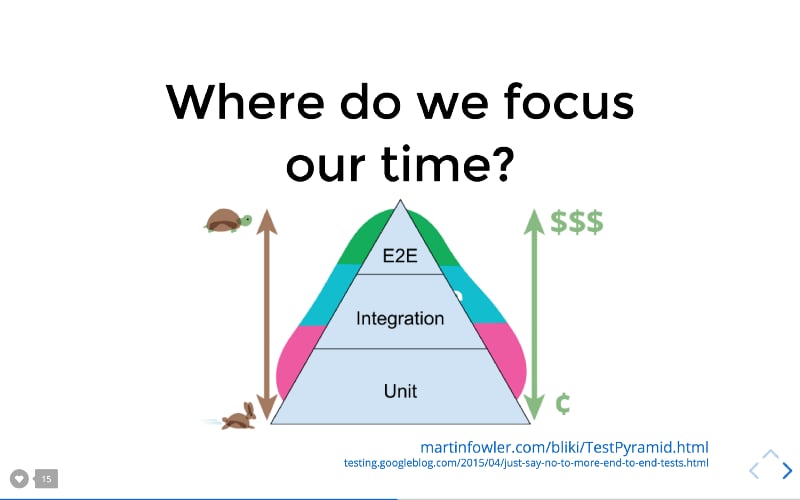
This testing pyramid is a combination of one I got from Martin Fowler's blog and one I got from the Google Testing blog.
As indicated here, the pyramid shows from bottom to top: Unit, Integration, E2E. As you move up the pyramid the tests get slower to write/run and more expensive (in terms of time and resources) to run/maintain. It's meant to indicate that you should spend more of your time on unit tests due to these factors.
One thing that it doesn't show though is that as you move up the pyramid, the confidence quotient of each form of testing increases. You get more bang for your buck. So while E2E tests may be slower and more expensive than unit tests, they bring you much more confidence that your application is working as intended.
As noted, our tools have moved beyond the assumption in Martin's original Testing Pyramid concept. This is why I created "The Testing Trophy" 🏆
It doesn't matter if your component <A /> renders component <B /> with props
c and d if component <B /> actually breaks if prop e is not supplied. So
while having some unit tests to verify these pieces work in isolation isn't a
bad thing, it doesn't do you any good if you don't also verify that they
work together properly. And you'll find that by testing that they work together
properly, you often don't need to bother testing them in isolation.
Integration tests strike a great balance on the trade-offs between confidence and speed/expense. This is why it's advisable to spend most (not all, mind you) of your effort there.
For more on this read Testing Implementation Details. For more about the different distinctions of tests, read Static vs Unit vs Integration vs E2E Testing for Frontend Apps
The line between integration and unit tests is a little bit fuzzy. Regardless, I think the biggest thing you can do to write more integration tests is to stop mocking so much stuff. When you mock something you're removing all confidence in the integration between what you're testing and what's being mocked. I understand that sometimes it can't be helped (though some would disagree). You don't actually want to send emails or charge credit cards every test, but most of the time you can avoid mocking and you'll be better for it.
If you're doing React, then this includes shallow rendering. For more on this, read Why I Never Use Shallow Rendering.
I don't think that anyone can argue that testing software is a waste of time. The biggest challenge is knowing what to test and how to test it in a way that gives true confidence rather than the false confidence of testing implementation details.
I hope this is helpful to you and I wish you the best luck in your goals to find confidence in shipping your applications!
此内容由惯性聚合(RSS阅读器)自动聚合整理,仅供阅读参考。 原文来自 — 版权归原作者所有。