


In this article we’ll take a look at another Angular abstraction - the differs and more specifically the IterableDiffer; we’ll explain what the differs are and how the framework uses them internally. After that, we’ll take a look at how NgForOf works and design a custom data structure optimized for the directive. Finally, we’ll develop a custom differ which will speed up the change detection mechanism of Angular when working with large collections.
If you’re interested on higher level performance practices you can take a look at:
The code from this article can be found at:
There are a lot of articles written on this topic so we will just quickly provide some background which will help us understand how differs work and how the framework uses them internally.
Angular uses dirty-checking mechanism in order to detect changes in the templates’ expressions. Lets suppose we have the following template:
<ul>
  <li *ngFor="let item of items">
    {{ item }}
  </li>
<ul>
The snippet above will produce an unordered list of items. The list can change if the items collection we’re iterating over changes. Once Angular has to render the template above for first time it’ll simply get the items property from the controller of the component associated with this template and render the list items.
After that, on special events Angular will check whether the value of items property has changed. What are these special events? Well, basically almost any asynchronous event which happens in the browser. In fact, by default the framework is going to check if any of the bindings in any of the templates in any of the instances of any of the components in our application has changed. Although this sounds slow it’s not because of the numerous optimizations that Angular performs. Although that’s an interesting topic, it’s part of another discussion. Check this article for more details.
In short, by default, after each task from the queue, Angular is going to perform dirty checking, i.e. check whether the value of any of the expressions in the templates has changed and update the view.
On top of that when Angular performs change detection in the context of given component it will invoke its ngDoCheck life-cycle hook. This means that ngDoCheck is the perfect place to add custom piece of logic for detecting changes in the state of our components!

Lets take a look at the implementation of NgForOf to see how this actually works:
@Directive({selector: '[ngFor][ngForOf]'})
export class NgForOf<T> implements DoCheck, OnChanges {
  ngOnChanges(changes: SimpleChanges): void {
    if ('ngForOf' in changes) {
      // React on ngForOf changes only once all inputs have been initialized
      const value = changes['ngForOf'].currentValue;
      if (!this._differ && value) {
        // ...
        this._differ = this._differs.find(value).create(this.ngForTrackBy);
        // ...
      }
    }
  }

  ngDoCheck(): void {
    if (this._differ) {
      const changes = this._differ.diff(this.ngForOf);
      if (changes) this._applyChanges(changes);
    }
  }

  private _applyChanges(changes: IterableChanges<T>) {
    // ...
  }

  // ...
}
I have omitted parts of the implementation which are not essential for our discussion. There are three important points to discuss:
ngOnChanges - NgForOf implements the OnChanges life-cycle hook which is going to be invoked when Angular detects changes in any of the bindings in the template for given component or directive. In the context of the code above, Angular will check if the ngForOf input has changed (i.e. the collection we iterate over). If it has changed, we get its currentValue and find an appropriate differ in case we haven’t picked one yet. We’ll explain what the purpose of the differ is and how we pick it later in this article.ngDoCheck - NgForOf also implements the DoCheck life-cycle hook which is invoked once the change detection mechanism gets executed. In this life-cycle hook we check whether we have a differ assigned to the private _differ property and if we do, we invoke its diff method with the current value of ngForOf (i.e. the collection). The method diff of the differ is going to return a list of changes which have happened in the collection since the last check._applyChanges - once we have the list of changes, all we need to do is visualize them. That’s what the purpose of _applyChanges is; it receives a list of changes and updates the collection by optionally applying animations.IterableDifferAs the bullet points above mention, the IterableDiffer will be used to compare two collections and produce a list of changes in the form of IterableChanges collection. Later we pass this collection to _applyChanges in order to visualize the update. Why is it called IterableDiffer? It compares iterable collections - collections we can iterate over. This includes any collection which has an iterator associated with it.
The IterableChanges interface allows us to iterate over the changes in different ways, for instance:
For instance:
const a = [2, 1, 3];
const b = [1, 2, 4];
IterableChanges will contain the following list of updates:
0 from a has changed it’s position to index 1.1 from a has changed it’s position to index 0.2 from a has been removed.a with value 4 and index 2.In recap, we can say that internally NgForOf uses the life-cycle hooks ngOnChanges and ngDoCheck. ngOnChanges the directive uses in order to pick a differ based on the type of the current collection using the find method of an instance of the IterableDiffers collection. ngDoCheck is used to apply the differ over the current value of the collection. The differ is going to compare the collection with its previous value and return the list of changes.
It’s interesting how the differ compares the individual values in the collection. In particular, what properties of the values it uses in order to distinguish them. For this purpose we need to take a look at the TrackByFunction interface:
TrackByFunctionHere’s the interface of the function:
export interface TrackByFunction<T> { (index: number, item: T): any; }
By default, Angular is going to track the values by their identity with the following track-by function:
const trackByIdentity = (index: number, item: any) => item;
The differ will use the result from the track-by function to compare the value from a specific index in the iterable collection with its previous value. So in the following example:
const a = [2, 1, 3];
const b = [1, 2, 3];
The differ will compare a with b and find out that 1 and 2 has changed their positions because it’ll check the items with equality check using ===.
In some cases, however, a simple equality check between the values is not enough. We may want to track the values between a specific feature they have instead of tracking them by their reference. Lets suppose we have two instances of given reference type which represent the same business entity:
const Employee1 = { id: 1, name: 'Minko' };
const Employee2 = { id: 1, name: 'Minko' };
const Employee3 = { id: 2, name: 'John' };

const a = [Employee1, Employee3];
const b = [Employee2, Employee3];
In this case, Employee1 and Employee2 represent the same business entity so we should consider the collections equivalent. However, if we use IterableDiffer with the default TrackByFunction we’ll get a result of changes indicating that the first element from a has been removed and replaced with Employee2, which is incorrect. To get a correct result, we should provide the following TrackByFunction:
const trackById = (index: number, item: any) => item.id;
Notice that comparing two items from the collections will always happen in O(1) time, independently from the TrackByFunction. For every two values returned by two invocations of the TrackByFunction Angular will always apply === check.
Now we know what the purpose of the IterableDiffer is and how it compares the individual values from the collection. The only thing we’re not familiar with is the comparison algorithm. In fact, it’s not trivial at all since the Angular team tried to optimized as much as possible since NgForOf is frequently used directive and often it has to work with big data sets.

Lets take a brief look at the DefaultIterableDiffer. It is a concrete implementation of the IterableDiffer interface which Angular uses by default for comparing iterable collections:
export class DefaultIterableDiffer<V> implements IterableDiffer<V>, IterableChanges<V> {
  // ...

  diff(collection: NgIterable<V>): DefaultIterableDiffer<V>|null {
    // ...
  }

  check(collection: NgIterable<V>): boolean {
    if (Array.isArray(collection)) {
      (this as{length: number}).length = collection.length;

      for (let index = 0; index < this.length; index++) {
        // ...
      }
    } else {
      iterateListLike(collection, (item: V) => {
        // ...
      });
    }
    return this.isDirty;
  }

  // ...
}
That’s pretty much enough in order to find out potential ways to improve the differ. It’s interesting that the DefaultIterableDiffer implements two interfaces IterableDiffer and IterableChanges. We already took a look at both abstractions - the first one implements a differ for collections we can iterate over and the IterableChanges encapsulates the changes which the differ has found.
Obviously this abstraction violates the SRP but why? For efficiency. Keeping the state of IterableChanges and the functionality of IterableDiffer in one place we can have both - well encapsulated and efficient abstraction. The differ can reuse the internal state of the IterableChanges without having to specify a contract for accessing it and/or using inefficient calls to do so.
Now take a look at the check method. We can clearly see that the DefaultIterableDiffer iterates over the collection in order to check what has changed inside of its state compared to the last check. Treating the collection as a black box automatically introduces O(n) time complexity.
This has pros and cons. The pros is that the differ is just a consumer of the collection so it relies that the collection is an array or has iterator implementation. This makes the DefaultIterableDiffer reusable since it’ll work with most built-in collections and external libraries. The cons is that we need to iterate over the entire collection in order to find whether and what has changed inside of it.
On the following diagram you can see how everything fits together:
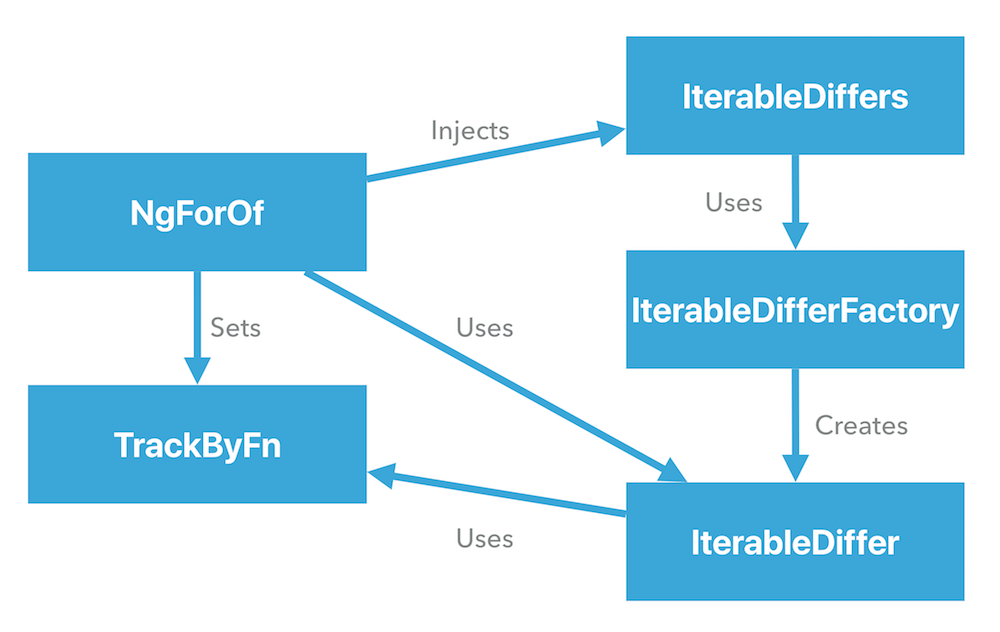
Notice how NgForOf uses the IterableDiffers in order to get an IterableDiffer which supports the collection we’re iterating over. Internally, the IterableDiffers will check whether there’s any IterableDifferFactory which knows how to instantiate a differ which can handle the given collection.
Finally, NgForOf sets the TrackByFn by calling the create method of the selected by IterableDiffers factory.
IterableDifferAlthough the IterableDiffer can find whether given collection has changed, the collection knows this best. A possible way to optimize the change detection is to move the logic for keeping track of the changes that have happened in given collection to the collection itself. This way detecting a change will give us O(1) complexity same as getting all the changes that have happened in some specific interval of time. This however, is only possible if we can afford to use a custom data structure in our application.
DifferableListIn computer science there’s the concept of persistent data structures. The instances of these data structures allow us to preserve their previous versions when modified. Fully persistent data structures allow us to do some fancy time travelling, forking of universes and other crazy stuff.
I got inspired by this concept in order to develop a collection optimized for the Angular’s change detection mechanism which I called DifferableList. It decorates the List from immutable.js and provides a way to keep track of the changes happening inside of it by using a linked list. Here are few pieces of its implementation:
export class DifferableList<T> {
  /** @internal */
  changes = new LinkedList<IterableChangeRecord<T>>();

  constructor(private data = List<T>([])) {}

  pop(): DifferableList<T> {
    // ...
  }

  set(idx: number, item: T) {
    // ...
  }

  get size() {
    return this.data.size;
  }

  get(idx: number) {
    return this.data.get(idx);
  }

  indexOf(item: T) {
    return this.data.indexOf(item);
  }

  [Symbol.iterator]() {
    return new DifferableListIterator<T>(this);
  }

  // ...
}
This is a classical implementation of the decorator design pattern where the decorated component is the immutable List. Lets take a look at the set method’s implementation:
export class DifferableList<T> {
  // ...

  constructor(private data = List<T>([])) {}

  set(idx: number, item: T) {
    const prev = this.data.get(idx);
    const result = new DifferableList<T>(this.data.set(idx, item));
    if (prev) {
      result.changes.add({
        currentIndex: null,
        previousIndex: idx,
        item: prev,
        trackById: trackByIdentity
      });
    }
    result.changes.add({
      currentIndex: idx,
      previousIndex: null,
      item: item,
      trackById: trackByIdentity
    });
    return result;
  }

  // ...
}
In the constructor of the DifferableList we create a new instance of the immutable List if a value of the first argument is not set. Right after that, in the set method we get the current value associated with index idx. We create a new instance of the DifferableList way by passing an argument to the constructor - the immutable list with the set operation applied to it. In case we have value for the index idx in the initial list we push a change - removed value from index idx with previous value equal to prev. Right after that we push another change to the list - a value item has been added to index idx.
This way with constant complexity we can keep track of all the modifications which has happened in the list in given period of time!
Notice also that in order to make the DifferableList play well with JavaScript and respectively NgForOf we need to implement the iterator design pattern for it (i.e. make the collection iterable).
The iterator itself is quite simple:
class DifferableListIterator<T> implements Iterator<T> {
  private current = 0;

  constructor(private collection: DifferableList<T>) {}

  next(): IteratorResult<T> {
    if (this.current < this.collection.size) {
      return {
        done: false,
        value: this.collection.get(this.current++)
      };
    } else {
      return { done: true, value: null };
    }
  }
}
We keep track of the index we’re currently in and return objects containing the values:
done - indicating whether we’ve reached the end of the collection.value - the current value for the given index.Notice how for the purpose we use only the public interface of the collection so we don’t have leak of any implementation details.
IterableDifferAlthough this collection will work with the DefaultIterableDiffer if we use it we’ll loose all the optimizations we did so far since the differ will iterate over items in instances of the DifferableList to compare them instead of just accessing their changes property.
In order to boost the performance of our application we can introduce a DifferableListDiffer (yes, sounds silly).
Here are the basics of the implementation of the DefaultIterableDiffer:
export class DifferableListDiffer<V> implements IterableDiffer<V>, IterableChanges<V> {
  forEachAddedItem(fn: (record: IterableChangeRecord<V>) => void) {
    let fst = this._changes.firstNode;
    while (fst) {
      const record = fst.element;
      if (record.previousIndex === null) {
        fn(record);
      }
      fst = fst.next;
    }
  }

  // ...

  diff(collection: NgIterable<V>): DifferableListDiffer<V> | null {
    this._data = collection as DifferableList<V>;
    const changes = this._data.changes;
    this._changes = changes;
    if (changes.size() > 0) {
      this._data.changes = new LinkedList<IterableChangeRecord<V>>();
      return this;
    } else {
      return null;
    }
  }
}
Notice how in diff we just get the current collection, access its changes property and based on its size we either preserve its value, set it to an empty list and return the current instance, or return null. We return the current instance of the DifferableListDiffer because it implements the IterableChanges interface which the _applyChanges method of NgForOf uses.
IterableDifferFactoryFinally, we just need to plug our custom iterable differ in order to let Angular choose it for diffing DifferableLists. For the purpose we need to implement an IterableDifferFactory:
@Injectable()
export class DifferableListDifferFactory<V> implements IterableDifferFactory {
  supports(objects: any): boolean {
    return objects instanceof DifferableList;
  }

  create(trackByFn?: TrackByFunction<V>): IterableDiffer<V> {
    return new DifferableListDiffer<V>();
  }
}
That’s pretty much all. We have two methods:
supports - check whether the differ instantiated with this factory supports given collection.create - instantiates the differ.Now we need to plug our factory as a provider:
@Component({
  providers: [IterableDiffers.extend([new DifferableListDifferFactory()])],
  // ...
})
export class EmployeeListComponent {
  // ...
}
IterableDiffers will pick the correct differ for given collection; if we have multiple differs which support the collection the IterableDiffers will invoke the create method of the factory for the first match.
On top of the application “Purely Fast” I run few benchmarks showing what performance boost do I get when removing and adding items to a collection and iterating over it with NgForOf. Here are the results:
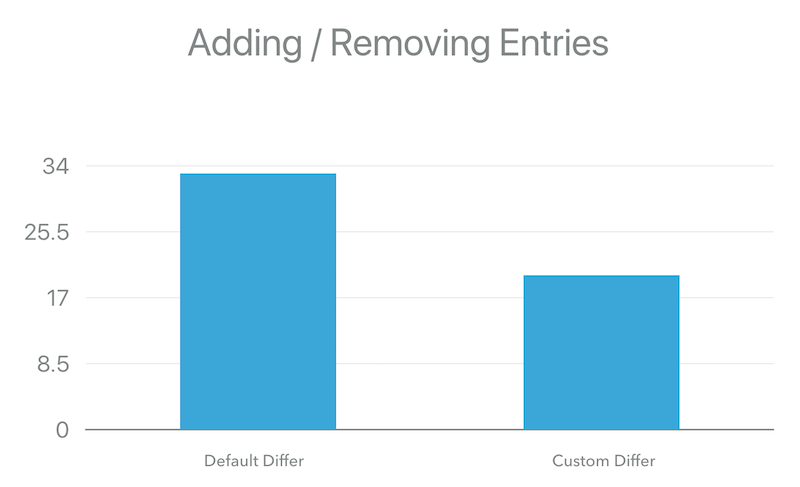
With 1k items the time for adding and removing an item dropped from 33.03ms to 19.9ms which is a significant improvement!
The e2e test and the benchmarks can be found here.
In this article we explained the basics of how Angular’s change detection works. We covered details of how NgForOf uses implementations of the IterableDiffer abstraction in order to find all the changes which has happened between two consecutive ticks of the change detection.
This was followed by explaining in details how the differs use functions subtypes of the TrackByFunction interface.
After that we discussed how the DefaultIterableDiffer works and the pros and cons for the violation of the SRP in its implementation.
Inspired by the section “Encapsulation versus Performance” and persistent data structures we implemented a data structure optimized for Angular which keeps track of its changes. In order to take advantage it we built a simple IterableDiffer and a factory for it. After that we explained how the IterableDiffers will pick the right differ for given collection.
Finally, we looked at benchmarks which show the performance boost we got from the optimization.
此内容由惯性聚合(RSS阅读器)自动聚合整理,仅供阅读参考。 原文来自 — 版权归原作者所有。