
惯性聚合 高效追踪和阅读你感兴趣的博客、新闻、科技资讯
阅读原文 在惯性聚合中打开

推荐订阅源

Martin Fowler
Martin Fowler
L
LINUX DO - 最新话题
P
Proofpoint News Feed
Cyberwarzone
Cyberwarzone
Know Your Adversary
Know Your Adversary
cs.CL updates on arXiv.org
L
Lohrmann on Cybersecurity
D
Darknet – Hacking Tools, Hacker News & Cyber Security
Security Latest
Security Latest
T
The Exploit Database - CXSecurity.com
Exploit-DB.com RSS Feed
P
Privacy & Cybersecurity Law Blog
K
Kaspersky official blog
The Last Watchdog
The Last Watchdog
Webroot Blog
Webroot Blog
Scott Helme
Scott Helme
T
Threat Research - Cisco Blogs
C
Cyber Attacks, Cyber Crime and Cyber Security
WordPress大学
WordPress大学
L
LINUX DO - 热门话题
OSCHINA 社区最新新闻
OSCHINA 社区最新新闻
博客园 - Franky
V
Visual Studio Blog
O
OpenAI News
AI
AI
Hacker News: Ask HN
Hacker News: Ask HN
V2EX - 技术
V2EX - 技术
GbyAI
GbyAI
Recent Commits to openclaw:main
Simon Willison's Weblog
S
Schneier on Security
Spread Privacy
Spread Privacy
Y
Y Combinator Blog
I
InfoQ
H
Hackread – Cybersecurity News, Data Breaches, AI and More
T
Threatpost
C
Cybersecurity and Infrastructure Security Agency CISA
F
Fortinet All Blogs
C
CERT Recently Published Vulnerability Notes
T
The Blog of Author Tim Ferriss
C
Check Point Blog
Apple Machine Learning Research
有赞技术团队
有赞技术团队
人人都是产品经理
人人都是产品经理
N
News and Events Feed by Topic
Project Zero
Project Zero
小众软件
小众软件
让小产品的独立变现更简单 - ezindie.com
B
Blog
G
Google Developers Blog

Minko Gechev's blog

skillgrade Unit Tests for AI Agent Skills You Should Care About AI Generative Development LLM-first Web Framework Reactive framework in ~200 lines of JavaScript Managing Angular Are LLMs going to replace us? Prefetching Heuristics Design Patterns in Open Source Projects - Part II Design Patterns in Open Source Projects - Part I What I learned doing 125 public talks - Part I Dynamic imports solve all the problems, right? 5 Angular CLI Features You Didn't Know About Angular quicklink Preloading Strategy Introducing Bazel Schematics for Angular CLI Building TypeScript Projects with Bazel Joining Google Playing Mortal Kombat with TensorFlow.js. Transfer learning and data augmentation Fast, extensible, configurable, and beautiful linter for Go Introducing Guess.js - a toolkit for enabling data-driven user-experiences on the Web Machine Learning-Driven Bundling. The Future of JavaScript Tooling. JavaScript Decorators for Declarative and Readable Code 3 Tricks For Using Redux and Immutable.js with TypeScript Follow Your Dream Career with Open Source. Personal Story. Redux Anti-Patterns - Part 1. State Management. Faster Angular Applications - Understanding Differs. Developing a Custom IterableDiffer Faster Angular Applications - Part 2. Pure Pipes, Pure Functions and Memoization Faster Angular Applications - Part 1. On Push Change Detection and Immutability Understanding Dynamic Scoping and TemplateRef Implementing a Simple Compiler on 25 Lines of JavaScript Developing Statically Typed Programming Language WebVR for a Gamified IDE 7 Angular Tools That You Should Consider Announcing ngrev - Reverse Engineering Tool for Angular Implementing Angular's Dependency Injection in React. Understanding Element Injectors. Distributing an Angular Library - The Brief Guide Angular in Production Ahead-of-Time Compilation in Angular Using Stripe with Angular (Deprecated) Building an Angular Application for Production Implementing the Missing "resolve" Feature of the Angular 2 Router Scalable Single-Page Application Architecture Managing ambient type definitions and dealing with the "Duplicate identifier" TypeScript error Static Code Analysis of Angular 2 and TypeScript Projects Enforcing Best Practices with Static Code Analysis of Angular 2 Projects ViewChildren and ContentChildren in Angular Dynamically Configuring the Angular's Router Angular 2 Hot Loader Lazy Loading of Route Components in Angular 2 Aspect-Oriented Programming in JavaScript Flux in Depth. Store and Network Communication. Using JSX with TypeScript Flux in Depth. Overview and Components. Even Faster AngularJS Data Structures Boost the Performance of an AngularJS Application Using Immutable Data - Part 2 Angular2 - First Impressions Build Your own Simplified AngularJS in 200 Lines of JavaScript Persistent State of ReactJS Component Boost the Performance of an AngularJS Application Using Immutable Data Processing Binary Protocols with Client-Side JavaScript Stream your Desktop to HTML5 Video Element Multi-User Video Conference with WebRTC Asynchronous calls with ES6 generators Binary Tree iterator with ES6 generators WebRTC chat with React.js AngularJS in Patterns (Part 3) AngularJS in Patterns (Part 2). Services. Using GitHub Pages with Jekyll! AngularJS in Patterns (Part 1). Overview of AngularJS Singleton in JavaScript Express over HTTPS What I get from the JavaScript MV* frameworks Remote Desktop Client with AngularJS and Yeoman The magic of $resource (or simply a client-side Active Record) AngularJS Inheritance Patterns AngularAOP v0.1.0 Advanced JavaScript at Sofia University AngularJS style guide Lazy prefetching of AngularJS partials VNC client on 200 lines of JavaScript Aspect-Oriented Programming with AngularJS CSS3 flipping effect Practical programming with JavaScript Why I should use publish/subscribe in JavaScript JavaScript, the weird parts Functional programming with JavaScript plainvm Looking for performance? Probably you should NOT use [].sort (V8) JavaScript image scaling ELang Caching CSS with localStorage Self-invoking functions in JavaScript (or Immediately Invoked Function Expressions) Asus N56VZ + Ubuntu 12.04 (en) Asus N56VZ + Ubuntu 12.04 Debian Squeeze + LXDE on Google Nexus S (or having some fun while suffering) HTML5 image editor Курсови проекти – ФМИ Carousel Gallery SofiaJS...
2.5X Smaller Angular 2 Applications with Google Closure Compiler
2016-07-21 · via Minko Gechev's blog

In the post “Building an Angular 2 Application for Production” we explored how we can decrease the bundle size of a “Hello world!” application to from about 1.6M (non-minified & uncompressed) to 49K! We did this by using the following techniques:

  • Angular offline template compiler for generating tree-shakable code.
  • Tree-shaking of ES2015 modules with rollup.
  • Bundling of the application.
  • Minification with uglifyjs.
  • Compression with gzip.

Although we achieved impressive results we can do even better! In this post I’ll show some of the work done by Alex Eagle and Jeff Cross from the Angular core team.

Disclaimer: This article explains a research which uses experimental tools tools which WILL change in near future. Do not use anything described here in production.

Closure Compiler

For our purpose we’ll use the Google Closure Compiler:

The Closure Compiler is a tool for making JavaScript download and run faster. Instead of compiling from a source language to machine code, it compiles from JavaScript to better JavaScript. It parses your JavaScript, analyzes it, removes dead code and rewrites and minimizes what’s left. It also checks syntax, variable references, and types, and warns about common JavaScript pitfalls.

The steps that we are going to go through this time will be simplified since Closure Compiler can do most of the work for us, such as tree-shaking, minification and bundling! This will help us to reduce the tools from our tool-chain to only ngc and Closure Compiler!

Everything looks like a piece of cake at first, however, there are some complications:

Obstacles - Incomplete ES2015 Module Support

Fortunately, Google Closure compiler officially supports ES2015, but unfortunately it supports only a subset of the module syntax. For instance:

bar.js

index.js

foo.js

import {bar} from './index';
console.log(bar);

…is not supported by Closure Compiler because of export * from ./bar.

Solution - goog.module

An alternative module syntax that works well with the compiler is goog.module. Unfortunately the TypeScript compiler doesn’t support transpilation to goog.modules. For this purpose we have to use tsc combined with the tool tsickle which allows us to hook in the ngc compilation process and emit Closure-friendly ES2015 instead.

In short, we need a custom build of Angular and all of its dependencies to goog.module modules. At this point this is achievable by going through a list of hacky solutions, however, soon the CLI and the Angular starters will automate this process completely and will eliminate all the boilerplates.

Results

Alex Eagle, posted his experiment on GitHub and shared all the details about the build process in this document.

Lets run the build script and see what the bundle size of our Angular application will be!

Note that the build script below requires brotli. Brotli is a tool which implements the brotli general-purpose lossless compression algorithm. For further details visit Brotli’s GitHub repository.

$ git clone https://github.com/mgechev/closure-compiler-angular-bundling
$ cd closure-compiler-angular-bundling
$ npm install
$ npm run build

Now if we go to dist we’ll find:

$ cd dist
$ ls -lah
total 344
drwxr-xr-x   7 mgechev  staff   238B Jul 21 12:18 .
drwxr-xr-x  15 mgechev  staff   510B Jul 21 12:18 ..
-rw-r--r--   1 mgechev  staff    80K Jul 21 12:18 bundle.js
-rw-r--r--   1 mgechev  staff    20K Jul 21 12:18 bundle.js.brotli
-rw-r--r--   1 mgechev  staff    23K Jul 21 12:18 bundle.js.gz
-rw-r--r--   1 mgechev  staff   3.7K Jul 21 12:18 property_renaming_report
-rw-r--r--   1 mgechev  staff    32K Jul 21 12:18 variable_renaming_report

20K bundle! We have almost 150% improvement compared to our previous experiments!

In order to make sure that the application works run:

The code from above is hosted in my GitHub account.

Comparison

On the diagram below you can find how the Google Closure Compiler + ngc bundle stays next to the other ones produced by the different bundling strategies explored in the previous post:
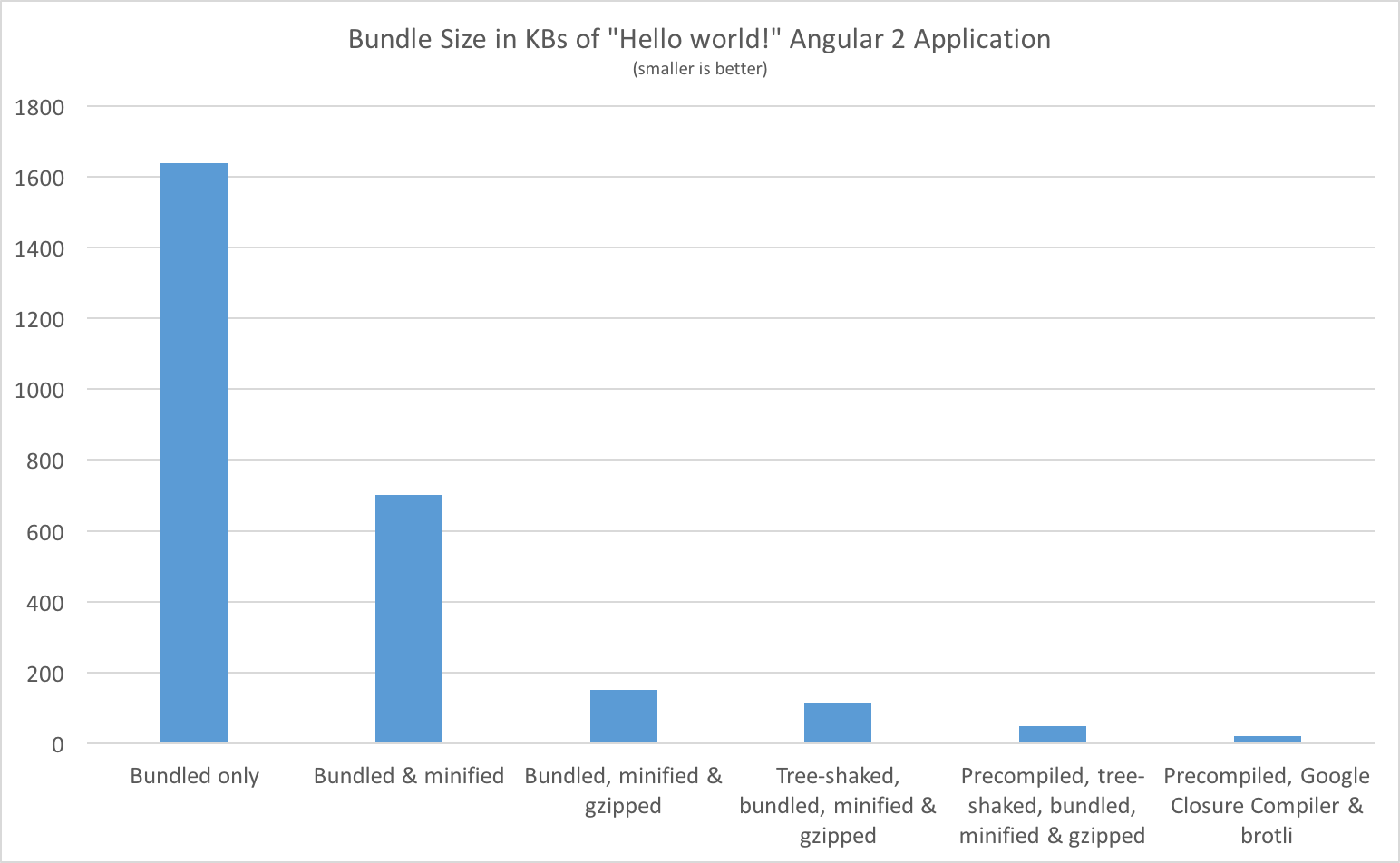
ngc + Google Closure Compiler bundle comparison

Since the size amplitude above is huge, the diagram below illustrates how the bundle produced in this post compares to the other compressed bundles from the previous post:
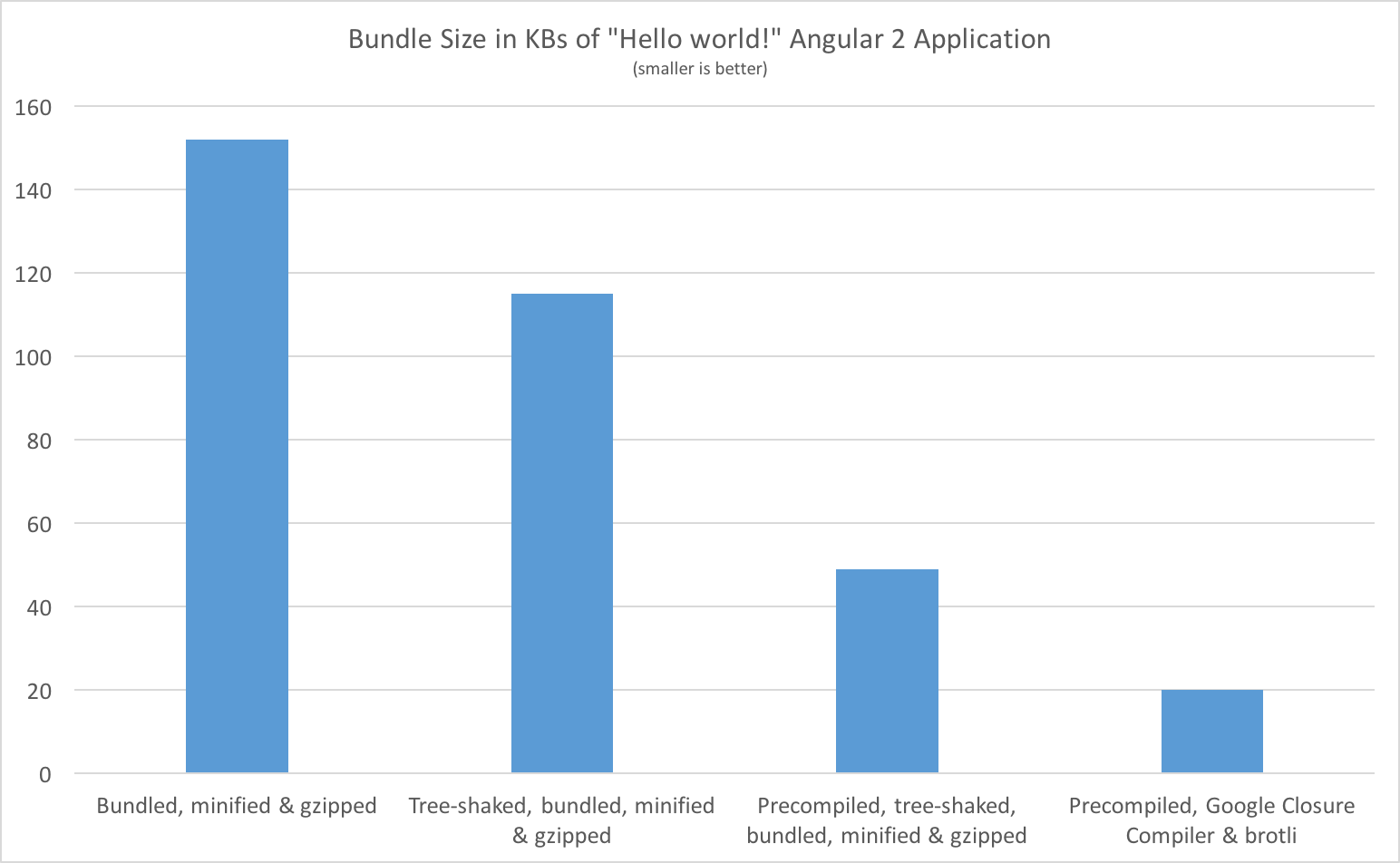
ngc + Google Closure Compiler bundle comparison

Conclusion

With the advanced compression of Google Closure Compiler we are able to drop the bundle size of a “Hello world!” application to 20K! However, this came with the price of a few hacks - custom build of Angular and its dependencies to goog.modules. However, in near future the entire process will be completely abstracted and automated. This will allow us to apply advanced build techniques such as offline compilation, tree-shaking, transpilation, compression and minification with only a single command!

References

For further reference take a look at the following resources: