
惯性聚合 高效追踪和阅读你感兴趣的博客、新闻、科技资讯
阅读原文 在惯性聚合中打开

推荐订阅源

U
Unit 42
P
Proofpoint News Feed
The Last Watchdog
The Last Watchdog
S
Secure Thoughts
cs.AI updates on arXiv.org
N
News | PayPal Newsroom
Application and Cybersecurity Blog
O
OpenAI News
S
Security @ Cisco Blogs
宝玉的分享
宝玉的分享
Hacker News: Ask HN
Hacker News: Ask HN
T
Troy Hunt's Blog
Google Online Security Blog
WordPress大学
WordPress大学
有赞技术团队
有赞技术团队
TaoSecurity Blog
TaoSecurity Blog
Help Net Security
Help Net Security
Latest news
Latest news
NISL@THU
NISL@THU
S
Security Affairs
博客园_首页
C
CXSECURITY Database RSS Feed - CXSecurity.com
博客园 - 聂微东
AI
AI
www.infosecurity-magazine.com
Recent Announcements
P
Privacy & Cybersecurity Law Blog
小众软件
小众软件
cs.CV updates on arXiv.org
Hugging Face - Blog
Hugging Face - Blog
博客园 - 司徒正美
AWS News Blog
AWS News Blog
W
WeLiveSecurity
Google DeepMind News
I
InfoQ
Schneier on Security
Recent Commits to openclaw:main
T
The Exploit Database - CXSecurity.com
IT之家
IT之家
T
Threatpost
Scott Helme
Scott Helme
L
LINUX DO - 热门话题
腾讯CDC
CTFtime.org: upcoming CTF events
N
News and Events Feed by Topic
L
LINUX DO - 最新话题
F
Full Disclosure
大猫的无限游戏
大猫的无限游戏
H
Heimdal Security Blog
S
SegmentFault 最新的问题

Max Stoiber's Essays

Save polish for where it matters How I get things done How I run gratitude circles How to present to executives Message me whenever How I manage my todos as a CEO How to run recurring virtual meetings efficiently How to have great taste How to be great at storytelling How we make brainstorming work How do you invent the future? Why I'm vigorous about giving feedback How to ship faster How to be better at making decisions How I tend to my digital garden David Cain: Do Quests, Not Goals Deliberate practice beats every other form of training, even via transfer learning How we foster deeper connections in our remote team Why I don't compliment people for their talent How can you slow down life? (which is perceptually half over by 23) 1:1s are for personal connection, not project updates Developer tools startups are playing on hard mode Developer tools are different than tools for any other profession You probably don't need GraphQL Why I Love Tailwind Margin considered harmful I am joining Gatsby Why I Write CSS in JavaScript Tech Choices I Regret at Spectrum Streaming Server-Side Rendering and Caching
Being unreasonably responsive has made my projects more successful
Max Stoiber · 2024-08-20 · via Max Stoiber's Essays

A big part of the reason some of my open source projects were successful was that I was unreasonably responsive. I used to respond to new issues within a few hours, ideally with a fix if they were bug reports.

In fact, for react-boilerplate, I spent hours answering questions on how to use React and other tools included in the boilerplate—even if those questions had nothing to do with the boilerplate specifically.

At the time, I did this just because I enjoyed doing it. Only in hindsight, after react-boilerplate’s success, did I realize how beneficial it was—and since then, I’ve done it intentionally.

The two virtuous cycles of being unreasonably responsive

I noticed that being unreasonably responsive causes two virtuous cycles that enabled me to learn more and thus build much better solutions than anybody else. (or framed another way, get more tracers for my bullets)

1) It builds trust and thus retains users

Even if a solution isn’t perfect for their use case yet, responding quickly builds up the user’s trust that the solution will keep improving. So, despite whatever rough edges they might be hitting, there is a higher chance they will keep using it since they believe it will keep getting better.

As a great example, this HackerNews thread shows how, by simply responding quickly to GitHub issues, Wez turned two users into superfans who are publicly recommending his terminal to others on HN 🤯
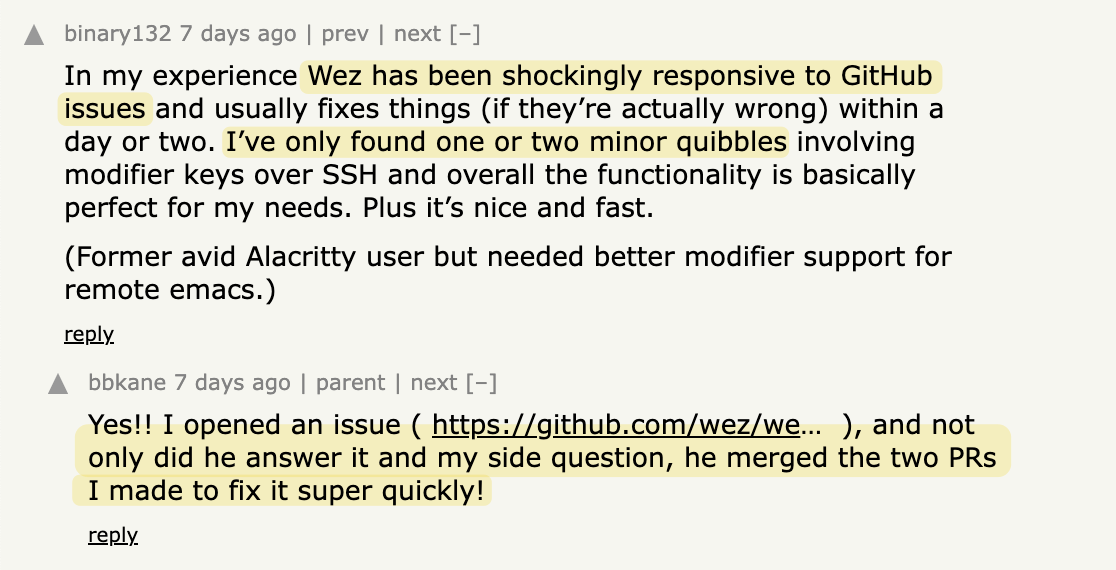
binary132 on: Okay, I Like WezTerm: "In my experience Wez has been shockingly responsive to GitHub issues and usually fixes things (if they’re actually wrong) within a day or two. I’ve only found one or two minor quibbles involving modifier keys over SSH and overall the functionality is basically perfect for my needs. Plus it’s nice and fast. (Former avid Alacritty user but needed better modifier support for remote emacs.)      	 bbkane:  "Yes!! I opened an issue ( https://github.com/wez/wezterm/issues/4917 ), and not only did he answer it and my side question, he merged the two PRs I made to fix it super quickly!"

2) It makes users give more feedback

If users hear their current feedback being considered (whether or not it’s acted upon!), they are much more likely to keep giving more. That, multiplied by a whole user base, means that the creators who respond quickly get much more feedback.

In react-boilerplate’s case, this was a major key to its success. Other boilerplates represented the sole opinions of their creators; react-boilerplate represented the combined opinion of every single person I spoke to about React, and I ended up speaking to a lot of them.

”Responsive” doesn’t mean you have to act on it!

Notably, “responding” doesn’t mean “acting on.” People often misunderstand this and think they have to implement everything anybody says really quickly. Nothing could be further from the truth.

Not all feedback is worth acting on, and that’s fine. You just have to respond to it with an actual human acknowledgment of the feedback. For example, these responses are great and don’t involve immediately acting on the feedback:

  1. Dismissal: “Actually, the reason the feature works this way and not that way is X. Have you tried doing it this way?”

  2. Postponing: “Thanks for the bug report. I’ve added it to our backlog and we’ll get to it later.”

    1. Important: when you do this, followup later once you did actually get to it.

Example: Raphael Schaad and Erik Kuebler at Cron

Cron was a new calendar app I was trying. I liked the initial version but had some feedback, so in true vigorous feedback style, I sent a bunch of it in, and both Raphael, the founder, and Erik, the PM, were incredibly responsive. Here is just one example email thread:
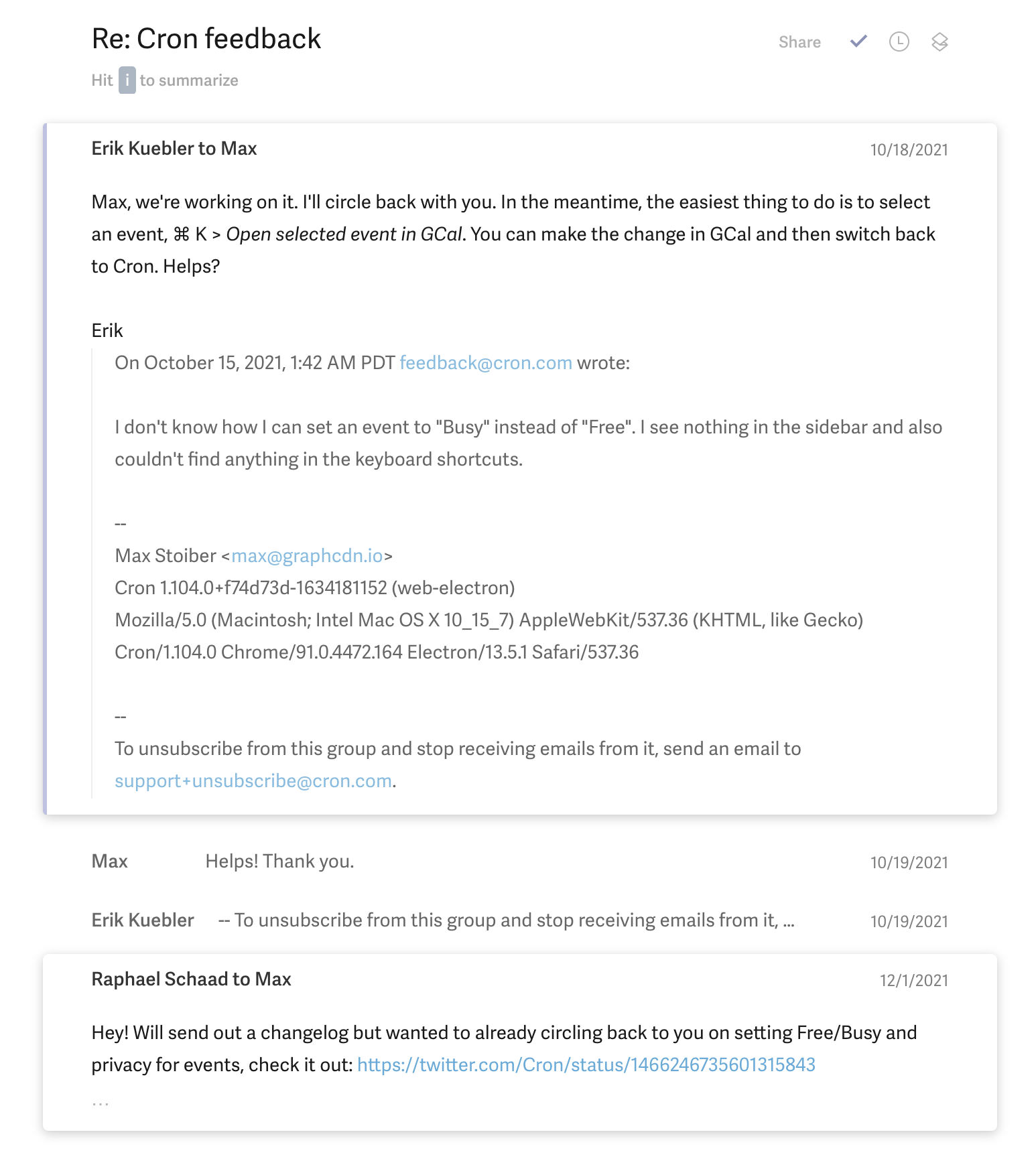
The result of their responsiveness? I sent in more and more feedback because I knew they were listening:
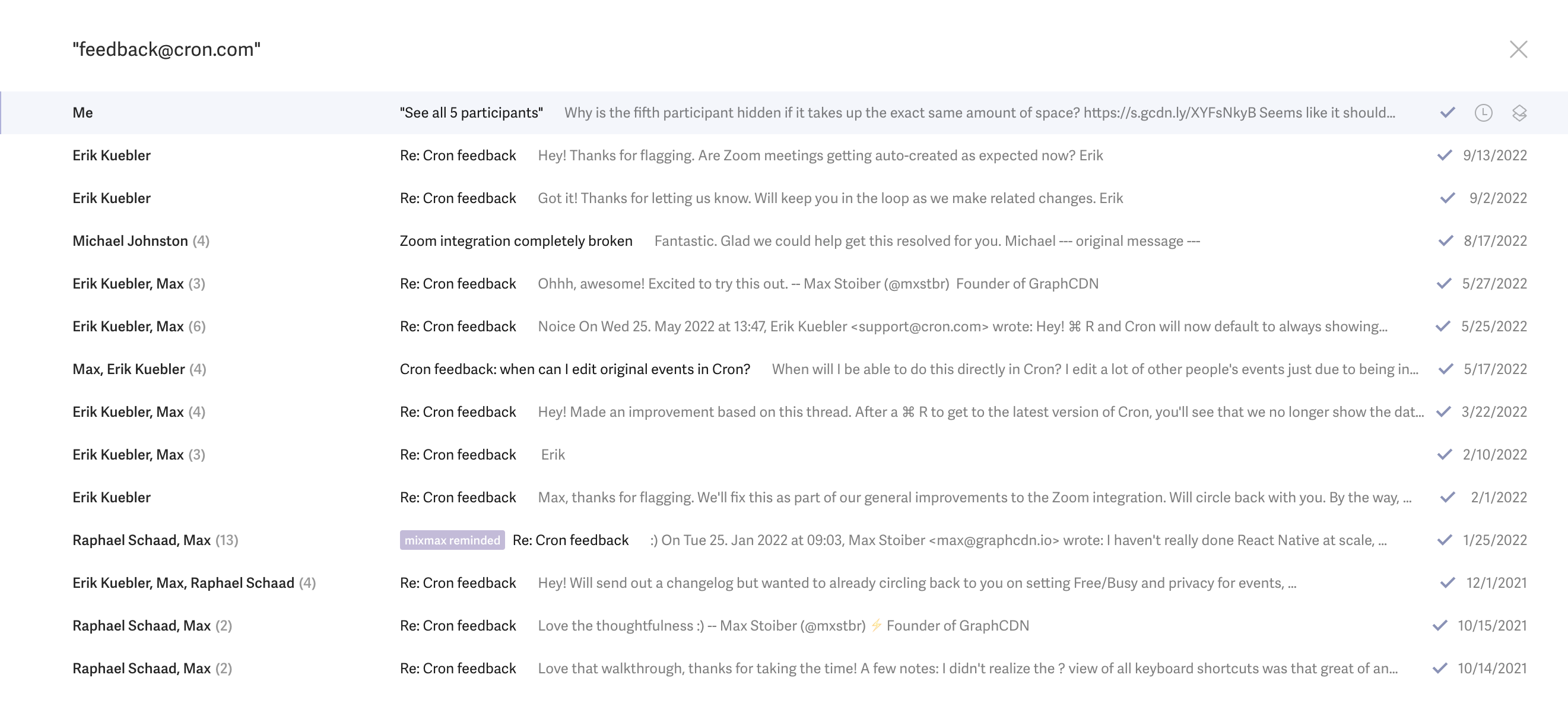
Every single one of those threads looks something like the one above:

  1. A rapid, thoughtful acknowledgment of the feedback

  2. A specific next step (if they were going to take one eventually)

  3. A follow-up once that next step was completed

And, undoubtedly as a result of being so good at listening to (and thus getting more) feedback, Cron became the best calendar app I’ve ever used and ended up being acquired by Notion and turning into Notion Calendar—which I still use to this day.