
惯性聚合 高效追踪和阅读你感兴趣的博客、新闻、科技资讯
阅读原文 在惯性聚合中打开

推荐订阅源

Spread Privacy
Spread Privacy
V
Visual Studio Blog
Cyber Security Advisories - MS-ISAC
Recorded Future
Recorded Future
云风的 BLOG
云风的 BLOG
Microsoft Azure Blog
I
InfoQ
Apple Machine Learning Research
MyScale Blog
MyScale Blog
M
MIT News - Artificial intelligence
WordPress大学
WordPress大学
Recent Announcements
V
V2EX
The GitHub Blog
The GitHub Blog
奇客Solidot–传递最新科技情报
奇客Solidot–传递最新科技情报
Jina AI
Jina AI
小众软件
小众软件
aimingoo的专栏
aimingoo的专栏
V
Vulnerabilities – Threatpost
C
Check Point Blog
C
Cyber Attacks, Cyber Crime and Cyber Security
AI
AI
宝玉的分享
宝玉的分享
P
Proofpoint News Feed
量子位
Attack and Defense Labs
H
Hackread – Cybersecurity News, Data Breaches, AI and More
P
Privacy International News Feed
Google DeepMind News
CTFtime.org: upcoming CTF events
C
CERT Recently Published Vulnerability Notes
腾讯CDC
Latest news
Latest news
Google DeepMind News
The Register - Security
cs.CV updates on arXiv.org
cs.AI updates on arXiv.org
G
GRAHAM CLULEY
Blog — PlanetScale
Blog — PlanetScale
博客园_首页
美团技术团队
The Cloudflare Blog
T
Tenable Blog
cs.CL updates on arXiv.org
J
Java Code Geeks
SecWiki News
SecWiki News
Webroot Blog
Webroot Blog
N
News | PayPal Newsroom
博客园 - 叶小钗
博客园 - Franky

Hacker News

randoFont GitHub - onehorizonai/silo-terminal: A dark phosphor Apple Terminal profile inspired by the sealed systems and green-blue screens of Silo. Fading Maize | 2001 to 2026 Show HN: Onboard-CLI–a fast developer tool built in Go uses AST and LLM Show HN: Finterm.ai Finance CLI for Claude Code and Codex Show HN: Codex Explorer,一款用于 Codex CLI 的本地会话管理器 Pylon — full-stack framework for coding agents GitHub - Corgea/Sighthound: Corgea's rule-based SAST scanner Kastra | Execution Governance for AI Systems devthropology.com Embersent — Know Exactly Who Read Your Document GodUI — UI Collection for Modern Interfaces Show HN: Reverse-engineering web apps into agent tools GitHub - Kuberwastaken/subagentmaxxing: Drive OpenAI Codex & Cursor CLI coding agents as subagents with the same ergonomics as native Claude Code subagents (grok-4.5, composer-2.5, gpt-5.5). Uniform run/fanout CLI + Claude Code skill. Aside Strata - Guess the City from a 3D Map a dark terminal Blocks.ai | Connect your agent to the world. Noticky — Sticky Notes & Always-on-Top Windows for Mac Make the hard day easier for the people you love CASHFLOW — Debt Network Optimizer 0 A.D.: Empires Ascendant FormGrid - Create Delightful Forms & Surveys for Free Codapult — Everything Your SaaS Needs, Already Wired Together LaTeX Diff Viewer - GitHub Marketplace LinguaGuessr analog.watch Estimania — Daily Estimation Game I Replaced Whisper with Parakeet on a $55/Month CPU Server. Here Is What Actually Happened. HyperSwitcher – Mac App & Window Switcher CLERC-DATA/epee · Datasets at Hugging Face GitHub - gladiaio/gladia-cli EvenKeel — your money coach BareMetalRT — Bare Metal AI Build a Second Brain That Actually Remembers Why It Changed Tokenstead - Find AI Models for Your Hardware Fideby - Standing by the people you trust, when you can rubber duck GitHub - forgedculture/legibility-field-kit GitHub - ronak-create/FableCut: Zero-dependency browser video editor that AI agents can drive — JSON timeline, MCP + REST, live-reloading UI GitHub - BuceaGeorgia/VIRENA: A minimal Vision-Language-Action model you can read: frozen CLIP + a tiny head on ManiSkill PickCube. Runs on a Mac, no GPU. Fehu - Apps on Google Play GitHub - fresswolf/Slopera: The browser for the slop era Release Kiyeovo 1.0.0 · Realman78/Kiyeovo Noema — AI Company Analysis GitHub - hamidi-dev/opentab: 📊 Browse your AI coding spend in the terminal — OpenCode, Claude Code, Codex & more GitHub - sgInnora/wc2026-prediction-ledger: Receipt-verified AI prediction ledger for World Cup 2026: pre-kickoff sha256-locked forecasts scored vs results, with calibration + market baselines. Live: goalpulse.io/open-data GitHub - michaelwrites67-ctrl/yogen: 予言 Yogen — a 500-agent AI swarm that debates your idea and predicts the outcome. Self-host free with your own Anthropic key. GitHub - teddytennant/wizard: Self-extending autonomous agent in one Rust binary. One-line install, any provider (OpenAI-compatible, Anthropic, xAI) or fully local via llama.cpp, live /evolve self-modification, MCP, messaging gateway, built-in bench arcaide.foo Show HN: Android Developer Verification Package blacklisted in Aurora Store OpenDescent: Private messaging for normal people GitHub - tarunlnmiit/autopilot-jobhunt: AI job agent: scans 130+ careers pages nightly, scores every role against your resume with an LLM (0–100), alerts you on Telegram, and drafts tailored cover letters + resumes. Free & open source. 18 Words - Daily Word Challenge The State of US Local Government Accessibility 2026 flow - Real-time network throughput dashboard for the terminal. - Terminal Trove Battle LLM Robots GitHub - robesris/ffvii-realtime: Speed up Final Fantasy VII (Rebirth / Remake / Revelation) Tactical Mode slow-motion so combat plays at real-time speed Agent Sessions - Local History for AI Coding Agents Scrutora — code, cloud & consent compliance in one platform SoulOS Tutorials GitHub - gaemi/agentic-fc: Open-source football management simulation played by AI agents through MCP and watched through a TUI console. GitHub - talalalrwas/ocr-grab: Flameshot clone that adds OCR. GitHub - JustVugg/colibri: Run GLM-5.2 (744B MoE) on a 25GB-RAM consumer machine — pure C, zero deps, experts streamed from disk. Tiny engine, immense model. 🐦 GitHub - saifmukhtar/kinetic figment computer linear.gratis - Free Linear Client Feedback Forms GitHub - atelier-ws/atelier: Runtime for coding agents. Models are getting smarter, but a model is only as capable as the environment supporting it. Atelier is that environment. https://atelier.ws Atlas · Tomesphere | Tomesphere Codenames Generator GitHub - lyfeninja/lyfeninja_blkseal_python_sdk: Lightweight Python client for signing and verifying digital content using lyfe.ninja's BlkSeal product powered by BlkBolt™. Designed for zero dependencies, simple integration, and exact content verification. DateTimeMate OpenScreenShot — Full-page screenshot & annotation tool for Chrome 38-0 — Build Your Premier League Dream Team Cyrinx — data over sound, measured GitHub - BhaveshThapar/mcp-audit HN Work GitHub - Northwood-Systems/foreman: Self-hosted LLM gateway. Cost effective, deterministic, and fast. Secure and private by default. A Visualization Language for the AI Era GitHub - weirdGuy/kastor: Declarative language and toolchain for AI agents: define agents, tools and prompts in HCL, then compile to frameworks or manage them on hosted platforms with plan/apply semantics. Abralo - Run multiple Claude Code agents in one window GitHub - mehranzand/repofleet: RepoFleet is an issue-centered CLI tool for managing Git workflows across multiple repositories. Pug — Open Source Product Analytics Chiptune Radio — Aleph Void, LLC Free Mermaid Live Editor & Diagram Maker GitHub - hirasso/html-obfuscator: Obfuscate emails, phone numbers, and other sensitive data in PHP. Invisible to humans, hidden from bots until they interact. Davit — a native macOS UI for Apple containers GitHub - rowboatlabs/rowboat: Open-source AI coworker, with memory Yamanote.fun PostgreSQL on AWS: Size & Benchmark EC2 Instances GitHub - Rodiun/frugon: Free, local, open-source LLM cost analyzer — see where your LLM bill leaks, on your machine. WhimFiles - Find Any File in Seconds Agent Draw: An agent draws while you talk, built on TLDraw Neil the Seal GitHub - animesh-94/Onboard-CLI: An AST-powered, local-first CLI that visualizes complex system architectures and enforces architectural boundaries via instant Git hooks. ridealong — live London trains Clusy | Agent-Native Notebook for ML and Data Science snowscroll · Instagram, without the spiral. GitHub - vishal-dehurdle/state-harness: Runtime safety net for LLM agents. Detects token spirals, kills doomed tasks early, tells you exactly why. Rust core, Python SDK. pip install state-harness GitHub - DO-SAY-GO/freelang: I love freelang
Today I’m launching papercrane-cli: a BI tool built for Claude Code | Papercrane Blog
timliu9 · 2026-07-09 · via Hacker News

Every analytics vendor is bolting an AI copilot onto their dashboards. Power BI has one. Tableau has one. They all work the same way: the human drives the old tool, and the AI sits in a sidebar making suggestions.

I went the opposite direction. I took the agent you already use and built the BI tool around it.

papercrane-cli is a command line tool that gives Claude Code everything it needs to turn a business question into a live dashboard: authenticated access to your data, a real dashboard workspace, and a path to a link you can send to anyone. It launches today.

It’s free and it runs on the Claude subscription you already pay for.

Here’s why it exists.

One prompt in Claude Code: install, sign in, connect Salesforce, build, publish. About four minutes, sped up.

Agents are already great at dashboards. Here’s what stops them.

If you use Claude Code, you’ve probably tried this. You ask it for a revenue dashboard and it writes genuinely good React. Charts, layout, the works. Then it runs into three problems. I know because I hit every one of them, and papercrane-cli is the tool I wanted on the other side.

1. Everything an agent builds is frozen in time

Ask an agent for a dashboard right now and you get one of three things: an HTML file, a PDF, or a chat artifact. All three share a flaw you won’t notice until Thursday: the numbers were baked in at build time. It’s a photograph of your business, accurate the moment it was taken and drifting further from the truth every day after.

MCP doesn’t fix this, and it’s worth being precise about why. MCP is good at what it does: it lets your agent call tools during a conversation. The catch is that the connection belongs to the chat session. The dashboard your agent writes can’t inherit it. So the agent queries your data, hard codes the results, and hands you something that looks like a dashboard and behaves like a screenshot.

Papercrane puts the data connection inside the dashboard itself. Every dashboard is a small Next.js app whose server code calls the same authenticated API your agent used to build it. The chat ends. The numbers keep moving. That difference is structural: no amount of prompting gets you there without a standing data layer underneath.

2. Authentication is messy and isn’t portable

Your numbers live behind sign in screens: GA4, HubSpot, Salesforce, QuickBooks. An agent can’t click through those screens, and the workarounds are ugly. Either someone technical builds a custom developer connection for every tool (a project measured in weeks, with approval queues and security reviews), or you start pasting secret keys into terminals and chat windows and hoping nobody scrolls up.

We did the connection work once, for everyone. Connecting a tool is just signing in: your browser opens a normal sign in page, you approve access the way you’d connect any two apps, done. Your agent gets one clean, secure way to reach GA4, Stripe, HubSpot, Postgres, BigQuery, and 50+ more: warehouses, ad platforms, CRMs, finance, product analytics. The credentials stay encrypted with Papercrane, off your laptop and out of your chat history, and when a service needs its access renewed behind the scenes, that’s handled for you.
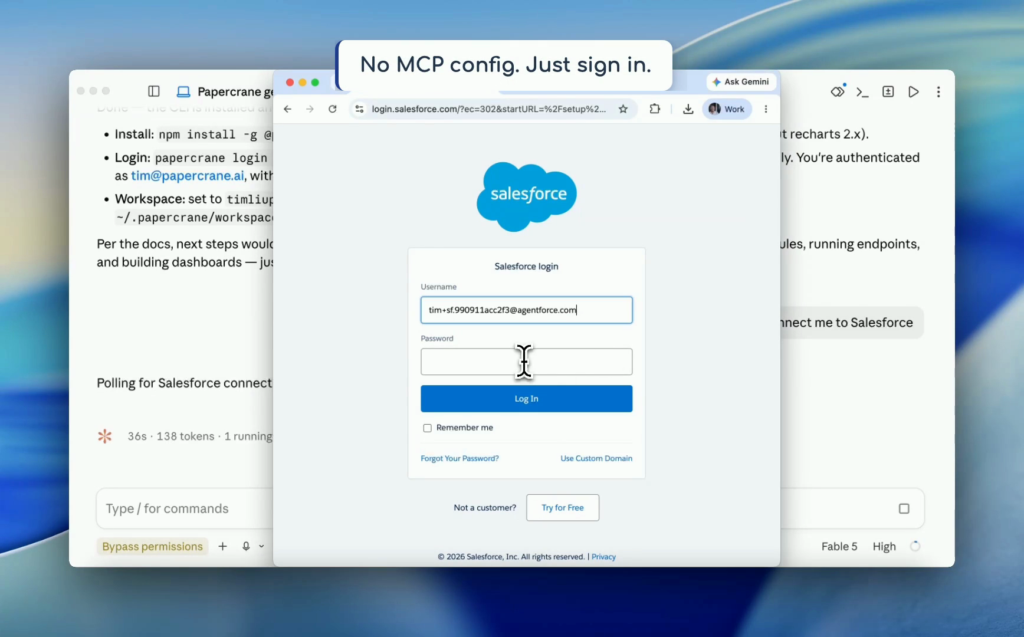
 A standard Salesforce sign in page shown while connecting Salesforce to Papercrane
Connecting a source is a normal sign in page. No keys, no config.

3. A dashboard is something you send to someone

A dashboard earns its keep the moment you send it: to your team, your CEO, a client. That’s the step where every local prototype dies. When you’re ready, papercrane publish puts your dashboard on a link you can share, with access control, and the numbers are live for the recipient too. The cloud side handles what a local tool never will: hosting, embedding, custom domains.
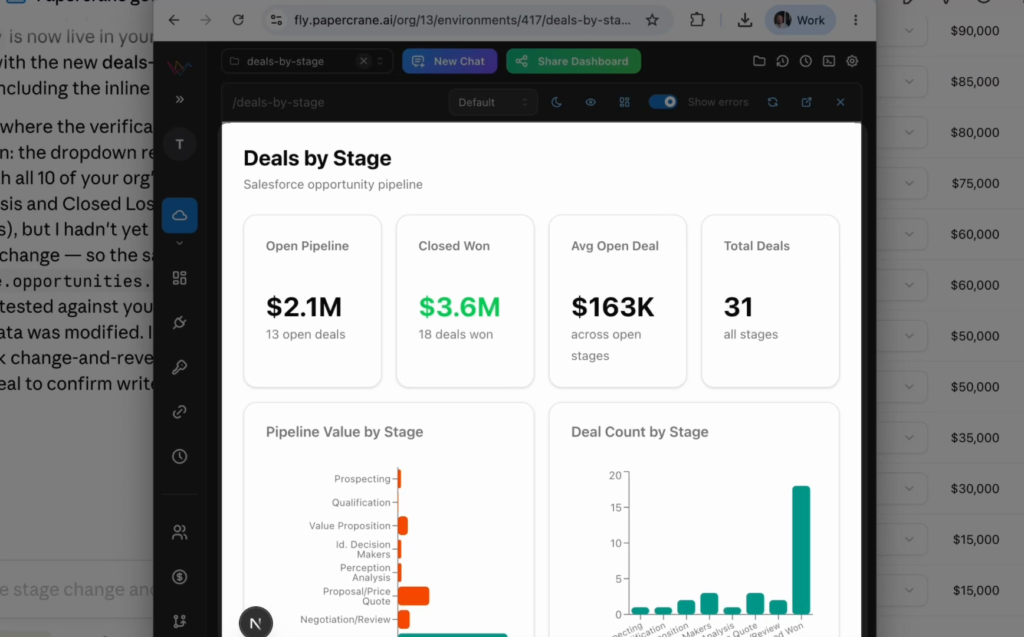
A published deals by stage dashboard live on papercrane.ai with a share button
Published and live. Send the link to anyone, and the numbers stay live for them too.

It goes both ways

Everything so far describes data flowing in. It can flow out too. A dashboard can carry actions: a button that moves a deal to its next stage in Salesforce, a control that updates the record behind a chart. The same authenticated connection that reads the numbers can write them back. That’s the point where the word dashboard starts to undersell what you’ve got: a report you can act from is a tool, and BI has never shipped one of those.
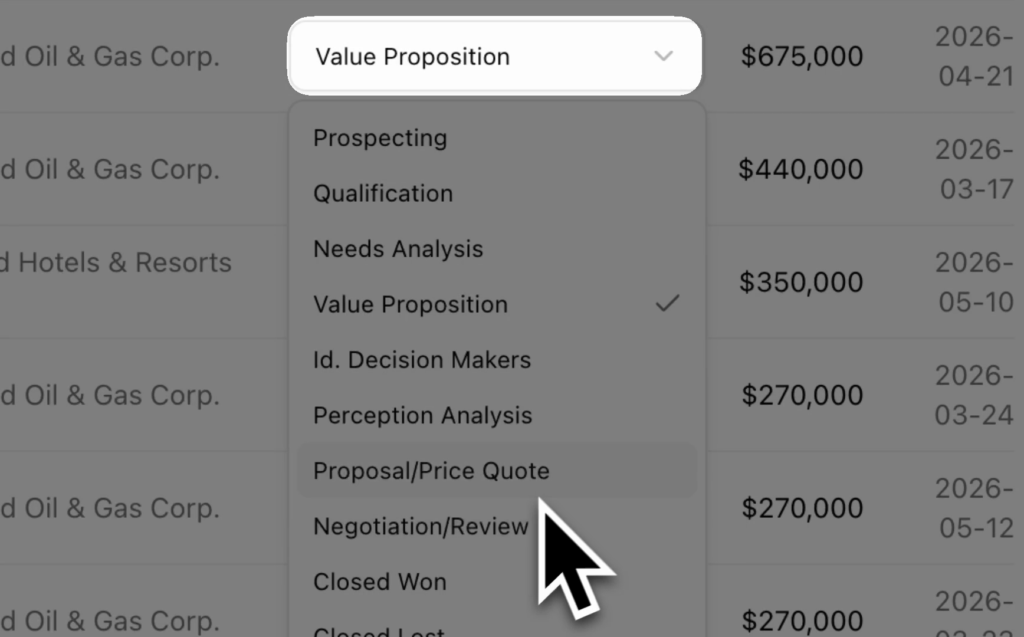
A stage dropdown open on a deal in a Papercrane dashboard, changing the Salesforce stage directly from the dashboard
Move a deal to its next stage right on the dashboard. Salesforce gets the update.

All of your credentials, in one place

There’s a quieter problem with how people wire agents to data today: the credentials end up everywhere. An API key in an env var on your laptop. Another in an MCP config. One pasted into a prompt three weeks ago that you’ve already forgotten about. Multiply that by every teammate who wants their agent reaching the same systems, and nobody can answer the two questions that matter: who has access to what, and how do we turn it off?

With Papercrane, your organization connects each source once. Credentials are encrypted and held in one place, agents reach data through one authenticated API, connections are audit logged, and access gets revoked centrally. A teammate’s agent gets the same reach as yours without anyone forwarding keys over Slack. That starts to matter at exactly the moment this stops being a toy: the dashboard is real, the data is sensitive, and more than one person’s agent is touching it.

When a connector doesn’t exist, your agent writes one

Every integration is a TypeScript handler, and the CLI includes a guide written for the agent itself: papercrane local-integration-guide prints the whole how to straight to stdout. If your data lives somewhere we don’t cover, tell your agent to build the connector. It lands in your workspace, runs locally, and is callable exactly like the hosted ones. The toolset extends itself.

Code you own

Every dashboard is Next.js and React source sitting in your workspace: a page.tsx, a server action, recharts, Tailwind. Publish it to your own GitHub repo with one command. If you leave Papercrane tomorrow, you keep working software.

A tool for AI, not for a person

Every design decision in papercrane-cli follows from one question: what does the agent need? The docs are served as markdown a model can read. Every command prints output a model can parse. There’s no manifest spec or protocol here, just ruthless convention: if Claude Code can read it and run it, it works. Codex, Cursor, and anything else that reads stdout work too.

Which is why setup is one prompt. Open Claude Code and type:

Read https://papercrane.ai/get-started.md and login

Your agent reads the guide, installs the CLI, opens your browser to sign you in, and connects your first source. From there you just ask for what you want to see

Building happens right where you’re chatting, too. papercrane-cli is wired into Claude Code’s preview, so the dashboard renders inside the Claude app while the agent works on it. You watch the charts take shape next to the conversation that’s building them.
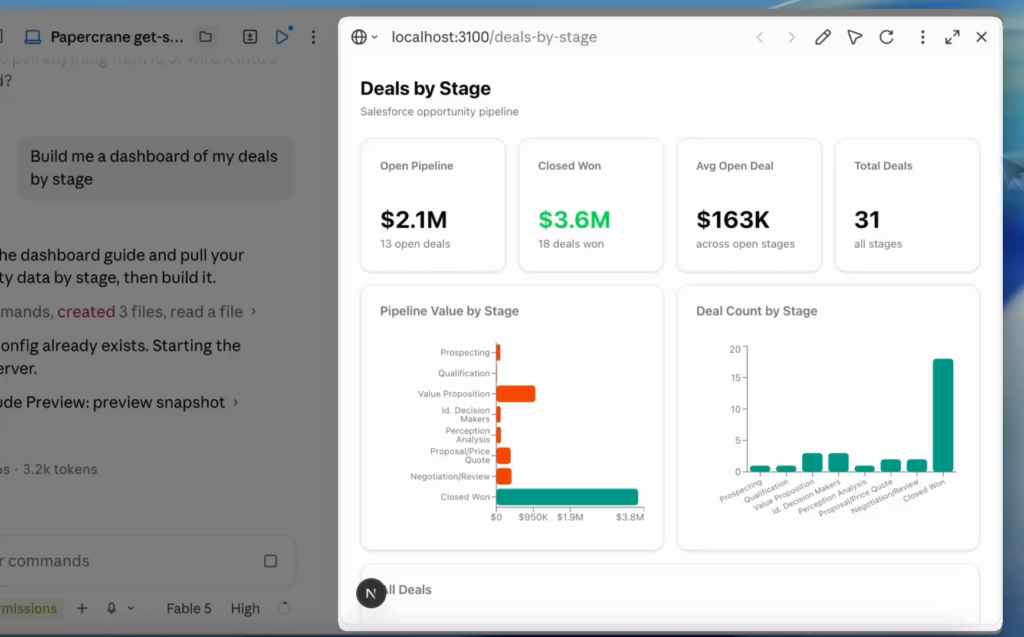
A Salesforce deals dashboard rendering inside Claude Code's preview pane, next to the conversation that built it
The dashboard takes shape inside the Claude app, right next to the conversation building it.

What it costs

The CLI is free. Dashboards run on your own Claude or OpenAI subscription, so there are no AI credits to buy and no per seat pricing to negotiate. The free tier includes five dashboards and every connector. Paid tiers add team features, custom domains, and embedded analytics when you need them.

Where this is going

BI tools have spent thirty years making humans better at operating software. That era is ending. The next BI tool doesn’t need a friendlier query builder, because the thing driving it reads documentation at a thousand words a second and never gets tired of clicking. It needs what an agent needs: credentials, a workspace, and a way to ship. That’s what we’ve built.

If you have Claude Code installed, you’re ninety seconds from a live dashboard on your real data. Paste the prompt, watch what happens, and send me the first dashboard you build. I read everything.

npm install -g @papercraneai/cli, or just tell your agent: Read https://papercrane.ai/get-started.md and login