惯性聚合 高效追踪和阅读你感兴趣的博客、新闻、科技资讯
阅读原文 在惯性聚合中打开

推荐订阅源

Cloudbric
Cloudbric
T
Threat Research - Cisco Blogs
Simon Willison's Weblog
AWS News Blog
AWS News Blog
P
Privacy & Cybersecurity Law Blog
H
Help Net Security
云风的 BLOG
云风的 BLOG
G
GRAHAM CLULEY
Spread Privacy
Spread Privacy
Cyber Security Advisories - MS-ISAC
A
Arctic Wolf
Project Zero
Project Zero
Engineering at Meta
Engineering at Meta
P
Privacy International News Feed
Blog — PlanetScale
Blog — PlanetScale
Stack Overflow Blog
Stack Overflow Blog
M
MIT News - Artificial intelligence
The Register - Security
Recorded Future
Recorded Future
cs.AI updates on arXiv.org
C
Cisco Blogs
PCI Perspectives
PCI Perspectives
Recent Announcements
Martin Fowler
Martin Fowler
A
About on SuperTechFans
W
WeLiveSecurity
GbyAI
GbyAI
V
Vulnerabilities – Threatpost
The GitHub Blog
The GitHub Blog
D
Darknet – Hacking Tools, Hacker News & Cyber Security
C
Check Point Blog
Y
Y Combinator Blog
月光博客
月光博客
Scott Helme
Scott Helme
奇客Solidot–传递最新科技情报
奇客Solidot–传递最新科技情报
Google DeepMind News
F
Fortinet All Blogs
U
Unit 42
G
Google Developers Blog
钛媒体:引领未来商业与生活新知
钛媒体:引领未来商业与生活新知
T
Threatpost
Application and Cybersecurity Blog
Google Online Security Blog
Recent Commits to openclaw:main
OSCHINA 社区最新新闻
OSCHINA 社区最新新闻
Cisco Talos Blog
Cisco Talos Blog
博客园 - 三生石上(FineUI控件)
Hugging Face - Blog
Hugging Face - Blog
MongoDB | Blog
MongoDB | Blog
博客园 - 司徒正美

Software Defined Talk

Episode 579: The Headless Lifestyle Episode 578: War for Talent Episode 577: Let’s go to Buc-ee’s Episode 576: Observability's Next Phase Episode 575: UI blizzard Nobody Wants to Be a Measurer Episode 573: How many quadrillions in a Googol? The world isn’t curl Episode 571: The Enterprise Dunbar number The Enterprisification of Agents Episode 569: Agent Assimilation Episode 568: Claude Code, OpenAI Drama, and Is Anyone Still Using Backstage? Episode 567: Building Voice and Streaming Apps for the Enterprise with Alberto Episode 566: The code is actually kinda useless Episode 565: Field Engineering is the YOLO team New Token Machines Episode 563: Claude Camp Episode 562: Bureaucracy: Still Unsolved Episode 561: Two Guys and Their Tokens You Can Feel It Coming Episode 559: A series of OODA loops Episode 558: Tara Raj on Amazon Nova Act Episode 557: Moltbot Maximists Episode 556: This Conversation is Hardened After the Dream The Alpha and The Omega Episode 553: 2025 Year in Review Episode 552: Tech Strategy: Past, Present, Future Episode 551: An Australian Documentary Episode 550: Typeface Philosophy Episode 549: The Fermi Paradox of Agentic Development Episode 548: Household CMDB Episode 547: Whitney goes to KubeCon Episode 546: The cURLing Test Episode 545: No one cares about Chickens Episode 544: The Enterprise Turing Test Arts and Crafts Yuriy Shyyan on owning your own Cloud. Episode 541: Why not do everything Episode 540: How to build a factory Episode 539: The Final Demand Episode 538: Michael Irwin on Docker, Developers, and AI Episode 537: YOLO acquisitions My search engine couldn’t help me Episode 535: Don’t put randomness in your workflow Episode 534: Capitalism is working Episode 533: It’s a Type 2 Kolache Less Goofy. More Enterprise. Episode 531: YAYAML Episode 530: His proper name is Sasquatch Episode 529: Windsurf, AI Agents, and Kiro Episode 528: You can’t spell Clippy without CLI Episode 527: Victor Adossi on WebAssembly Episode 526: The Optimist, the Origin, and the Deck Episode 525: AI Native vs. AI Add-on Episode 524: It’s a Box in a Box Episode 523: Sterling Chin on APIs, AI, and Building MCP Servers Episode 522: A 5-star cannot stand Episode 521: The MacGuffin Episode 520: Excited is overused Episode 519: This is a “hit by pitch” Episode 518: It Is What It Is Episode 517: Trademark’s in the Mail Episode 516: Vibe Strategy Episode 515: Rick Houlihan, MongoDB Field CTO on Document Databases Episode 514: It’s All Affiliate Links Episode 513: Put On A Musical Episode 512: Let’s Not Ruin This Episode 511: G-Wiz Episode 510: Vibe Code This Baby Episode 509: It’s like the Suburbs Episode 508: Software Defined Interviews Crossover: PaaS and Career Advice with Brian Gracely Episode 507: Battery of Potential Episode 506: Put It On Ice Episode 505: There Could be Extra Innings Episode 504: Socrates Didn’t Whiteboard Episode 503: Maybe Puppies Solve Everything Episode 502: Have a Plan or Throw It Away Episode 501: Checkbox Features Episode 500: 2024 Year in Review Episode 499: Star, Archive, or Spam? Episode 498: I’m not ready to start a new streak Episode 497: Big Math Episode 496: It’s Not About Being Paranoid Episode 495: The most honorable of mentions Episode 494: We are going to move the couch Episode 493: Stay in the sandbox Episode 492: Aran Khanna on Cloud Insurance Episode 491: The OSS Money Trap Episode 490: AI's use UI's Episode 489: Whitney Lee: From Wedding Photographer to Cloud-Native DevRel Episode 488: Am I Here for the Mission or the Paycheck? Episode 487: WordPress Drama and Chicken Sandwiches Episode 486: Platform Engineering vs. DevOps Episode 485: It's an Ending, That's Enough Episode 484: A Lot of USB Ports Episode 483: [AGPL does not close deals for you] Episode 482: Tip Jar Economy There Never Was a Rug Episode 480: No offsite content
Kubernetes Rules Everything Around Me, VMworld, Pivotal Container Service
Software Defined Talk LLC · 2017-09-01 · via Software Defined Talk

Episode 105 · August 31st, 2017 · 58 mins 20 secs

It’s VMworld this week, so there’s fresh news from the Dell Technologies universe to sort through. VMware releases it’s SDDC on AWS scheme and Pivotal announces its container service/stack, Pivotal Container Service (PKS). We discuss both, including a meandering overview of what PKS is and some theory about what enterprises actually want with all that VMware in public cloud. Also, the tragic story of airline and hotel upgrades, like pearls to tired business travelers.

Misc.

Now you can buy kubernetes from Dell

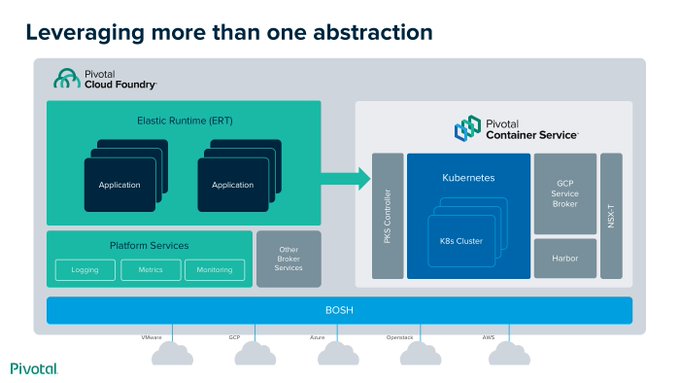
  • VMware/Pivotal/Google make a kubo distro. Uses BOSH, NSX, and kubo to setup clusters. Will run on vSphere and Google Cloud, promises to work with other Google Cloud services, be continuously updated to be compatible with GCE containers. Also, VMware storage services and comparability with VMware systems management tools.
  • El Reg coverage, and also from The New Stack.
  • TPM: “The private PKS stack will use vSAN for storage, vRealize Automation for orchestration and governance, vCloud Director for provisioning, and vRealize Operations for monitoring. (So, in theory, one could run the PKS stack on the AWS cloud slices that VMware has partnered with Amazon to create, effectively creating a clone of GKE to run on AWS bare metal iron. . . .)”
  • More laundry listing of the parts from Google, that is, Google Cloud services you can use in a PKS environment: BigQuery, Bigtable, Spanner, Storage, SQL, Pub/Sub, Vision API, Speech API, Natural Language API, Translate API.
  • A list of capabilities from Cornelia’s(?) talk, and what BOSH does (and, thus, does in k8 management).
  • Use it for: “PKS™ is ideal for workloads like Spark and ElasticSearch, and when you need access to infrastructure primitives. Further, use PKS for apps that require specific co-location of container instances, and for those that need multiple port binds.”
    • The Pod affinity thing here is for when you want to run multiple things grouped together, like with Spark, Elastic Search, etc. where you the different things go together.
  • More value-props’ing:
    • i.e., kubernetes on it’s own is hard.
    • As Ramji points out, PKS means you’ll get a consistent, standardized kubernetes/container technology across the Dell Technologies portfolio.
    • Watters lays it out.
  • Positioning: guidance seems to be that PKS is mostly for large organizations, “enterprises.”
  • PKS to GA in 2017Q4, pricing then too.
  • Diagram here:.
  • Some vendor exec story-time here, and Pivotal blog post.
  • So, you can run PCF and PKS side-by-side.
  • See longer explanation from Chad Sakac:
    • “historically, [Dell Technologies’] point of view on the container/cluster manager abstraction ecosystem wasn’t clear”
    • See also this pro'er diagram.
    • Lots of emphasize on a unified, compatible approach/GTM: “We now have a Cloud Native/Digital Transformation stack where there is a SINGLE target we are furiously running towards now as VMware, Pivotal, and Dell EMC – no mis-alignment, no differences in PoV. “
  • Market context:
    • You may recall Coté’s summary of the CoreOS commissioned 451 survey, which linked to a 2016(?) Gartner survey where 18% of respondents had containers in production, with 4% being “significant production”
    • That CoreOS/451 survey had a very important footnote: the survey respondents were already running containers already. It was more about which container orchestration platforms they liked.
    • It was hard to do conclusive ranking of container orchestrators since people were using multiple ones. But, if you lump together CoreOS’s kubernetes distro with generic kubernetes, kubernetes wins out over Docker Swarm, 49% vs. 36%.
    • Meanwhile: “By 2020, 50%+ of global enterprises will be running containerized applications in production, up from <20% today.”
  • RedMonk’s “developers are the kingmakers” theory, more.

SDDC on VMware

  • Run the VMware stack on AWS, out of beta: “For the IT and software development sectors, the deal means that VMware mainstays such as all its software-defined data center ware—vCenter, NSX, vSphere, VSAN and others—will run on AWS instead of VMware's own cloud.”
  • Pricing?
  • ”The three-year contract costs $109,366 per host, which would save about 50% compared to the on-demand hourly billing rate, according to VMware. Another program can cut costs by up 25% based on their on-premises VMware product licenses, as long as those on-premises products remain active…. There are separate charges for IP and data transfers, as the standard AWS egress fees still apply. Each host has 2 CPUs, 36 cores, 72 hyper-threads, 512 GiB RAM and local flash storage.” - ”the estimated total cost of ownership for VMware Cloud on AWS is up to $0.09 per VM per hour, according to VMware”
  • More pricing info from TPM: “The base on demand price for this server is $8.3681 per hour, which works out to around $6,109 per month.”
  • Cloud-context, from Derrick Harris: “Look at the companies’ most-recent fiscal years—2016—during which VMware grew about 9 percent to just over $7 billion in revenue, while AWS grew about 45 percent to more than $12.2 billion in revenue. It’s on pace for about $16 billion in revenue in 2017.”
  • And, more from Derrick on public cloud companies ever elusive quest to grab on-premises workloads and revenue: “There will continue to be a lot of big workloads running inside company data centers. If AWS and Google really want a shot at owning them, they’ll probably need to get their hands (and code) a little dirty by going to where those applications live and showing there’s a better way of doing things.”
  • It makes you wonder if a strategy for public cloud companies going behind-the-firewall is just wishful projection on the on-premise set’s part. 451 surveys a predicting that by 2019, 60% of work-loads will run on cloud technologies (across public, hosted, and private), with under 25% on private cloud (hosted/managed and on-premises).

VMworld, in general

  • Round-up of news from Larry Dignan - lot’s of security stuff, of which Coté has no clue. And, of course, the VDI/desktop stuff. It’s like the old Project Octopus era vision of VMware.
  • Delving into VMware financials, and some product portfolio strategy typing.
  • VIO, VMware’s OpenStack distro has a few production users, but, “for the most part customers are deploying it for their development and test environments, where programmers want to embrace OpenStack and the IT managers want to keep everything on a VMware substrate”
  • VIO pricing: “The other thing that is new with VIO 4.0 is that it is no longer free. Starting with this release, VIO will cost $995 per server socket in a Datacenter Edition, but customers who are using VIO in conjunction with the vRealize management suite will be able to get it for $495 per socket. That is just the price of the perpetual license; reckon another 18 percent or so on top of that for annual support.”

  • Chad Sakac explains all the stacks, how it does hybrid cloud, etc.

BONUS LINKS! Not covered in show.

SDN

  • Turns out, SDN is a condiment, not an entrée.
  • Also, a good list of adoption challenges any new technology/thought-technology faces. # Meta, follow-up, etc.
  • Patreon - like anyone who starts these things, I have no idea WTF it is, if it’s a good idea, or if I should be ashamed. Need some product/market fit.
  • Check out the Software Defined Talk Members Only White-Paper Exiguous podcast over there.
  • Join us all in the SDT Slack.

Mid-roll

Recommendations