

惯性聚合 高效追踪和阅读你感兴趣的博客、新闻、科技资讯
阅读原文 在惯性聚合中打开

推荐订阅源

S
Schneier on Security
P
Proofpoint News Feed
Apple Machine Learning Research
WordPress大学
WordPress大学
博客园 - Franky
V
V2EX
爱范儿
爱范儿
J
Java Code Geeks
小众软件
小众软件
Last Week in AI
Last Week in AI
The Cloudflare Blog
让小产品的独立变现更简单 - ezindie.com
Hugging Face - Blog
Hugging Face - Blog
T
The Blog of Author Tim Ferriss
酷 壳 – CoolShell
酷 壳 – CoolShell
The Register - Security
GbyAI
GbyAI
Vercel News
Vercel News
Y
Y Combinator Blog
腾讯CDC
F
Fortinet All Blogs
I
InfoQ
N
Netflix TechBlog - Medium
B
Blog RSS Feed
D
Docker
OSCHINA 社区最新新闻
OSCHINA 社区最新新闻
量子位
博客园 - 司徒正美
阮一峰的网络日志
阮一峰的网络日志
The GitHub Blog
The GitHub Blog
Microsoft Security Blog
V
Visual Studio Blog
博客园 - 三生石上(FineUI控件)
宝玉的分享
宝玉的分享
Blog — PlanetScale
Blog — PlanetScale
H
Help Net Security
云风的 BLOG
云风的 BLOG
A
About on SuperTechFans
Scott Helme
Scott Helme
T
Tor Project blog
U
Unit 42
Google Online Security Blog
PCI Perspectives
PCI Perspectives
钛媒体:引领未来商业与生活新知
钛媒体:引领未来商业与生活新知
NISL@THU
NISL@THU
D
Darknet – Hacking Tools, Hacker News & Cyber Security
aimingoo的专栏
aimingoo的专栏
cs.CV updates on arXiv.org
Stack Overflow Blog
Stack Overflow Blog
Security Archives - TechRepublic

InfoWorld

AWS boosts CloudWatch Logs query limits by 10x to ease debugging for developers, SREs 21 LLMs tuned for special domains The new AI lock-in AWS adds Advanced Prompt Optimization tool to Bedrock Capacity markets could reshape cloud computing Four cutting-edge tools for spec-driven development Anthropic puts Claude agents on a meter across its subscriptions Notion courts developers with a platform for AI agents and workflow automation Using continuous purple teaming to protect fast-paced enterprise environments A better way to work with SQL Server Evidence-driven workflows: Rethinking enterprise process design AWS debuts Graviton-powered Redshift RG instances to cut analytics costs SAP’s AI promises last year? Most are still rolling out GitLab CEO sees developer tool bill increasing 100-fold Red Hat adds support for agentic AI development What’s new and exciting in JDK 26 Kill the loading spinner with local-first data and reactive SQL A networking revolution at AWS Tokenmaxxing is super dumb Hands-on with React, Supabase, and PowerSync How to add AI to an existing product (without annoying users) Your AI doesn’t need another database What happens when engineering teams reorganize around AI agents Python isn’t always easy When cloud giants meddle in markets 12 model-level deep cuts to slash AI training costs The best new features in Python 3.15 Teradata launches platform for enterprise AI agents moving beyond pilots Three skills that matter when AI handles the coding MongoDB targets AI’s retrieval problem Building AI apps and agents with Microsoft Foundry Designing front-end systems for cloud failure No, AI won’t destroy software development jobs Diskless databases: What happens when storage isn’t the bottleneck Vibe coding or spec-driven development? The agentic AI distraction Vibe coding or spec-driven development? How to choose Cloud providers are blinded by agentic AI SAP to acquire data lakehouse vendor Dremio Small language models: Rethinking enterprise AI architecture Making AI work through eval hygiene Improving AI agents through better evaluations AI in the cloud is easy but expensive Running AI in the cloud is easy – and expensive Making AI work for databases Harness teams of agentic coders with Squad Harness teams of coding agents with Squad Oracle NetSuite announces AI coding skills for SuiteCloud developers Why it’s so hard to create stand-alone Python apps A new challenge for software product managers The hidden cost of front-end complexity GitHub shifts Copilot to usage-based billing, signaling a new cost model for enterprise AI tools OpenAI’s Symphony spec pushes coding agents from prompts to orchestration The front-end architecture trilemma: Reactivity vs. hypermedia vs. local-first apps Enterprise AI is missing the business core The best JavaScript certifications for getting hired Google begins putting the guardrails on agentic AI Why world models are AI’s next frontier Where to begin a cloud career Google pitches Agentic Data Cloud to help enterprises turn data into context for AI agents How open source ideals must expand for AI Is your Node.js project really secure? How I doubled my GPU efficiency without buying a single new card SpaceX secures option to acquire AI coding startup Cursor for $60B Google’s Gemma 4 shines on local systems – both big and small AI is upending the SaaS game How AI is upending SaaS tools Snowflake offers help to users and builders of AI agents From the engine room to the bridge: What the modern leadership shift means for architects like me Addressing the challenges of unstructured data governance for AI The cookbook for safe, powerful agents Enterprises are rethinking Kubernetes GitHub pauses new Copilot sign-ups as agentic AI strains infrastructure Best practices for building agentic systems Making agents dull Oracle delivers semantic search without LLMs When cloud giants neglect resilience Exciting Python features are on the way Ease into Azure Kubernetes Application Network The agent tier: Rethinking runtime architecture for context-driven enterprise workflows The two-pass compiler is back – this time, it’s fixing AI code generation MuleSoft Agent Fabric adds new ways to keep AI agents in line Salesforce launches Headless 360 to support agent‑first enterprise workflows Tap into the AI APIs of Google Chrome and Microsoft Edge Where will developer wisdom come from? GitHub adds Stacked PRs to speed complex code reviews The hyperscalers are pricing themselves out of AI workloads HTMX 4.0: Hypermedia finds a new gear Google Cloud introduces QueryData to help AI agents create reliable database queries Hands-on with the Google Agent Development Kit Are AI certifications worth the investment? AWS targets AI agent sprawl with new Bedrock Agent Registry Cloud degrees are moving online Swift for Visual Studio Code comes to Open VSX Registry AI agents aren't failing. The coordination layer is failing Anthropic rolls out Claude Managed Agents Microsoft’s reauthentication snafu cuts off developers globally Meta’s Muse Spark: a smaller, faster AI model for broad app deployment Bringing databases and Kubernetes together AWS turns its S3 storage service into a file system for AI agents
First look: Lemonade serves up local AI with limitations
2026-05-13 · via InfoWorld

Lemonade, created by AMD, is a server application plus GUI for running local AI models, similar to projects like LM Studio (or, more distantly, ComfyUI). What it lacks in configurability, it tries to make up for in broader integration with third-party apps that use standard APIs, and with support for non-NVIDIA runtimes.

Lemonade works with a variety of runtimes and back-end engines. It supports AMD GPUs, Ryzen NPUs, Vulkan, and CPU execution (although not for all tasks), along with the llamacpp, whispercpp, sd-cpp, kokoro, ryzenai-llm and flm back ends. In addition to providing its own set of APIs, Lemonade interoperates with a broad set of industry standards including OpenAI, Ollama, Anthropic, and llama.cpp. Both GGUF and ONNX models are supported.

The biggest omission is NVIDIA-specific GPU support. Only Vulkan (generic GPU) and AMD (ROCm) GPUs are supported. So, if you plan on using StableDiffusion models with NVIDIA hardware, you may want to look elsewhere for now. (StableDiffusion models do not have Vulkan runtime support, only AMD GPU and generic CPU support.)

While NPU processing is available, here too the support is limited. On Linux it’s available only via FastFlowLM, and on Windows it works only via Ryzen AI SW.

When you set up Lemonade, it will make a best guess as to what inference engine and back-end configuration is best suited to the system.
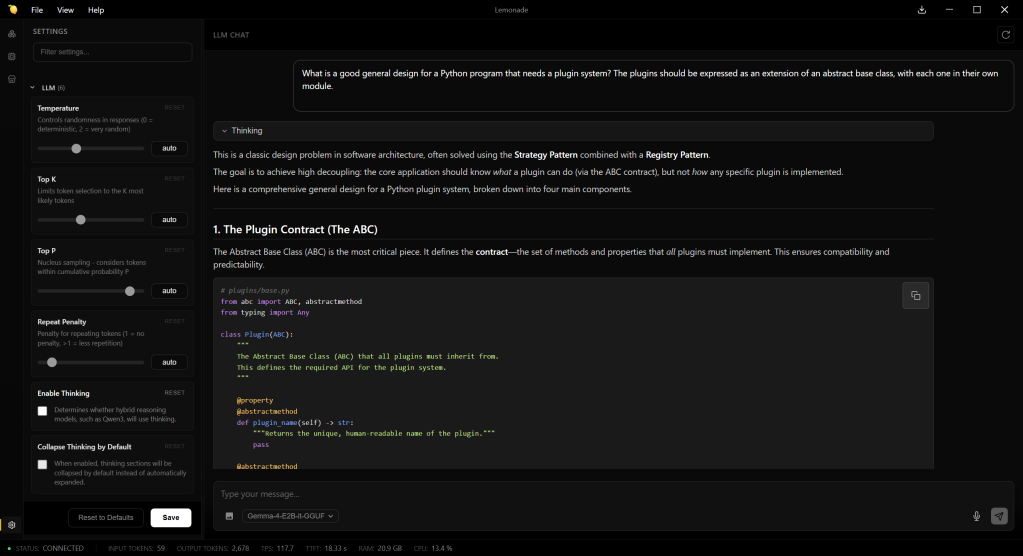
Lemonade chat interface

Chat interface for AMD’s Lemonade server. Few configuration options are available for working with models; most of them are visible at the left.

Foundry

The Lemonade app can run a few different ways: as a CLI application, as a GUI desktop app (a la LM Studio), and as a server. The CLI version can be used to run the inference engine headlessly — with no GUI, just the server components and APIs — or as a way to launch the GUI with a specific model and other settings. Lemonade’s server can also be delivered as an embeddable component for other apps.

Like LM Server, Lemonade offers a ready-to-download catalog of models for common tasks: LLMs (Gemma, gpt-oss, Qwen), image generation (Flux, SD, Z-Image), and so on. You’re not limited to the models in the catalog, although that’s the most convenient way to set them up. Integrating with other apps that use one of Lemonade’s supported APIs typically involves little more than pointing the app to Lemonade as an endpoint, and talking to one of the supported API types.

Unfortunately, Lemonade’s most visible feature, its GUI — a chat interface where you can interact with locally-run models — is also its weakest feature, because it exposes very little flexibility when running or serving models. Not many “knobs” are available for how models are served, and they’re rudimentary ones: temperature, top K and P, repeat penalty, turning thinking on or off, and that’s about it.

Notably, you can’t use the GUI to control how many layers of a model run on the GPU, which means for the most part you’re stuck with models that fit in memory. You can do this by manually passing parameters to how models are loaded, but the point is that you shouldn’t have to. After all, having to perform such manual twiddling defeats much of the purpose of having a convenient GUI.
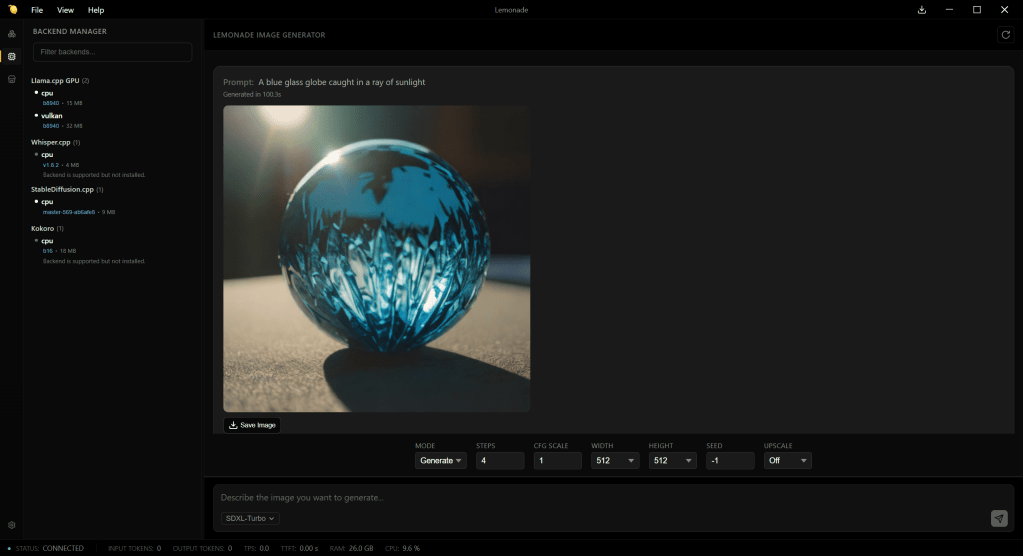
Lemonade image generation

Generating an image using Lemonade server, via the SDXL-Turbo model. Only AMD GPU and Vulkan acceleration is supported.

Foundry

Lemonade’s chat interface also lacks some useful features. If you start a new chat, any existing chat is wiped out; there’s no chat history system as there is with LM Studio or other apps. Images generated in chats can be saved, but there’s no straightforward way to save the text of a chat; right-clicking on the chat and hitting “Save” generates an HTML copy of the whole interface of the application at that moment.

On the plus side, I appreciated the “Logs” pane, which shows detailed real-time information generated by the server.

The main reason to use Lemonade, given its current feature set and general design, is to have a convenient way to work with AMD (ROCm) GPUs, the Ryzen NPUs, and their runtimes, when you are likely to keep the entire model in memory. But for scenarios where you want more control available through the GUI, and support for NVIDIA devices as a standard feature, you’ll want to look elsewhere first.