


Can we stop El Niño before it starts?
A controversial geoengineering proposal suggests that brightening clouds off South America could weaken a burgeoning El Niño, but major technical and ethical questions remain
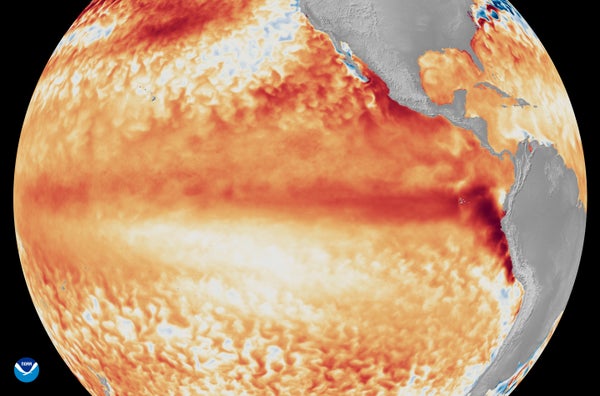
Satellite imagery showing the difference from average sea surface temperatures at the equator in the tropical Pacific Ocean (depicted using various shades of red and orange for warmth) during the first week of June 2026, as compared with the baseline used by NOAA’s Coral Reef Watch.
NOAA Satellites
Throughout the coming months, El Niño is forecast to bring droughts, heat waves and other extreme weather to every continent on Earth. The cyclical climate event, driven by unusually warm ocean temperatures in the equatorial Pacific, has been gaining steam, with water temperatures reaching record highs. But a new study published Wednesday in Science Advances suggests that it may be possible—in theory, if not in practice—to blunt the grim cycle of disasters by seeding clouds off the coast of Peru and Chile, where El Niño originates.
The idea is to spray sea salt into the lower atmosphere, making nearby clouds more reflective. With less sunlight penetrating to Earth’s surface, the ocean would become cooler, depriving El Niño of the warm water it requires. This ambitious strategy, known as marine cloud brightening (MCB), has been one of several geoengineering strategies contemplated as a way to counteract global warming. But critics warn that if large-scale MCB systems were to someday fail, it could lead to “termination shock,” a catastrophically abrupt rebound in temperature.
The new proposal aims to sidestep that hazard by using MCB only occasionally and only in a small portion of the atmosphere. Lead author Jessica Wan, a postdoctoral fellow at the University of Chicago, sums up the question that inspired her team’s work: “Could you get some of the short-term benefits of geoengineering without those long-term risks?”
If you're enjoying this article, consider supporting our award-winning journalism by subscribing. By purchasing a subscription you are helping to ensure the future of impactful stories about the discoveries and ideas shaping our world today.
According to the researchers’ computer modeling, the answer is yes. When they simulated super El Niño events from 1997–1998 and 2015–2016, they found that MCB substantially reduced ocean warming if deployed early enough in the season—around May or June, just when forecasts become reasonably reliable. With El Niño projected to cause $84 trillion in global economic losses over the 21st century, the appeal of such an intervention is obvious.
Yet many experts argue that the technology is impractical and that we ought not meddle in climate phenomena we don’t fully understand. “It’s a very risky business to go in and try to interfere with a natural process that’s been occurring for millions and millions of years,” says Michael McPhaden, a retired senior scientist with the U.S. National Oceanic and Atmospheric Administration, who wasn’t involved in the new study. “I think nature is far too complex.”
Indeed, El Niño’s complexity limited the researchers’ simulations to two years; beyond that, the model becomes untrustworthy. “The long-term consequences of ... dampening El Niño are hard or impossible to anticipate,” says Raymond Pierrehumbert, a University of Oxford planetary scientist, who wasn’t involved in the new study. As the authors themselves acknowledge, MCB could produce a stronger La Niña—El Niño’s cool-water counterpart—the following year, bringing a different set of global weather disruptions.
Beyond the scientific uncertainties, MCB is fraught with ethical questions: Who should be allowed to make a decision with such far-reaching effects? Which world regions should be spared at the expense of others? As McPhaden puts it, “El Niño creates winners and losers, and if you modify El Niño, you’re going to make winners and losers as well.” The climate pattern leads to weather that devastates agriculture in parts of Africa and Asia, for example, but it also tends to suppress Atlantic hurricanes, making it a boon to the U.S. Gulf Coast and the Caribbean.
Despite these dilemmas, some experts say that a more constrained MCB may be the most politically acceptable form of geoengineering. Though monumental in its own right, “it is a much easier decision” to temper a specific extreme event than to play dice with the entire global climate, says Frank Keutsch, a Harvard University atmospheric chemist. Keutsch wasn’t involved in the new study but led a planned solar geoengineering experiment that was canceled in 2024.
Even if the international community could strike a fair agreement for MCB deployment, it’s unclear whether the technology itself can deliver. Wan’s team estimates it would take 2,400 ships—2 percent of the world’s merchant fleet—equipped with sprayers to nip El Niño in the bud. But according to David Keith, a University of Chicago climate scientist, who wasn’t involved in the new study but has worked with some of its authors, the sprayers of today would need to improve in efficiency by a hundredfold.
Still, Wan hopes for a breakthrough as more start-ups and research groups try their hand at MCB. Should those efforts pay off, she believes the technology could buy humanity precious time to address the root cause of climate change: fossil-fuel consumption. “I think that’s the potential benefit of this kind of strategy,” Wan says. “It’s reducing the worst impacts while we come up with a more permanent solution.”
If you enjoyed this article, I’d like to ask for your support. Scientific American has served as an advocate for science and industry for 180 years, and right now may be the most critical moment in that two-century history.
I’ve been a Scientific American subscriber since I was 12 years old, and it helped shape the way I look at the world. SciAm always educates and delights me, and inspires a sense of awe for our vast, beautiful universe. I hope it does that for you, too.
If you subscribe to Scientific American, you help ensure that our coverage is centered on meaningful research and discovery; that we have the resources to report on the decisions that threaten labs across the U.S.; and that we support both budding and working scientists at a time when the value of science itself too often goes unrecognized.
In return, you get essential news, captivating podcasts, brilliant infographics, can't-miss newsletters, must-watch videos, challenging games, and the science world's best writing and reporting. You can even gift someone a subscription.
There has never been a more important time for us to stand up and show why science matters. I hope you’ll support us in that mission.
此内容由惯性聚合(RSS阅读器)自动聚合整理,仅供阅读参考。 原文来自 — 版权归原作者所有。