
惯性聚合 高效追踪和阅读你感兴趣的博客、新闻、科技资讯
阅读原文 在惯性聚合中打开

推荐订阅源

K
Kaspersky official blog
小众软件
小众软件
Engineering at Meta
Engineering at Meta
博客园 - 三生石上(FineUI控件)
WordPress大学
WordPress大学
G
Google Developers Blog
Cyber Security Advisories - MS-ISAC
V
V2EX
freeCodeCamp Programming Tutorials: Python, JavaScript, Git & More
Google DeepMind News
Security Archives - TechRepublic
CTFtime.org: upcoming CTF events
C
Check Point Blog
aimingoo的专栏
aimingoo的专栏
罗磊的独立博客
钛媒体:引领未来商业与生活新知
钛媒体:引领未来商业与生活新知
MongoDB | Blog
MongoDB | Blog
L
LINUX DO - 热门话题
酷 壳 – CoolShell
酷 壳 – CoolShell
奇客Solidot–传递最新科技情报
奇客Solidot–传递最新科技情报
H
Help Net Security
Martin Fowler
Martin Fowler
G
GRAHAM CLULEY
Simon Willison's Weblog
OSCHINA 社区最新新闻
OSCHINA 社区最新新闻
博客园 - Franky
V
Vulnerabilities – Threatpost
云风的 BLOG
云风的 BLOG
博客园_首页
C
Cybersecurity and Infrastructure Security Agency CISA
量子位
Stack Overflow Blog
Stack Overflow Blog
Recent Announcements
让小产品的独立变现更简单 - ezindie.com
I
Intezer
Scott Helme
Scott Helme
A
About on SuperTechFans
博客园 - 司徒正美
Hacker News: Ask HN
Hacker News: Ask HN
The GitHub Blog
The GitHub Blog
Forbes - Security
Forbes - Security
Threat Intelligence Blog | Flashpoint
博客园 - 聂微东
人人都是产品经理
人人都是产品经理
The Cloudflare Blog
cs.CV updates on arXiv.org
Spread Privacy
Spread Privacy
T
Tailwind CSS Blog
S
Security Affairs
宝玉的分享
宝玉的分享

Scientific American Content: Global

Physicist says splashy new cosmology study made ‘elemental’ mistake These absurdly cute mice live at higher altitudes than any other mammal—here’s how they do it Cases of an explosive diarrhea-causing parasite are rising fast in the U.S. Early bird, night owl or something else? Five patterns may define how we sleep Scientists just caught a glimpse of Earth’s biggest game of The Floor Is Lava Can we stop El Niño before it starts? RFK, Jr. is turning his attention to another vital health advisory group Why ‘Neil the seal’ is unleashing chaos in Tasmania Scientists just confirmed Einstein’s greatest theory—again Detecting hidden nuclear weapons in space may be possible using cosmic rays Why more extreme rain could mean more shark bites Exclusive: International timekeepers to vote on changing the leap second to a leap hour Why are the steel beams inside a Manhattan skyscraper buckling? Experts explain How math helped the Allies win World War II Should you be taking creatine? Astronomers just discovered some of the most primordial and extreme objects in the universe New York City’s Manhattanhenge is back—here’s how to see it Sleep matters more for weight loss than you might think Did our modern human ancestors and Neanderthals share a common culture? Wordle, but for art history—Anthropeum turns the Met Museum into an online game NASA Chinese spacecraft beams back first image of Earth’s “mini moon” Can AI help improve the chances of a successful IVF pregnancy? Is AI ruining our skills? Early results are in—and they’re not good For July 4, NASA unveils an astronomical fireworks show, complete with sound effects How working memory could give rise to consciousness Ancient As the U.S. turns 250, its climate has profoundly changed 250 years later, new history is uncovered from the first major battle of the American Revolution What will happen to Earth’s moon in the far future? The biological dogma that women don’t make new eggs after birth may be wrong The Reflecting Pool’s algae problem has better solutions than hydrogen peroxide, experts say NASA needs volunteers to spend a year locked in a Mars simulation Male marathoners might be twice as likely to ‘hit the wall’ as women—the reason why might surprise you Too hot? Know the signs of heat illness and how to stay safe Why digital government records are so hard to preserve The White House goes all in on aliens with new UAP Science Advisory Council Global ocean temperatures are entering ‘uncharted territory,’ climate scientists say Earth is home to 20 million insect species—three times more than we thought Astronomers just began the largest cosmic time-lapse in history This planet survived the death of its star—and kept its atmosphere Scientists just unveiled “cyborg” cockroaches that can breathe underwater for hours Supreme Court limits police searches of phone location data Why this 98-qubit quantum computer is a big deal Europe wants to build the biggest particle accelerator on Earth. Will the rest of the world join in? NASA unveils four new missions to help make its ambitious moon base plans happen New York City could see its hottest weather in more than a decade The math behind the universe AI finds hidden ECG signal that predicts sudden cardiac death risk China’s LineShine supercomputer tops global rankings with almost 2 quadrillion calculations per second London botanic gardens digitizes 7 million specimens See the glittering heart of the Milky Way in this stunning new image Pigeons live ‘at the edge of chaos,’ researchers confirm
Ancient cave paintings can harbor human DNA for millennia, scientists find
Tom Metcalfe · 2026-07-02 · via Scientific American Content: Global

The breakthrough could reveal previously hidden ancient human activity inside caves acting as “genetic archives”
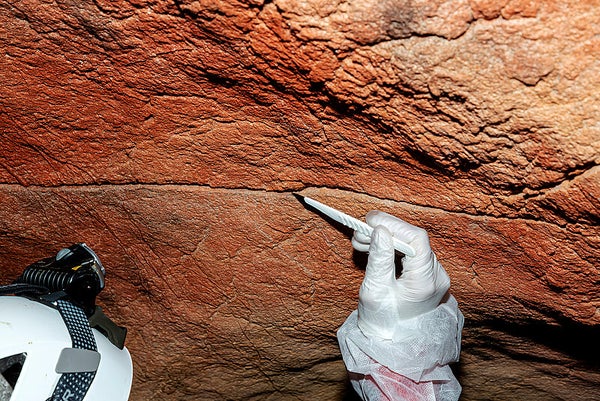
Pigment sampling at a claviform rock art figure in Tebellín, Spain.

Pigment sampling at a claviform rock art figure at the Tebellín site in Spain.

Alberto Martínez Villa; From “Investigating Ancient Human DNA Preservation on Cave Walls and in Rock Art,” by Alba Bossoms Mesa et al., in Nature Communications, Vol. 17; 2026

In a first, scientists recovered human DNA from ancient cave paintings, a breakthrough that could open new ways to investigate prehistoric human activity by enabling caves to act as “genetic archives” that could reveal more about the ancient people who painted them.

The new research focused on caves in Spain and Portugal, but the technique could be applied anywhere. “The samples with better DNA, which allowed us to look into their genetic ancestry—these could be up to 16,000 years old," says geneticist Alba Bossoms Mesa, a doctoral student at the Max Planck Institute for Evolutionary Anthropology in Leipzig, Germany.

The researchers took samples of pigments from both ancient cave paintings and the surfaces of nearby unpainted rocks inside 11 caves. The findings, which were recently published in Nature Communications, could help date paintings in Spain’s Covarón Cave to the Upper Paleolithic period, which spanned from 50,000 to 12,000 years ago.


On supporting science journalism

If you're enjoying this article, consider supporting our award-winning journalism by subscribing. By purchasing a subscription you are helping to ensure the future of impactful stories about the discoveries and ideas shaping our world today.


Bossoms Mesa, the study’s first author, explains how the researchers took the samples while also preserving the paintings. In some cases, the scientists took tiny surface samples from areas that had already been damaged, while in others—such as in Spain’s famed Altamira Cave—water from above naturally flows over some of the ancient paintings, and that was collected for the research.
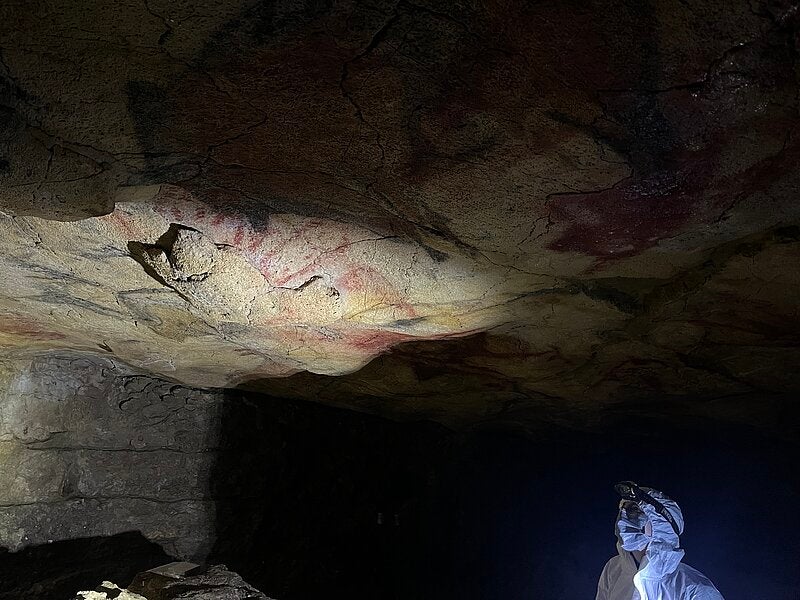
Polychrome ceiling of Altamira from which pigment samples were analyzed.

Polychrome ceiling of Altamira from which pigment samples were analyzed.

© Matthias Meyer

The researchers successfully recovered ancient human DNA in five samples taken from the caves. In most cases, it was mixed with ancient animal DNA—often from species such as bats and rodents. This mixed DNA was an important signal: the researchers believe it likely indicates that sediments from the cave floor were naturally transferred to the walls. By contrast, in Portugal’s Escoural Cave, the researchers found isolated human DNA that they believe came from the original artists—perhaps left by their touch when they rested their body on the wall, or from saliva or sweat during the painting process.

At Spain’s Covarón Cave, most of the samples were mixed animal and human DNA, but they contained much more ancient DNA than elsewhere. As a result, the researchers were able to trace the genetic ancestry of the people who once lived there.

Their analysis indicates that the cave paintings were probably made by hunter-gatherers who lived in Western and Central Europe sometime between 16,700 and 5,200 years ago. Unmixed human DNA from this period was found only on unpainted cave walls, so it’s unclear if it came from the artists.

Adam Brumm, an archaeologist at Australia’s Griffith University, who was not involved in the study, welcomes the results: “Several years ago we tried to extract ancient DNA from dated Late Pleistocene hand stencils in Sulawesi and Borneo,” he says. “We had no success, so I’m glad to see the promising results obtained by this team.”

Brumm was one of the scientists that found the world’s earliest-known cave art on Sulawesi, which is thought to be more than 67,800 years old.

“The demonstration that human DNA can persist on cave walls for thousands of years is encouraging,” he says. If successful, extracting ancient human DNA from rock art “will be a game changer that will revolutionize our understanding of early human culture.”

It’s Time to Stand Up for Science

If you enjoyed this article, I’d like to ask for your support. Scientific American has served as an advocate for science and industry for 180 years, and right now may be the most critical moment in that two-century history.

I’ve been a Scientific American subscriber since I was 12 years old, and it helped shape the way I look at the world. SciAm always educates and delights me, and inspires a sense of awe for our vast, beautiful universe. I hope it does that for you, too.

If you subscribe to Scientific American, you help ensure that our coverage is centered on meaningful research and discovery; that we have the resources to report on the decisions that threaten labs across the U.S.; and that we support both budding and working scientists at a time when the value of science itself too often goes unrecognized.

In return, you get essential news, captivating podcasts, brilliant infographics, can't-miss newsletters, must-watch videos, challenging games, and the science world's best writing and reporting. You can even gift someone a subscription.

There has never been a more important time for us to stand up and show why science matters. I hope you’ll support us in that mission.