


Steel support columns in the Midtown building, which is being converted from offices into apartments, may have been overloaded, experts say
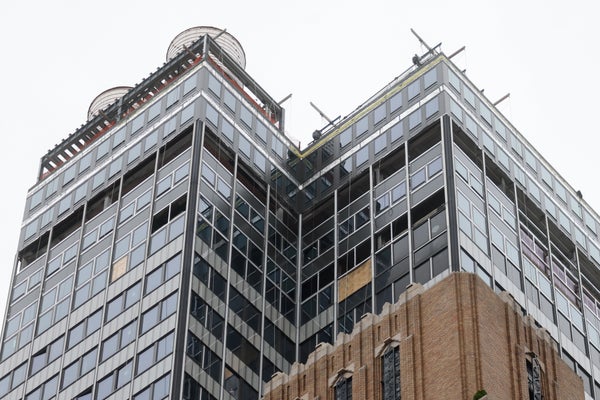
235 East 42nd Street after reports of falling debris in New York City on Tuesday, July 7, 2026.
Michael Nagle/Bloomberg via Getty Images
The evacuation of a skyscraper in Midtown Manhattan and the surrounding area was ordered on Tuesday after the building showed signs of potential collapse that may have been caused by overload, experts say.
The Fire Department of the City of New York (FDNY) said in a statement on Tuesday that it received a call to the building just before 8 A.M. EDT. When the FDNY arrived at 235 East 42nd Street, near Grand Central Terminal, it found at least two steel columns buckling on the 21st and 22nd floors and sagging flooring between the 21st and 26th floors.
Buckling steel columns are a well-known issue among the engineering community, says Gregoy Deierlein, a professor of structural engineering at Stanford University. Deierlein wouldn’t speculate on what specifically may have caused the buckling in this case. But he says it’s not uncommon for columns to become damaged or weakened. That, in turn, can lead floors above the weak points to sag as the column bends, he says.
If you're enjoying this article, consider supporting our award-winning journalism by subscribing. By purchasing a subscription you are helping to ensure the future of impactful stories about the discoveries and ideas shaping our world today.
“Imagine if you’re standing on the floor and you look over—the portion of the floor supported by that column would have dropped a little bit, so it’s going to look like a sagging floor,” Deierlein says.
When buildings like this skyscraper are constructed, engineers erect columns designed to support not just the weight of the building itself but also a certain amount of “live load” per square foot. That extra load includes the people using the building and any other contents. Deierlein says that sometimes the live load limit can be exceeded during renovations because construction materials may be stockpiled inside a building while work is ongoing.
“That could be a very concentrated live load, which could be enough load to overcome the column strength,” he says. “Then the question is, is the column strength enough for what it should have been designed for? Or it could have been a combination of the column wasn’t quite strong enough for what it was designed for, and then you add a lot of load to it.”
While several stories were being added to the building as part of the renovation, Magued Iskaner, a professor in the civil, urban and environmental engineering department at the New York University Tandon School of Engineering, says he would be “very surprised” if this wasn’t taken into account during the planning stages.
“One of the most common reasons for increase of load is that the load gets transferred from one area of a building to a new area,” he adds. “All of these people could have done these things correctly, but the presumed capacity of a column is off simply because there was a latent defect that nobody knew about.”
The most likely point of failure for load-bearing infrastructure is at the joints which connect components, says Doug Holmes, an engineering professor at Boston University. Those connections are “where a significant amount of shearing forces are exerted—think a bolt shearing off—and in the buckling of columns. But, of course, if there is corrosion or wear or damage, any of the components along the load path can be a source of failure.”
The 37-story tower, which formerly served as the New York City headquarters of pharmaceutical giant Pfizer, is in the middle of a $75 million conversion from offices into a luxury apartment project, with some 1,600 units planned.
The conversion from offices to residential is a joint project by David Werner Real Estate Investments and MetroLoft. Neither company immediately responded to a request for comment. In a comment reported by the New York Times, MetroLoft said: “The safety of everyone at and surrounding the building is our number one priority.”
“We’re thankful there were no injuries, and as the [city’s Department of Buildings] clarified, no debris fell from the building. We want to confirm that the affected area is a small section of one of the two buildings on this site. As the FDNY spokesperson noted, the entire building itself is not at risk of collapse.”
Gensler, the architecture firm leading the project, also did not immediately reply to a request for comment.
Engineers from the Department of Buildings have also been deployed to the scene, and the FDNY is reportedly using drones to further examine the building.
The New York Times and other outlets report that emergency beams and other supporting structures are being installed in an effort take pressure off the affected columns. Deierlein says that these measures are needed in the short term—at least until the cause of the damage can be ascertained. But a permanent replacement of the columns “is not an easy thing in an existing building like this.”
“You would have to potentially jack up the floors and eventually need to put in temporary columns nearby, probably take out the damaged column,” he says. “That’s what you want to do. Whether or not that’s feasible in this case, that would be up to the team.”
The core of the problem likely lay not in any issues with materials, Iskander says, but in human error. Miscommunications can occur, even in projects with budgets in the tens of millions of dollars.
“It’s par for the course that sometimes stuff like this just happens,” he says. “There is nothing deeper of concern in the regulations or codes or the materials that are used.”
Editor’s Note (7/7/26): This is a developing story and may be updated.
If you enjoyed this article, I’d like to ask for your support. Scientific American has served as an advocate for science and industry for 180 years, and right now may be the most critical moment in that two-century history.
I’ve been a Scientific American subscriber since I was 12 years old, and it helped shape the way I look at the world. SciAm always educates and delights me, and inspires a sense of awe for our vast, beautiful universe. I hope it does that for you, too.
If you subscribe to Scientific American, you help ensure that our coverage is centered on meaningful research and discovery; that we have the resources to report on the decisions that threaten labs across the U.S.; and that we support both budding and working scientists at a time when the value of science itself too often goes unrecognized.
In return, you get essential news, captivating podcasts, brilliant infographics, can't-miss newsletters, must-watch videos, challenging games, and the science world's best writing and reporting. You can even gift someone a subscription.
There has never been a more important time for us to stand up and show why science matters. I hope you’ll support us in that mission.
此内容由惯性聚合(RSS阅读器)自动聚合整理,仅供阅读参考。 原文来自 — 版权归原作者所有。