


For almost 60 years, a global ban on nuclear weapons in space has held up. But the growing number of satellites and increasing geopolitical tension has scientists worried the moratorium could fail
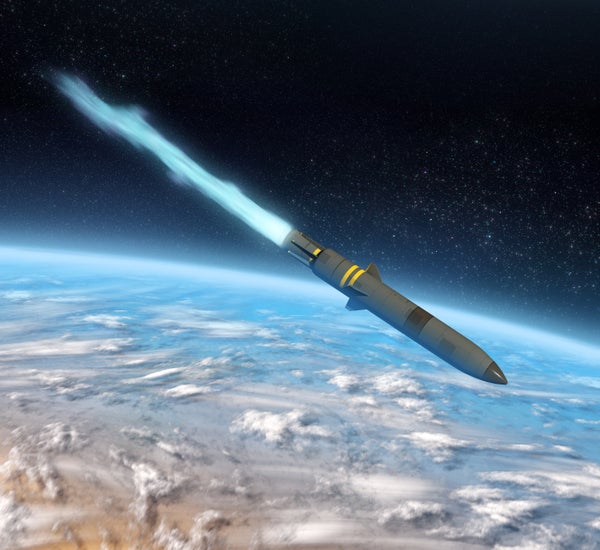
Intercontinental missile in Earth orbit.
Maciej Frolow/Getty Images
For almost 60 years, the world’s most powerful militaries have agreed not to put nuclear weapons into orbit around Earth. But the Outer Space Treaty (OST), ratified in 1967 by the U.S. and Soviet Union as tensions between the two superpowers were at their peak, has no teeth; it’s effectively a gentleman’s agreement. That’s a problem, experts say: while the honor system has held so far, increasingly suspicious moves by Russia and the growing number of satellite targets mean a stronger policing of orbit is desperately needed.
“The reason this is under pressure is that the U.S. heavily depends on space capabilities for military power, and Russia, in particular, is exploring how to take those space capabilities away,” says Jeffrey Lewis, a nuclear nonproliferation expert and a distinguished fellow at the Foreign Policy Research Institute.
“They seem to be considering mass kill [of satellites] in orbit, and if you think about it, what’s the easiest way to get rid of all those Starlink satellites? It would be to detonate a small number of nuclear weapons.”
If you're enjoying this article, consider supporting our award-winning journalism by subscribing. By purchasing a subscription you are helping to ensure the future of impactful stories about the discoveries and ideas shaping our world today.
Now a nuclear physicist thinks he might know how to protect against such a threat: in a paper published on Wednesday in Nature, nuclear scientist Areg Danagoulian describes a system to detect secreted nuclear weapons in space using the interactions between uranium and charged particles in Earth’s magnetic field. It could act as an early warning system, finally giving the OST an objective verification system that doesn’t rely on diplomacy.
When the OST was signed, nuclear war wasn’t an idle possibility but felt likely, and both the U.S. and Soviet Union worried that the other would use their nascent orbital capabilities to rain down hellfire from the heavens. Since then, the threat has changed. Weapon delivery systems such as intercontinental ballistic missiles (ICBMs) have improved, and the worry isn’t that space-based nukes might take out targets on Earth. Instead security experts fear that the weapons could instead target the growing space-based military and communications infrastructure.
While such a detonation would likely damage Russia’s space capabilities as well, Lewis argues that the Kremlin’s calculation may be that Russia “is probably better off in a world in which no one has space capabilities than a world in which the U.S. has dramatically better weapons.”
The concern that Russia could deploy this kind of antisatellite weaponry has mounted throughout the war in Ukraine, particularly following the February 2022 launch of Russia’s Kosmos 2553 satellite. While the Kremlin says the satellite is part of a radar system, the U.S. has alleged that, while not a weapon itself, Kosmos 2553 is designed to help develop a nuclear antisatellite system.
Kosmos 2553 began to spin out of control in April 2025 and is believed to currently be nonoperational. Even so, the saga amplified concerns among nuclear security experts over the need to have a way of verifying OST compliance.
Danagoulian, an associate professor at the Massachusetts Institute of Technology, believes the answer lies in detecting the interaction between uranium atoms and high-energy cosmic-ray particles. The area of space occupied by satellites is filled with high-energy protons, and when they strike atoms of uranium—the element used in many nuclear weapons—it causes a process known as spallation, in which the collisions lead to the ejection of neutrons.
“If you detect those neutrons, that itself can be a telltale sign that there is an unusual amount of uranium on the satellite, and it’s most likely to be a nuclear weapon,” Danagoulian says.
It’s not a simple idea, Danagoulian says. The neutrons’ signal is weaker the farther away you are from the source, and the high amount of protons, electrons and gamma radiation shooting around in low-Earth orbit can create a lot of background noise.
“It’s not easy, but we believe that it can be done,” Danagoulian says.
To accomplish the goal, Danagoulian proposed a satellite fitted with a detector array constructed of pixels. Each pixel measures around a centimeter squared and is covered by a form of diamonds. The diamonds are “very good at detecting charged particles, such as electrons and protons, but are essentially transparent to neutrons,” he says. “If a neutron comes in, it’s not going to interact with the diamond, but it will interact with an internal neutron detector.”
While the diamonds help filter out all the background particles, the detector also needs to be able to differentiate between neutrons coming from a potential weapon and neutrons that are just bouncing off of Earth. To solve that problem, Danagoulian proposes installing a device known as a neutron scatter camera, which traces the location of a neutron over the course of just a fraction of a second to determine which direction it came from.
Lewis says Danagoulian’s proposal could work in theory, but he points to a major shortcoming: in order to detect weapons-grade uranium with a high degree of certainty, the detection system would need to be within around four kilometers (about 2.5 miles) of the suspected weapon. In the context of space, that essentially means the detector and the weapon would need to be right next to each other.
The detector would also need to observe the suspicious satellite for as long as a week to get an accurate reading. Beyond any logistical hurdles, Lewis says this kind of satellite shadowing could have political repercussions back on Earth.
Geopolitics aside, Danagoulian says his work has received encouragement from colleagues on “the other side of the fence” of national security, who say his verification proposal is “a valuable thing to work on.”
“Our hope is that as we are publishing this paper, people who work on classified research can take this and can modify it,” Danagoulian says. “Hopefully this leads us to a working solution.”
此内容由惯性聚合(RSS阅读器)自动聚合整理,仅供阅读参考。 原文来自 — 版权归原作者所有。