


The hominins may have gone on adventures, but they lacked key skills of modern humans
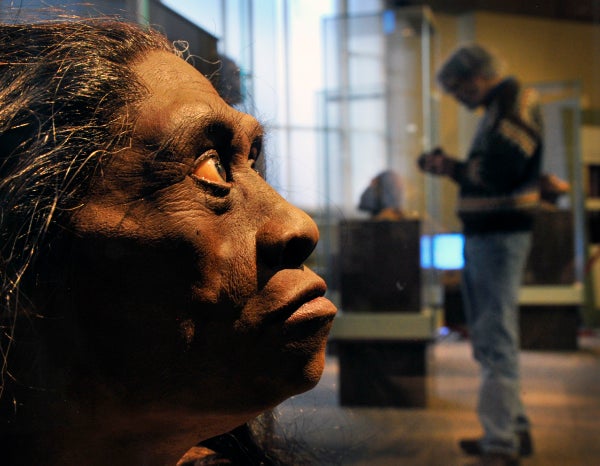
For two decades, scientists thought this ancient human could hunt and start fires. Now, a new study claims they could do neither.
The Washington Post/Contributor/Getty Images
An ancient human ancestor called Homo floresiensis was likely a scavenger who subsisted on the scraps left behind by the fearsome Komodo dragons that shared their home on the island of Flores in Indonesia. That’s the key takeaway from a new study that challenges previous evidence that suggested these ancient hominins, nicknamed “hobbits” in a nod to the J.R.R. Tolkien creatures, could hunt large prey and start fires.
When scientists first discovered H. floresiensis fossils on Flores, one of the islands that make up Indonesia, two decades ago, they speculated that the short, small-brained hominins may have been closely related to another ancient human, Homo erectus. This was supported by the bones of an apparently murdered Stegodon, an extinct species of elephant, and burnt remains in the cave where the hobbit fossils were found—leading scientists to believe they were able to hunt and used fire.
But the new study, publishede today in Science Advances, claims that hobbits did neither of those things.
If you're enjoying this article, consider supporting our award-winning journalism by subscribing. By purchasing a subscription you are helping to ensure the future of impactful stories about the discoveries and ideas shaping our world today.
Instead the authors claim that Komodo dragons actually ate the Stegodon, and the hobbits scavenged on the reptiles’ leftovers. To prove this, they fed goat carcasses to Komodo dragons at a zoo and compared the bite marks on those bones to marks found on the bones of the Stegodon.
This method of taphonomy—the technical term for the study of what happens to organisms after death—offers a “smoking gun of who did what,” says Briana Pobiner, a paleoanthropologist at the Smithsonian National Museum of Natural History and a co-author on the study.
“It’s a great example, in many ways, of going back to study a fossil assemblage that hadn’t been studied with these taphonomic methods in more detail,” she says. “The more we do this, the more we’re able to answer or clarify or overturn some ideas that have been out there for a while.”
The researchers also studied roughly 4,500 rodent bones found in the cave and discovered no burns or evidence of fire. The burnt bones that had been discovered alongside the hobbits, the authors argue, were likely the result of Homo sapiens using the cave at a later date.
Dean Falk, an anthropology professor at Florida State University who was not involved in the research, says the paper is making a “dramatic claim” about assumptions widely shared among scholars since the discovery of the species. The ability of H. florensiensis to hunt and create fire, Falk says, is “what has remained after these 20-some years, and this paper is coming out and saying, ‘Wait a minute. Hold on.’”
Falk notes that the study doesn’t answer every outstanding question about the hobbits, including whether these ancient humans could have hunted Stegodon without cutting through to the bone.
“It’s really interesting, and it will generate more research,” Falk says.
Although Homo floresiensis is an ancient species of human, it isn’t entirely clear how it relates to our own species, H. sapiens, or to other extinct kinds of humans, such as Neanderthals. What we do know is that in different parts of the world, these species existed at the same time, Pobiner says. H. florensiensis appears to have died out on Flores some 50,000 years ago after the arrival of modern humans on the island; at that time, Neanderthals and H. sapiens lived alongside each other in Europe and Asia. (Neanderthals are thought to have gone extinct some 10,000 years later.)
The possibility that Homo floresiensis evolved differently and survived without some of the key behavioral abilities of modern humans offers a new perspective on the human family and our own origins, Pobiner adds.
“There are long-standing misunderstandings about human evolution as being all progressive and that behavioral evolution was linear,” Pobiner says. “This is a good example that our family tree was not a straight line.”
If you enjoyed this article, I’d like to ask for your support. Scientific American has served as an advocate for science and industry for 180 years, and right now may be the most critical moment in that two-century history.
I’ve been a Scientific American subscriber since I was 12 years old, and it helped shape the way I look at the world. SciAm always educates and delights me, and inspires a sense of awe for our vast, beautiful universe. I hope it does that for you, too.
If you subscribe to Scientific American, you help ensure that our coverage is centered on meaningful research and discovery; that we have the resources to report on the decisions that threaten labs across the U.S.; and that we support both budding and working scientists at a time when the value of science itself too often goes unrecognized.
In return, you get essential news, captivating podcasts, brilliant infographics, can't-miss newsletters, must-watch videos, challenging games, and the science world's best writing and reporting. You can even gift someone a subscription.
There has never been a more important time for us to stand up and show why science matters. I hope you’ll support us in that mission.
此内容由惯性聚合(RSS阅读器)自动聚合整理,仅供阅读参考。 原文来自 — 版权归原作者所有。