


AI found a hidden heart-risk signal in 100-year-old ECG technology
A new model flags people at high risk of sudden cardiac death from a routine ECG—and reveals a warning sign in the heart’s electrical activity
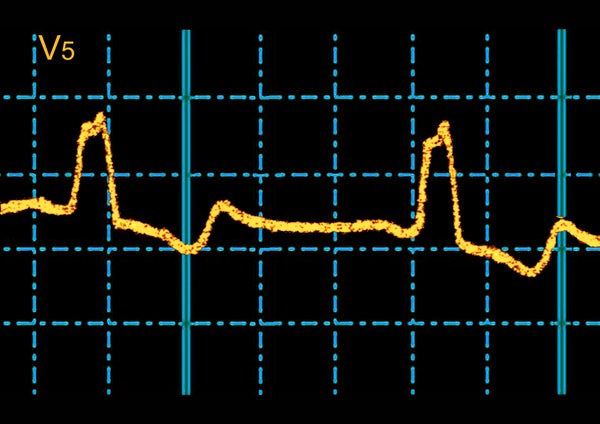
ECGs translate the heart’s electrical activity into a waveform of peaks and valleys. The new study used more than 440,000 such recordings to train and test an AI model.
BSIP/UIG Via Getty Images
Sudden cardiac death kills more than 300,000 people in the U.S. each year, even though implantable defibrillators have been able to stop many lethal arrhythmias for decades. The main issue today isn’t the device that stops a cardiac arrest; it is figuring out who needs one. In a new Nature study, a team led by Ziad Obermeyer, an associate professor at the University of California, Berkeley, trained a neural network to answer that question from a 10-second electrocardiogram. Then they trained a second neural network to reveal what the first was keying on.
The two-model setup points to a larger ambition for AI in medicine: getting a machine to surface a fresh clue that human experts can then see and check for themselves. Obermeyer’s team used the first network to predict risk and the second to translate that prediction into a visible feature on an ordinary ECG, one a cardiologist could learn to spot.
To decide who should get a defibrillator, cardiologists currently lean on an ultrasound measurement of how much blood the left ventricle pumps with each beat—a measure known as left ventricular ejection fraction, or LVEF. Obermeyer points out that it is far from perfect. “A lot of people who suddenly die of cardiac arrest either never had the ultrasound before or they had it and the results were normal,” he says. At the same time, most defibrillators implanted on the strength of that test never end up firing. “Often a person who looked high risk turned out not to be so high risk after all,” Obermeyer says. To get around the problem, his team went looking for a better risk marker.
If you're enjoying this article, consider supporting our award-winning journalism by subscribing. By purchasing a subscription you are helping to ensure the future of impactful stories about the discoveries and ideas shaping our world today.
Electrocardiograms, or ECGs, measure the heart’s electrical activity and are cheap and nearly universal by comparison. Yet despite decades of studying ECG waveforms, cardiologists had never found a pattern that reliably flagged a high risk of cardiac arrest. His team turned to deep learning to find the pattern that human inspection had missed. The algorithm the team picked was a 64-layer residual neural network, or ResNet. “It’s kind of a workhorse model everyone uses. There’s nothing interesting about it,” Obermeyer says. “What is interesting is the data it’s learned from.”
To feed the network, Obermeyer’s group assembled one of the first population-scale datasets of its kind, with more than 440,000 ECGs from roughly 180,000 patients in Sweden, matched to national death certificates. Trained on the Swedish data, the otherwise generic ResNet flagged a high-risk group amounting to about 2.2 percent of patients. The signal held up when the team tested the model on separate datasets from the U.S. and Taiwan, suggesting this wasn’t a quirk of Sweden’s population or ECG equipment. Within that small group, the annual rate of sudden cardiac death reached 7 percent—well above the 4.6 percent rate among patients flagged by the standard ultrasound test. What’s more, more than 86 percent of the patients the algorithm singled out were not flagged by the traditional LVEF marker. By the traditional measure, many patients like these would have been sent home without a defibrillator.
“After we established this thing is working, we wanted to understand what this model is seeing in the ECG waveforms of high-risk people,” Obermeyer says. Standard AI interpretability tools like saliency maps can highlight which parts of a waveform a neural net weighted most heavily, but they stop there. A human cardiologist who spots something unusual on an ECG trace can sketch the anomalous wave. A neural network, by default, cannot. So, Obermeyer and his colleagues built a generative AI model to do just that. “Its job was to produce ECG waveforms that looked high-risk to the first model,” Obermeyer says.
Paired with the original network and guided by its risk score, the generative model reworked a real low-risk patient’s ECG step by step, morphing it smoothly into a high-risk version of the same trace. Many of the features the model keyed on were already familiar to cardiologists.
One feature, though, had never been described in the medical literature: a subtle slurring in one ECG lead called aVL, suggesting that the heart’s electrical signal was fragmenting as it moved through muscle.
Changxin Lai, a biomedical engineer at Johns Hopkins University who wrote an accompanying analysis in Natureand was not involved in the study, says this is why the work stands out. “The ECG has been around for more than 100 years, and this kind of data has been carefully evaluated by generations of cardiologists,” he says. “We extracted new knowledge from an artificial intelligence model.”
For some of the high-risk patients, the team also had cardiac magnetic resonance imaging, or MRI, scans. Those scans showed subtle, diffuse fibrosis, scarring associated with arrhythmias that can interfere with the heart’s electrical signals in a way that fits the synthetic waveforms the generative model produced. Obermeyer cautions that the fibrosis link is preliminary and has yet to be confirmed with biopsies.
The finding, while intriguing, is not ready to guide treatment. “This is an important area of research,” says Sumeet S. Chugh, who directs the Center for Cardiac Arrest Prevention at Cedars-Sinai Medical Center and was not involved in the study. “But from a patient care perspective there is much more research to be done before we will be using such findings to… identify candidates for the primary prevention implantable defibrillator,” he adds.
Even so, Obermeyer thinks the approach is worth pursuing. “There are some very fancy imaging techniques like MRI, but these things are not feasible for screening populations because of their expense and inconvenience,” Obermeyer says. ECGs, he argues, sit at the opposite end of the spectrum; they can be recorded nearly anywhere, with an Apple Watch or a simple device that connects to a smartphone. The team acknowledges that the model was trained on medical-grade ECGs and performs slightly worse on the lower-quality signals from consumer devices, though by a margin they describe as minor.
“I wouldn’t suggest going out and getting a defibrillator implanted just because we say your ECG is high risk,” Obermeyer says. “What’s nice about this is you don’t have to believe the AI at all. You can just use it to target additional testing like doing traditional risk markers.”
此内容由惯性聚合(RSS阅读器)自动聚合整理,仅供阅读参考。 原文来自 — 版权归原作者所有。