


Astronomers have for the first time observed an atmosphere around a giant planet orbiting a white dwarf
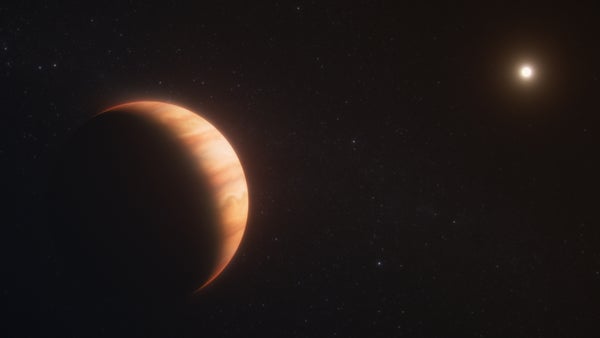
Artist’s concept of the gas giant planet WD 1856 b orbiting a white dwarf star.
NASA, ESA, CSA, Ralf Crawford (STScI)
The universe has a flair for the unlikely. In 2020 astronomers found something baffling: a gas giant planet called WD 1856 b orbiting the burned-out core of a dead, sunlike star.
And in a new study published today in Nature, researchers report an even wilder discovery: not only is WD 1856 b orbiting the glowing corpse of its star but it also has an atmosphere—and it’s still warm.
“It was unlike any other exoplanet spectrum we’ve seen,” says Ryan MacDonald, an astrophysicist at the University of St. Andrews in Scotland and the lead author of the study, “which caused a fair amount of head-scratching in our team.”
If you're enjoying this article, consider supporting our award-winning journalism by subscribing. By purchasing a subscription you are helping to ensure the future of impactful stories about the discoveries and ideas shaping our world today.
To understand why this planet is such a mystery, we first need to explain how our sun will die.
Stars like the sun aren’t massive enough to explode in spectacular supernovae. Instead they start to swell and turn a rusty color, becoming red giants. Then they shed their outer layers and collapse into white dwarfs—stellar embers that are significantly smaller than the original star but still contain much of its mass.
This demise is more of a whimper than a bang. But the corresponding upheaval is still catastrophic for any surrounding planets, which either get swallowed up by the expanding star or drift into wider orbits as the star’s gravity weakens—some are flung out from the system entirely. Yet somehow WD 1856 b survived.
It marks the first closely orbiting white dwarf planet with a confirmed atmosphere, opening up new possibilities for what might happen to planetary systems after their host star dies. A year on WD 1856 b is roughly 34 hours long. This is an orbit so tight that it raises the question of how the planet got there in the first place. Could it possibly have survived being swallowed up by the red giant and then spat back out as it collapsed into a red dwarf?
“There are two theories,” said Christopher O’Connor, a professor at Northwestern University and one of the study’s co-authors, said in a statement. “One is that the planet was swallowed by the host star as it was dying, and managed to survive on the inside. The other is that the migration took place due to the gravitational effect of other objects in the system.”
The answer was hiding in the planet’s heat.
By combining their temperature measurements with the planet’s mass and models of how giant planets cool over time, the astronomers effectively rewound its thermal history.
According to O’Connor’s first theory, the planet would have retained far more heat from when the star went red dwarf than the researchers observed. That suggests the second theory may be correct, and the planet was likely at a safer distance for more than a billion years before migrating inward.
“Each time it makes a close pass by the white dwarf, it would lose a little orbital energy into heat energy, which would make the furthest part of the orbit move a little closer,” MacDonald says. If you were watching with an infrared camera, you’d even be able to see the planet glow at the height of this process.
The study has intriguing implications for our own cosmic future. Roughly five billion years from now, the sun will follow the same path as this star, expanding into a red giant before shrinking into a white dwarf. Earth almost certainly won’t survive. The solar system’s gas giants, however, are another story.
“Jupiter has a long life ahead of it, even after the leftover core of the sun is merely a smoldering ember,” MacDonald says.
If future astronomers are around to study it, they might one day read Jupiter’s atmosphere the same way researchers analyzed WD 1856 b’s—as a fossil record of a planetary system that refused to die.
“Exoplanet science is a never-ending story of reimagining what is possible,” MacDonald says. “Whether a science fiction fan, a scientist or even a kid in school, who doesn’t want to know what will happen when the sun dies?”
If you enjoyed this article, I’d like to ask for your support. Scientific American has served as an advocate for science and industry for 180 years, and right now may be the most critical moment in that two-century history.
I’ve been a Scientific American subscriber since I was 12 years old, and it helped shape the way I look at the world. SciAm always educates and delights me, and inspires a sense of awe for our vast, beautiful universe. I hope it does that for you, too.
If you subscribe to Scientific American, you help ensure that our coverage is centered on meaningful research and discovery; that we have the resources to report on the decisions that threaten labs across the U.S.; and that we support both budding and working scientists at a time when the value of science itself too often goes unrecognized.
In return, you get essential news, captivating podcasts, brilliant infographics, can't-miss newsletters, must-watch videos, challenging games, and the science world's best writing and reporting. You can even gift someone a subscription.
There has never been a more important time for us to stand up and show why science matters. I hope you’ll support us in that mission.
此内容由惯性聚合(RSS阅读器)自动聚合整理,仅供阅读参考。 原文来自 — 版权归原作者所有。