


Trying to kill algae with chemicals is a common response when community ponds or other water features go green, but a freshwater ecologist says there may be safer and more effective solutions
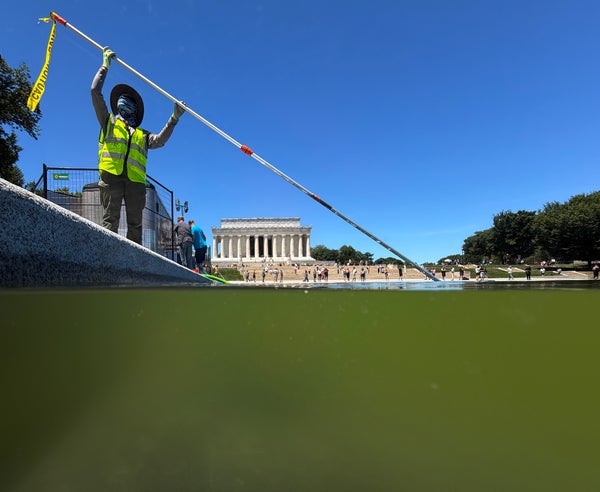
A U.S. National Park Service employee uses a vacuum pump to clean algae off the bottom of the newly repainted Lincoln Memorial Reflecting Pool on the National Mall on June 16, 2026 in Washington, DC.
Chip Somodevilla/Getty Images
The following essay is reprinted with permission from The Conversation, an online publication covering the latest research.
When the Lincoln Memorial Reflecting Pool turned green with algae just days after a US$15 million renovation, the U.S. government scrambled for chemicals and expensive technical solutions to fix the iconic landmark.
Trying to kill algae with chemicals is a common response when community ponds or other water features go green. But as a scientist who studies freshwater ecology, I can tell you there are better solutions that cost far less, last longer and carry less risk of harm to pets and wildlife.
If you're enjoying this article, consider supporting our award-winning journalism by subscribing. By purchasing a subscription you are helping to ensure the future of impactful stories about the discoveries and ideas shaping our world today.
Rather than battling against nature, these alternatives work with nature for long-term solutions.
The algal bloom that turned the Reflecting Pool a vibrant green shouldn’t have been a surprise.
The pool is big, more than a third of a mile long and around 165 feet wide. But it’s shallow, meaning it warms up quickly in the sun. When it was repainted “American flag blue” during the renovations in spring 2026, the new color darkened the pool, and darker colors absorb more heat.
On top of those conditions, the pool was refilled with water from the nutrient-rich tidal basin of the Potomac River. The combination of warm water and nutrients created prime conditions for algae to bloom, turning the water pea soup green.
As the national conversation over the Reflecting Pool shifts to political finger-pointing, an important environmental question deserves careful scrutiny: What is the best approach to maintain water quality in a case like this, whether for a national monument or a community water feature or pond?
Trying to chemically or mechanically remove algae can damage the structure of a water feature and may harm species in the water that could actually help solve the problem.
Importantly, chemical and mechanical solutions are only temporary fixes. When the Reflecting Pool is drained and filled again, there’s a good chance that algae will bloom again.
Limnologists—scientists like me who study inland water bodies—have spent many decades learning why lakes and ponds turn green and how to clear them up.
Often, nutrient-rich waters fueled by fertilizer runoff from farm fields or sewage from cities are the sources that stimulate algal growth.
However, natural ponds also host grazing zooplankton, which eat algae. For example, a type of zooplankton called Daphnia, known as water fleas because of the way these tiny crustaceans swim, can control algae by consuming it before it becomes a pea soup nuisance. Thus, a thriving Daphnia population can help maintain good water quality in a lake, pond or community water feature, even when nutrient levels spike.
In addition to being highly effective grazers, Daphnia have another superpower—they can evolve rapidly. Urban waterbodies are often harsh environments with a variety of challenges, including high temperatures, low levels of dissolved oxygen, and pollutants. Daphnia can adapt to tough conditions, making these creatures an ideal source of algae control in many urban ponds.
Rooted aquatic plants are also useful for algae control in ponds because they absorb nutrients. Thus, shallow ponds with thick beds of aquatic plants can often resist algal blooms when nutrient levels rise.
One downside to draining and refilling a pond or urban water feature to try to clean it is that doing so resets the aquatic ecosystem, erasing the signature of any past evolution that has taken place.
Imagine Daphnia in a shallow pond that experiences periodic heat waves throughout the summer. Through repeated exposure to high temperatures, natural selection favors heat-resistant genotypes that can thrive in an urban pond.
Daphnia and other grazing zooplankton can also evolve resistance to some types of cyanobacteria, also known as blue-green algae, which produce compounds that are toxic to people and pets. Daphnia that evolve resistance to those toxins can help control harmful cyanobacterial blooms.
If a Daphnia population that evolved to tolerate warm temperatures, low oxygen levels or cyanotoxins is removed, the new population likely won’t be ready to handle those local challenges. This evolutionarily naive population will perform poorly in its new environment, reducing its effectiveness at controlling algal blooms.
As a result, traditional mechanical and chemical approaches may actually work against the goal of minimizing algae in ponds and other water features.
The use of Daphnia to control algal blooms is just one example of solving environmental challenges with nature-based solutions.
Growing urban forests to provide cooling and improve air quality to help reduce the need for more energy-intensive air conditioning is another example. Maintaining urban wetlands can help reduce flooding, protect property and recharge groundwater more effectively and for less money than building and maintaining levees. Coastal marshes similarly reduce erosion, buffer storm surges and support fisheries.
All these urban ecosystems protect biodiversity and support human health and well-being.
From national landmarks to city parks and backyard ponds, projects of all sizes can take advantage of nature-based solutions. While each specific project is unique, some general principles apply.
Ecosystems are most resilient when they are diverse and connected. So, it is beneficial to use a variety of species and genotypes and provide corridors that support the movement of organisms and their beneficial genes.
Urban climates are changing rapidly, so it helps to use species and genotypes that will thrive under future conditions, including rising temperatures.
The hubbub over the Reflecting Pool holds a mirror up to assumptions about how to solve pressing environmental challenges. The idea of just engineering one’s way out of any environmental crisis has limits.
Understanding ecology and nature’s mechanisms of ecosystem resilience can achieve sustainable solutions that benefit both nature and people.
This article was originally published on The Conversation. Read the original article.
If you enjoyed this article, I’d like to ask for your support. Scientific American has served as an advocate for science and industry for 180 years, and right now may be the most critical moment in that two-century history.
I’ve been a Scientific American subscriber since I was 12 years old, and it helped shape the way I look at the world. SciAm always educates and delights me, and inspires a sense of awe for our vast, beautiful universe. I hope it does that for you, too.
If you subscribe to Scientific American, you help ensure that our coverage is centered on meaningful research and discovery; that we have the resources to report on the decisions that threaten labs across the U.S.; and that we support both budding and working scientists at a time when the value of science itself too often goes unrecognized.
In return, you get essential news, captivating podcasts, brilliant infographics, can't-miss newsletters, must-watch videos, challenging games, and the science world's best writing and reporting. You can even gift someone a subscription.
There has never been a more important time for us to stand up and show why science matters. I hope you’ll support us in that mission.
此内容由惯性聚合(RSS阅读器)自动聚合整理,仅供阅读参考。 原文来自 — 版权归原作者所有。