

惯性聚合 高效追踪和阅读你感兴趣的博客、新闻、科技资讯
阅读原文 在惯性聚合中打开

推荐订阅源

A
About on SuperTechFans
G
Google Developers Blog
L
LangChain Blog
aimingoo的专栏
aimingoo的专栏
OSCHINA 社区最新新闻
OSCHINA 社区最新新闻
云风的 BLOG
云风的 BLOG
小众软件
小众软件
月光博客
月光博客
Recent Announcements
人人都是产品经理
人人都是产品经理
P
Proofpoint News Feed
博客园 - 聂微东
让小产品的独立变现更简单 - ezindie.com
雷峰网
雷峰网
The Cloudflare Blog
博客园_首页
美团技术团队
大猫的无限游戏
大猫的无限游戏
B
Blog
IT之家
IT之家
Jina AI
Jina AI
H
Hackread – Cybersecurity News, Data Breaches, AI and More
C
Check Point Blog
钛媒体:引领未来商业与生活新知
钛媒体:引领未来商业与生活新知

Space - CBSNews.com

Full interview: NASA administrator Jared Isaacman on moon base plans, Artemis III, more Space station crew briefly moves to "safe haven" amid concerns over leaks NASA declares end of mission for long-lasting Mars orbiter Blue Origin vows to resume New Glenn launches before end of year in wake of massive explosion NASA taps 2 companies to develop buggies for its moon base program A look at lunar rovers for NASA's planned Moon Base Blue Origin explosion sparks space race concerns Blue Origin explosion could impact space race position against China Blue Origin explosion threatens to delay NASA's moon program Blue Origin rocket explodes in spectacular fireball A rare blue micromoon arrives this weekend and won't be back until December 2028. Here's what to expect. NASA's moon base plans include landers, buggies and drones for 2028 mission China launches Shenzhou 23 spacecraft carrying 3 astronauts, including 1 set to remain in space for a year SpaceX launches revamped Super Heavy-Starship rocket ahead of IPO SpaceX launches more powerful Super Heavy-Starship rocket on test flight Musk's SpaceX scrubs latest test launch of massive Starship rocket SpaceX launch of more powerful Super Heavy-Starship rocket scrubbed at last minute over technical issue SpaceX plans to explore "the true nature of the universe" as it preps for mega IPO SpaceX launches Dragon cargo ship on unpiloted flight to space station NASA maps show Earth's brightest and darkest regions at night NASA spacecraft to fly past Mars this week, on voyage to rare metal asteroid UFO files reveal Apollo 17 crew saw mysterious objects, lights during 1972 mission: Pentagon begins releasing new UFO files, unveiling dozens of photos, videos and documents The government Mysterious world beyond Pluto may have an atmosphere, astronomers say Inspiring and funny moments from Artemis II astronauts' town hall CBS News Things That Matter: A Town Hall with the Artemis Astronauts Artemis II crew gives 5-year-old aspiring astronaut Commander Jack a new spacesuit: "It says NASA!" What's next for the Artemis missions and potential return to the moon Astronaut Christina Koch details broken toilet ordeal, "great" showers in space
Sun erupts with 3 huge solar flares, increasing chances o...
Emily Mae Czachor · 2026-06-05 · via Space - CBSNews.com

By

Emily Mae Czachor

News Editor

Emily Mae Czachor is a reporter and news editor at CBSNews.com. She typically covers breaking news, extreme weather and climate. Emily Mae previously wrote for outlets like the Los Angeles Times, BuzzFeed and Newsweek.

Read Full Bio

/ CBS News

Add CBS News on Google

Three solar flares burst from the sun toward Earth this week, scientists said, and the enormous beams of energy, light and high-speed particles may increase the odds of seeing the northern lights for people across the United States as they travel closer to our planet.

Solar flares are giant eruptions of electromagnetic radiation, including X-rays and ultraviolet light, which launch into space off the sun's surface, according to NASA. The explosions are often associated with solar magnetic storms, also known as coronal mass ejections, and they can significantly disrupt technology on Earth if pointed in its direction.

The trio of flares that left the sun a couple of days ago were each expelled from the star at slightly different angles, all within a 24-hour period, according to the National Weather Service's Space Weather Prediction Center. The center predicts that the three of them will catch up to one another and combine before reaching Earth.

"There is a fair level of confidence about an Earth arrival," it said in an advisory. 

However, it noted that the intensity of the flares, and the extent to which they could impact Earth, remained uncertain. Scientists measure the strength of geomagnetic storms on a scale of 1 to 5, ranking from "minor" to "extreme." This one is expected to fall somewhere in the middle, with forecasters suggesting it will be either "strong" or "severe."

NASA said the powerful solar flare peaked just before 7:30 a.m. ET on Wednesday. It published an image of the fiery event, which shows the flare as a bright flash of light against the sun's darker silhouette. The space agency said this flare was classified as "X1.0," with X-class used to describe the largest and most intense flares.
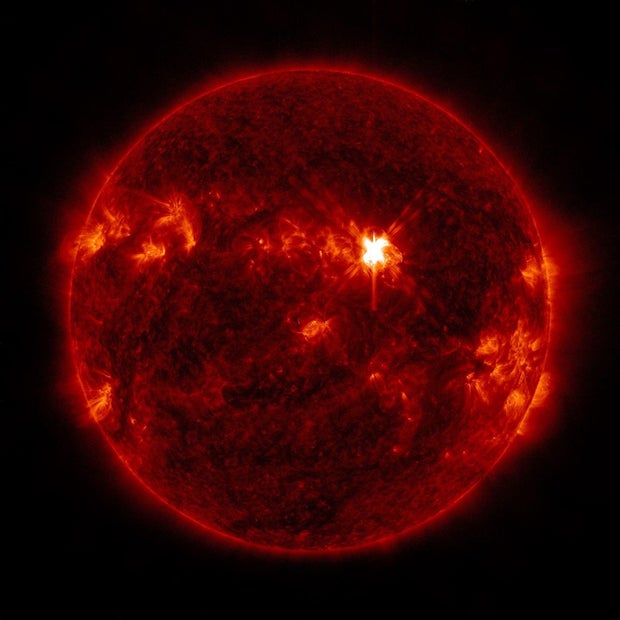
solar-flare-nasa.jpg
NASA captured this photo of a solar flare, which appears in the image as a bright flash of light, on June 3, 2026. NASA/SDO

Solar flares and geomagnetic storms are capable of impacting telecommunications and satellite systems on Earth, potentially meddling with radios, electric power grids and navigation systems, NASA has warned. They also may damage spacecraft and pose possible safety threats to astronauts.

Flares may also give way to spectacular displays of the aurora borealis, or northern lights, for people in the U.S. on Thursday and Friday. Northern lights are linked to geomagnetic storms, and strong storms have in the past produced northern lights well below the latitudes where they can normally be seen. In May 2024, one record storm caused northern lights as far south as Mexico.

In: