





As the four Artemis II astronauts closed in on the moon, they took time to send Easter greetings to Earth and had their own version of an egg hunt.
Artemis II commander Reid Wiseman, Victor Glover and Christina Koch on Sunday presented "astronaut wings" to Canadian crewmate Jeremy Hansen, making his first space flight, before getting down to work carrying out planned tests of new Artemis pressure suits. But first, Koch passed along Easter greetings to flight controllers.
"This time of year is something that many religions and many cultures hold dear," Koch said. "It's a time of emotions such as joy, as well as solemnness, honoring what's going on both in our world and in our religious beliefs."
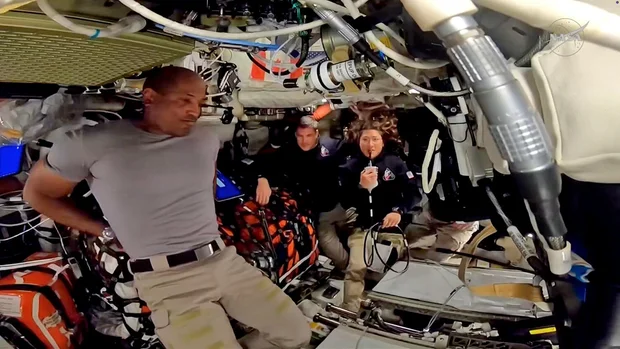
"Another aspect of that is our family tradition ... If I was on the Earth right now, I would be with my family in Houston and we would be hiding confetti eggs in the backyard and watching two very sweet little girls go try to find them."
Koch said the crew had hidden eggs around the cabin to mark the holiday. "They were the dehydrated scrambled egg variety," she added, "but we're all pretty happy with them."
Overnight Saturday, Koch said the crew had switched from measuring their increasing distance from Earth to tracking their decreasing distance to the moon. At the time she spoke, the Orion spacecraft was 76,362 nautical miles from the moon and 168,000 miles from Earth.
The trip around the moon so far has yielded unexpected detail on its surface, giving scientists a taste of things to come when they pass over the lunar far side Monday.
The two major goals of the Artemis II flight are to thoroughly test the Orion moonship and to work through the procedures and techniques needed to safely guide future crews to the moon. The Artemis II crew also plans a full agenda of science observations when they pass behind the moon's far side Monday afternoon and evening.
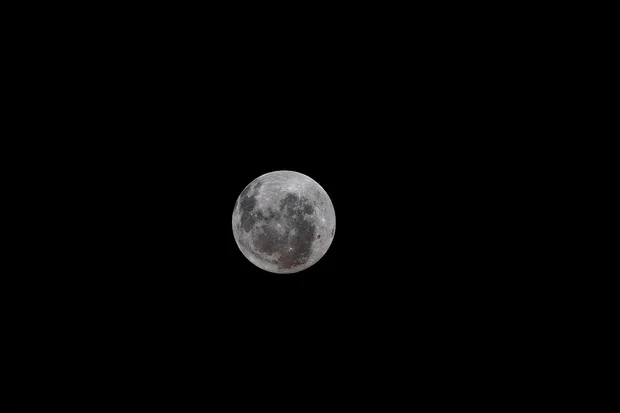
Looking at the moon overnight Saturday, Koch told flight controllers "the moon we are looking at is not the moon you see from Earth," adding that even some 75,000 miles from their target, they could easily discern topography and subtle differences in brightness.
She said Glover was "absolutely mesmerized" by a vast basin where "you can actually see the terrain. It's not an albedo change, it's not shadows. You can actually just tell that they are terrain features of the multi-ringed crater there."
Glover initially thought the structure was Mare Orientale, or "Eastern Sea," a high-priority target that straddles the terminator separating the side of the moon facing Earth and the normally unseen far side.
But Jacki Mahaffey in mission control replied that "we think based on your description of the basin that you saw, that is (Mare) Imbrium."
"Yes, that sounds right," Koch agreed. "I've never noticed that Imbrium has such a distinctive high albedo ring defining it. Also worth mentioning, we do apparently have a full moon. We can't detect any terminator at all. It looks like full limb all the way around."
Mare Imbrium, or the "Sea of Rain," has a diameter of 710 miles, one of the moon's largest "seas," or maria, formed by a massive impact event several billion years ago. It is surrounded by mountains that were formed by the impact.
Artemis II commander Reid Wiseman agreed the view of the moon was spectacular, even at a great distance.
"I'm not one for hyperbole, but it's the only thing I could come up with just seeing (the crater) Tycho, there's mountains to the north, you can see Copernicus ... it's just everything from the training, but in three dimensions and absolutely unbelievable. This is incredible."
"Moon joy," replied Mahaffey.
Before going to bed, the astronauts were told engineers had restored Orion's toilet to normal operation after trouble earlier dumping stored urine overboard.
"At this time you are go for all types of uses of the toilet," mission control radioed.
"And the crew rejoices!" Koch said. "Thank you!
Wiseman, Glover, Koch and Hansen were launched Wednesday and, after spending a full day checking out the Orion spacecraft, the ship left Earth orbit Thursday and headed for the moon.
The crew has had intermittent problems with their space toilet since launch, occasionally being told to avoid its use in favor of "contingency collapsible urinals," or CCUs, plastic containers used for urine collection that can be vented to space later. Each crew member has two of the devices.
The crew began Easter Sunday in space with a wakeup call featuring CeeLo Green's "Working Class Heroes" and a recorded message from retired astronaut Charlie Duke.
"Hello Reid, Victor, Christina and Jeremy. This is Apollo 16 astronaut Charlie Duke," he radioed. "John Young and I landed on the moon in 1972 in a lunar module we named Orion. I'm glad to see a different kind of Orion helping return humans to the moon.
"Thanks to you and the whole team on the ground for building a family. I pray it reminds you that we in America and all of the world are cheering you on. Thanks to you and the whole team on the ground for building on our Apollo legacy with Artemis. Godspeed and safe travels home."
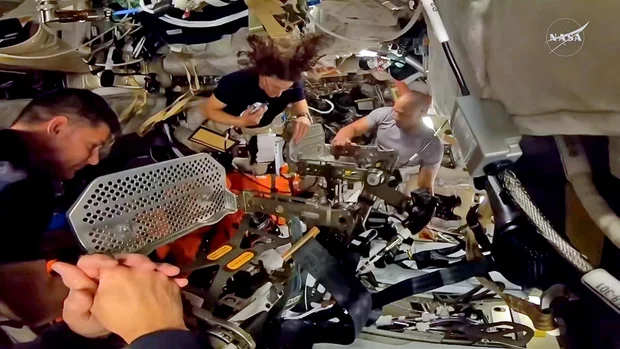
The crew's primary objective Sunday was to work with their bright orange pressure suits, designed to keep an astronaut alive for more than six days if their spacecraft lost air pressure or suffered some other sort of catastrophic failure.
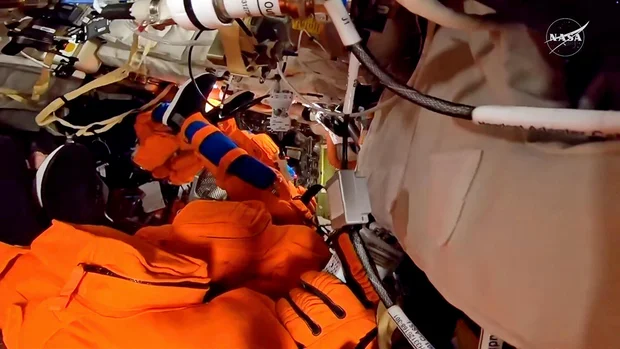
Wiseman and his crewmates planned to put on their suits in the cramped confines of the Orion capsule to give flight controllers a better idea of how fast they can be donned in an emergency.
They planned to pressurize the suits, practice getting into and out of their seats while suited, assess their ability to move about and to eat and drink using dispensers in the suit's helmet.
Early Monday, NASA said Artemis II officially entered the lunar sphere of influence at 12:38 a.m. EDT. So lunar gravity was exerting more of a pull on the spacecraft than Earth's.
The astronauts will reach a distance of 248,655 miles from Earth at 1:56 p.m. Monday, passing a record set by the crew of Apollo 13 in 1970. Wiseman and company will fly behind the moon and out of contact with Earth for about 40 minutes starting at 6:47 p.m. Monday.
While out of contact, the crew will pass within about 4,070 miles of the lunar surface at close approach and set a new distance record of 252,760 miles three minutes later. They'll fly back into contact with Earth at 7:27 p.m.
But they will be able to observe far side features well before and after passing directly behind the moon and even witness a solar eclipse as the moon passes in front of the sun from their perspective.
"We have amazing camera data from decades of orbiting spacecraft," said Kelsey Young, a member of the Artemis lunar science team.
"However, the human eye, especially when it's connected to a well-trained brain — which I assure you these four people have — are capable of in the blink of an eye making nuanced color observations that Apollo observations told us can tell us something scientifically."
In:
此内容由惯性聚合(RSS阅读器)自动聚合整理,仅供阅读参考。 原文来自 — 版权归原作者所有。