








By
Emily Mae Czachor
News Editor
Emily Mae Czachor is a reporter and news editor at CBSNews.com. She typically covers breaking news, extreme weather and climate. Emily Mae previously wrote for outlets like the Los Angeles Times, BuzzFeed and Newsweek.
/ CBS News
A NASA spacecraft headed toward the asteroid belt will fly past Mars on Friday, aiming to get a boost from the planet's gravitational field and save some of the propellant it needs to complete the second half of a six-year voyage.
The spacecraft, called Psyche after the rare asteroid it will explore, launched in October 2023. At the time, it set out on a 2.2-billion-mile journey to the metal-rich celestial rock, which scientists believe may hold clues about how the cores of planets like Earth initially formed.
Psyche will travel quite close to Mars, coming within just 2,800 miles of the red planet's surface at its nearest point, according to NASA. Slingshotting past at about 12,333 miles per hour, the spacecraft "will harness the planet's gravitational pull to speed up and adjust its trajectory" toward the asteroid, the agency said.
The asteroid that scientists have described as a "metal world" and "one of the more unusual objects in our solar system" sits in the asteroid belt between Mars and Jupiter. NASA's explorer is expected to approach and begin orbiting the ultimate target of its mission at the end of 2029.
But the spacecraft will take advantage of the opportunity to observe Mars in the meantime. The team operating it has already released an image of the planet from about 3 million miles away.
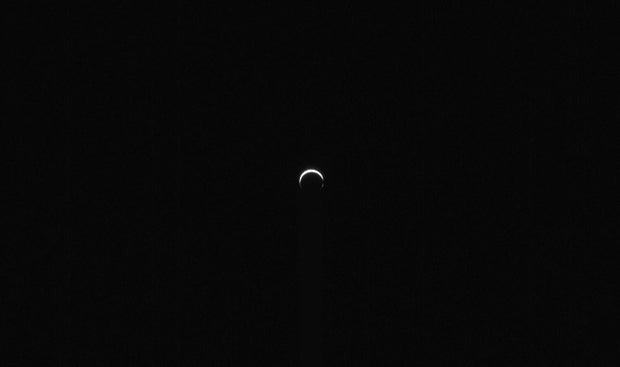
NASA said the operators plan to use the observations taken during Friday's flyby to compile a time-lapse of the encounter. One of them, Jim Bell of Arizona State University, said in a statement that Mars may not have its characteristic reddish hue in some of the images, although he still anticipates they'll be "just plain beautiful."
The spacecraft will also be able to test a satellite feature that it could eventually use to search for objects in the asteroid Psyche's orbit.
"Ultimately, though, the only reason for this flyby is to get a little help from Mars to speed us up and tilt our trajectory in the direction of the asteroid Psyche," said Lindy Elkins-Tanton, a lead investigator on the spacecraft's operations teams, in another statement. "But if all our instruments are powered up, and we can do important testing and calibration of the science instruments, that would be the icing on the cake."
Only a small portion of the objects floating in the asteroid belt are believed to be rich in metal like the asteroid Psyche, which scientists believe contains nickel and iron. They suspect it may be the exposed core of a rocky planet, potentially offering insights the formations and evolutions of planets like our own, according to NASA's mission overview.
Once in the asteroid's orbit, NASA's spacecraft is slated to take pictures of the asteroid's surface and shed light on its composition, over the course of about two years.
William Harwood contributed to this report.
In: