


惯性聚合 高效追踪和阅读你感兴趣的博客、新闻、科技资讯
阅读原文 在惯性聚合中打开

推荐订阅源

大猫的无限游戏
大猫的无限游戏
Webroot Blog
Webroot Blog
cs.AI updates on arXiv.org
T
Threat Research - Cisco Blogs
V2EX - 技术
V2EX - 技术
L
LINUX DO - 热门话题
Google DeepMind News
Recorded Future
Recorded Future
S
Schneier on Security
I
InfoQ
Cyber Security Advisories - MS-ISAC
cs.CV updates on arXiv.org
The GitHub Blog
The GitHub Blog
S
Security @ Cisco Blogs
O
OpenAI News
W
WeLiveSecurity
Vercel News
Vercel News
阮一峰的网络日志
阮一峰的网络日志
Simon Willison's Weblog
人人都是产品经理
人人都是产品经理
Cloudbric
Cloudbric
The Last Watchdog
The Last Watchdog
The Hacker News
The Hacker News
Google Online Security Blog
OSCHINA 社区最新新闻
OSCHINA 社区最新新闻
GbyAI
GbyAI
NISL@THU
NISL@THU
T
Tailwind CSS Blog
V
Visual Studio Blog
PCI Perspectives
PCI Perspectives
K
KPMG report finds enterprise disconnect between AI and its ROI | CIO
Jina AI
Jina AI
D
DataBreaches.Net
B
Blog RSS Feed
N
News and Events Feed by Topic
N
News and Events Feed by Topic
H
Heimdal Security Blog
cs.CL updates on arXiv.org
腾讯CDC
Latest news
Latest news
V
Vulnerabilities – Threatpost
Hacker News: Ask HN
Hacker News: Ask HN
WordPress大学
WordPress大学
V
V2EX
aimingoo的专栏
aimingoo的专栏
博客园 - 司徒正美
Apple Machine Learning Research
D
Darknet – Hacking Tools, Hacker News & Cyber Security
The Register - Security
Help Net Security
Help Net Security

Space - CBSNews.com

Space station crew briefly moves to "safe haven" amid concerns over leaks Sun erupts with 3 huge solar flares, increasing chances of northern lights across U.S. NASA declares end of mission for long-lasting Mars orbiter Blue Origin vows to resume New Glenn launches before end of year in wake of massive explosion NASA taps 2 companies to develop buggies for its moon base program A look at lunar rovers for NASA's planned Moon Base Blue Origin explosion sparks space race concerns Blue Origin explosion could impact space race position against China Blue Origin explosion threatens to delay NASA's moon program Blue Origin rocket explodes in spectacular fireball A rare blue micromoon arrives this weekend and won't be back until December 2028. Here's what to expect. NASA's moon base plans include landers, buggies and drones for 2028 mission China launches Shenzhou 23 spacecraft carrying 3 astronauts, including 1 set to remain in space for a year SpaceX launches revamped Super Heavy-Starship rocket ahead of IPO SpaceX launches more powerful Super Heavy-Starship rocket on test flight Musk's SpaceX scrubs latest test launch of massive Starship rocket SpaceX launch of more powerful Super Heavy-Starship rocket scrubbed at last minute over technical issue SpaceX plans to explore "the true nature of the universe" as it preps for mega IPO SpaceX launches Dragon cargo ship on unpiloted flight to space station NASA maps show Earth's brightest and darkest regions at night NASA spacecraft to fly past Mars this week, on voyage to rare metal asteroid UFO files reveal Apollo 17 crew saw mysterious objects, lights during 1972 mission: Pentagon begins releasing new UFO files, unveiling dozens of photos, videos and documents The government Mysterious world beyond Pluto may have an atmosphere, astronomers say Inspiring and funny moments from Artemis II astronauts' town hall CBS News Things That Matter: A Town Hall with the Artemis Astronauts Artemis II crew gives 5-year-old aspiring astronaut Commander Jack a new spacesuit: "It says NASA!" What's next for the Artemis missions and potential return to the moon Astronaut Christina Koch details broken toilet ordeal, "great" showers in space 5-year-old boy gets special gift; Artemis astronauts reveal if you can burp in space Bill Nye demonstrates experiments that break down Artemis II mission Victor Glover opens up about being first person of color to fly to or around moon Artemis astronauts talk "bird bath" showers, space exploration dream and more Watch: Artemis II crew surprises 5-year-old aspiring astronaut with new spacesuit Artemis astronauts reveal hopes for space exploration and if they would go back again Ron Howard, Artemis astronauts joke about bathrooms while recalling "Apollo 13" film's impact Reid Wiseman's advice to students: "Find your gift and share that with the world" Artemis astronauts talk food on mission and what they couldn't eat Christina Koch describes how Artemis mission was different from going to the ISS Artemis II crew reveals what they ate right after splashdown: "I got some peanut M&Ms, anybody want some?" Artemis II astronauts talk mission toilet troubles: "We made do" Artemis astronauts reveal the candy they ate immediately after splashdown Artemis II crew addresses toilet malfunction during spaceflight Astronaut Jeremy Hansen says "it's not that we never fail" but "we never stop there" "Apollo 13" director Ron Howard to Artemis crew: "What you accomplished was extraordinary" Artemis astronauts asked about most memorable moment, toughest decision made on moon mission 5-year-old aspiring astronaut Jack says "it was fun" to watch historic Artemis launch Artemis astronauts describe "spectacular" moon mission, eating peanut M&M's after splashdown Artemis commander Reid Wiseman describes "dramatic and important warning" while on mission Artemis astronaut Jeremy Hansen on what he missed about gravity: "Nothing" Artemis' Christina Koch says real heroes are "people on the ground" working on mission Artemis crew tells kids at town hall, moon flight was "the best roller coaster ride you've ever been on" Artemis' Victor Glover says seeing Earth in "one glance" is "very special perspective" Artemis astronauts on readjusting to gravity, capturing photos from space: "It's spectacular" Artemis astronaut Victor Glover describes his thoughts in final seconds before liftoff SpaceX launches high-power ViaSat internet satellite in rare flight of Falcon Heavy rocket Amanda Nguyen on her decision to bring the hospital band from her sexual assault to space Mars rover carries out chemistry experiment never done beyond Earth, discovers more building blocks of life In its third flight, a Blue Origin New Glenn rocket puts satellite payload into wrong orbit The youngest man to walk on the moon reflects on U.S. space exploration Artemis astronaut says "we can do amazing things" as he reflects on how mission united humanity Artemis II crew on historic moon mission and what it means for Earth: "We can do amazing things" Artemis II astronaut describes "the most unique thing" he saw on the far side of the moon Artemis II astronauts still awed by moonshot experience: "It was otherworldly" Artemis II reentry image raises questions online about heat shield "God of chaos" asteroid will pass close to Earth in 3 years, NASA says Artemis II astronauts reflect on historic mission around far side of the moon Recapping the historic Artemis II mission around the moon Artemis II astronauts welcomed home to Houston after historic moonshot Artemis II crew returns to Houston after successful mission What's next for space exploration after successful Artemis II mission Artemis II crew successfully splashes down in Pacific, ending historic moon mission Artemis II crew set for splashdown after historic journey around the moon NASA drops Artemis II moon mission playlist. These are the astronauts' wake-up songs. Artemis II crew splashes down near San Diego after historic moon mission 9 highlights from Artemis II's epic journey around the moon How an 8-year-old designed a zero-gravity indicator for Artemis II As Artemis II heads back to Earth, crew stakes their lives on the heat shield NASA crew on any concerns about Artemis II reentry: "We've done our homework" Artemis II crew talks about trip's highlights as they head toward Earth: "Quite an impressive sight" Artemis II astronauts reflect on historic flight as they wrap up moon mission NASA releases more dazzling photos, moonshots from Artemis II See stunning images taken by the Artemis II crew as they looped around far side of the moon Stunning photos from Artemis II show Earth, moon, eclipse from space Artemis II crew headed back to Earth after lunar flyby Artemis II crew completes record-breaking trip around the moon and sees "unreal" solar eclipse Artemis II travels around far side of the moon How Artemis II astronauts prepared to study the moon during the lunar flyby Artemis II set to make historic loop around the moon Artemis II astronauts find hidden eggs on Easter Sunday as they close in on the moon Artemis II crew capture new photo of far side of the moon Artemis II crew stunned by views as they ready to loop around far side of moon Artemis II astronauts speak during historic lunar mission Moon-bound Artemis II crew reflects on wonder of deep space experience: "You are special in all of this emptiness" Artemis II astronauts share message for the planet: "You're on a spaceship called Earth" What astronauts are eating on the Artemis II mission Artemis II crew passes halfway point to moon, shares new photos of Earth NASA shares first photos of Earth taken by Artemis II: "Hello, World" Moon-bound Artemis II astronauts enjoy a relaxed day in space, spectacular Earth views
Interstellar comet that zoomed past Earth could be oldest and coldest object ever seen in solar system, astronomers say
2026-06-23 · via Space - CBSNews.com

/ CBS/AFP

Add CBS News on Google

An interstellar comet that blazed past the sun and swung by Earth last year could be nearly three times older than our solar system and is unlike anything ever before seen in our cosmic backyard, astronomers said Monday.

The comet 3I/ATLAS is just the third visitor from beyond our solar system that humanity has ever observed, its unusual brightness offering scientists an unprecedented opportunity to study something that came from elsewhere in the galaxy.

After being spotted in July last year, the space rock prompted excitement online, with one prominent Harvard researcher speculating it could be an alien spacecraft — a theory that NASA shot down.

Now, observations by the world's most powerful telescopes are revealing more about the unique comet.

According to a new study published Monday in the journal Nature, 3I/ATLAS could be up to 12 million years old. Our solar system is believed to have formed around 4.5 billion years ago.

Lead study author Martin Cordiner of NASA's Goddard Space Flight Center told AFP that "maybe it's the oldest object to have been observed in our solar system."
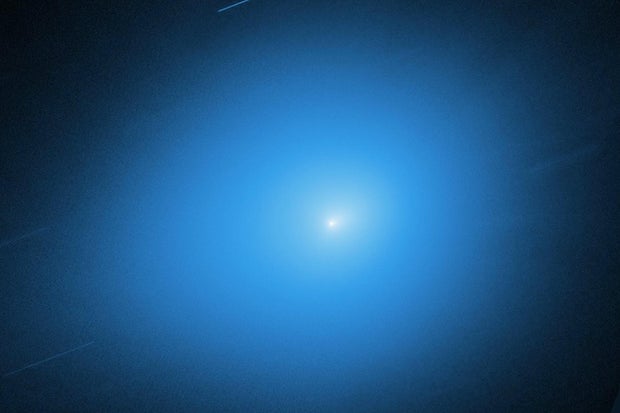
Interstellar Comet
This image, provided by NASA, shows the interstellar comet 3I/Atlas captured by the Hubble Space Telescope on Nov. 30, 2025, about 178 million miles from Earth.  NASA, ESA, STScI, D. Jewitt (UCLA), M.-T. Hui (Shanghai Astronomical Observatory), J. DePasquale (STScI) via AP

However, there could be "edge-case scenarios" that offer other explanations for the comet's unusual chemical composition, he added.

The new research is based on the comet's ratio of chemical elements, called isotopes, detected by the James Webb space telescope and the ALMA observatory in Chile.

These measurements "reveal an elemental composition unlike any solar system body," the study said.

Possible relic from "cosmic noon"

Compared to comets in our solar system, 3I/ATLAS has 10 times more deuterium, a type of hydrogen commonly seen in heavy water, according to the study.

"That high abundance of heavy water can only really happen, according to our understanding of astrochemistry, in a very cold environment," Cordiner explained.

This means the comet is also likely among the coldest objects ever seen in our solar system, the isotopic evidence suggesting it formed in an environment that was minus 243 degrees Celsius.

Exactly where this comet came from within the Milky Way remains a mystery.

But these interstellar objects are thought to form in a similar way to the comets in our Solar System — being flung out during the violent formation of a new planet.

Untethered to any star, 3I/ATLAS likely spent billions of years on "vast unimaginable trajectories around our galaxy," Cordiner said.

The scientists also detected a strange lack of chemical enrichment on the comet, which suggests it formed relatively close to stars being born.

It could even be a "relic" from an era called "cosmic noon" when many stars were forming around 10 billion years ago, Cordiner said.

The previous interstellar objects — 1I/'Oumuamua, which was spotted in 2017, followed by 2I/Borisov in 2019 — were not bright enough to gather isotopic evidence.

NASA has released several images of 3I/Atlas, including one in November showing it move through space about 180 million miles from Earth.

Last October, images taken by two Mars orbiters showed a bright, fuzzy white dot of the comet, appearing to move against a backdrop of distant stars as it was about 18,641,135 miles away from Mars. The month before that, an image showed the growing tail of 3I/ATLAS streaking across our solar system. 
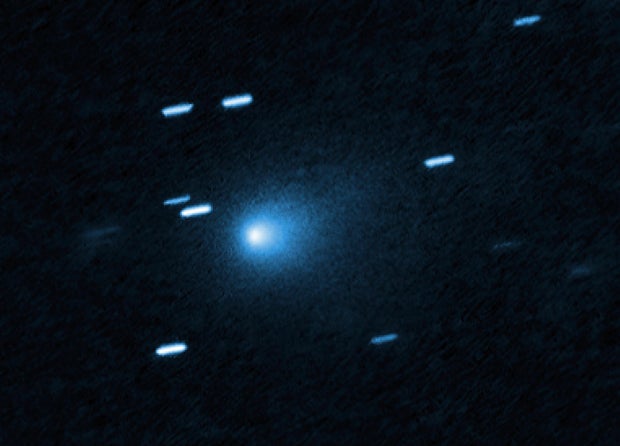
Interstellar Comet
This image provided by NASA/European Space Agency shows an image captured by Hubble of the interstellar comet 3I/ATLAS on July 21, 2025, when the comet was 277 million miles from Earth.  NASA/European Space Agency via AP

Harvard professor Avi Loeb, who had previously sparked controversy by suggesting 'Oumuamua could be an alien spacecraft, made similar suggestions about 3I/ATLAS.

"We should put all possibilities on the table that it's a rock, a comet, or something else until we get the evidence, the data that will tell us what it is," Loeb said in an interview with CBS Boston.

However NASA has dismissed the possibility of alien life. The Search for Extraterrestrial Intelligence Institute (SETI) said last month it had found "no evidence of extraterrestrial technology" on the comet.

"Just the beginning"

Several astronomers who have studied 3I/ATLAS, but were not involved in the new research, hailed the unprecedented results.

"Until these measurements we could only really dream about" getting this kind of information for an interstellar object, Darryl Seligman of Michigan State University told AFP.

He cautioned that the comet's age remained uncertain, adding it was "a safe bet that it's older than anything that formed in the solar system."

Astronomer Peter Veres, who was involved in identifying the comet at the International Astronomical Union's Minor Planet Center, called the research "exciting."

"The comet is now leaving the solar system and will never return, so future observations will become increasingly difficult," he told AFP.

However astronomers expect to spot many more interstellar objects in the coming years, particularly via the new Vera C. Rubin Observatory in Chile.

"This is just the beginning of an exciting new field, we've got a lot more to learn about these things — and what they can tell us about our galaxy," Cordiner concluded.

In:

Is NASA wrong about a comet?

Could alien tech be flying through our solar system? 05:43

Could alien tech be flying through our solar system?

(05:43)