

惯性聚合 高效追踪和阅读你感兴趣的博客、新闻、科技资讯
阅读原文 在惯性聚合中打开

推荐订阅源

J
Java Code Geeks
Google DeepMind News
奇客Solidot–传递最新科技情报
奇客Solidot–传递最新科技情报
小众软件
小众软件
Blog — PlanetScale
Blog — PlanetScale
腾讯CDC
A
About on SuperTechFans
Vercel News
Vercel News
I
InfoQ
阮一峰的网络日志
阮一峰的网络日志
月光博客
月光博客
钛媒体:引领未来商业与生活新知
钛媒体:引领未来商业与生活新知
人人都是产品经理
人人都是产品经理
S
SegmentFault 最新的问题
V
Visual Studio Blog
T
Tailwind CSS Blog
大猫的无限游戏
大猫的无限游戏
M
MIT News - Artificial intelligence
博客园 - 【当耐特】
freeCodeCamp Programming Tutorials: Python, JavaScript, Git & More
Microsoft Azure Blog
Apple Machine Learning Research
GbyAI
GbyAI
美团技术团队

Space - CBSNews.com

Space station crew briefly moves to "safe haven" amid concerns over leaks Sun erupts with 3 huge solar flares, increasing chances of northern lights across U.S. NASA declares end of mission for long-lasting Mars orbiter Blue Origin vows to resume New Glenn launches before end of year in wake of massive explosion NASA taps 2 companies to develop buggies for its moon base program A look at lunar rovers for NASA's planned Moon Base Blue Origin explosion sparks space race concerns Blue Origin explosion could impact space race position against China Blue Origin explosion threatens to delay NASA's moon program Blue Origin rocket explodes in spectacular fireball A rare blue micromoon arrives this weekend and won't be back until December 2028. Here's what to expect. NASA's moon base plans include landers, buggies and drones for 2028 mission China launches Shenzhou 23 spacecraft carrying 3 astronauts, including 1 set to remain in space for a year SpaceX launches revamped Super Heavy-Starship rocket ahead of IPO SpaceX launches more powerful Super Heavy-Starship rocket on test flight Musk's SpaceX scrubs latest test launch of massive Starship rocket SpaceX launch of more powerful Super Heavy-Starship rocket scrubbed at last minute over technical issue SpaceX plans to explore "the true nature of the universe" as it preps for mega IPO SpaceX launches Dragon cargo ship on unpiloted flight to space station NASA maps show Earth's brightest and darkest regions at night NASA spacecraft to fly past Mars this week, on voyage to rare metal asteroid UFO files reveal Apollo 17 crew saw mysterious objects, lights during 1972 mission: Pentagon begins releasing new UFO files, unveiling dozens of photos, videos and documents The government Mysterious world beyond Pluto may have an atmosphere, astronomers say Inspiring and funny moments from Artemis II astronauts' town hall CBS News Things That Matter: A Town Hall with the Artemis Astronauts Artemis II crew gives 5-year-old aspiring astronaut Commander Jack a new spacesuit: "It says NASA!" What's next for the Artemis missions and potential return to the moon Astronaut Christina Koch details broken toilet ordeal, "great" showers in space
Astronomers find 2 gigantic planets lighter than cotton c...
2026-06-25 · via Space - CBSNews.com

/ CBS/AP

Add CBS News on Google

Astronomers have uncovered a pair of giant planets that are lighter than cotton candy — super-puffs the size of Jupiter.

The featherweight pair — orbiting a star 1,110 light-years away — are the biggest exoplanets found to have less density than cotton candy.

That makes them the lightest known planets of their size, said the University of Oxford's George Dransfield.

"These two planets have densities comparable to a nice blob of shaving foam, fresh from the can," Dransfield said in an email. She and her team reported their findings Wednesday in Monthly Notices of the Royal Astronomical Society.

Dransfield suspects these fluffy, wispy worlds are probably white or blue, depending on whether the skies there are cloudy — not shades of cotton-candy pink. The planets are probably mostly hydrogen and helium, although it will take follow-up observations by NASA's Webb Space Telescope to confirm their chemical makeup.

Detected by NASA's Tess satellite over the past decade, these two especially puffy puffs orbit a star in the southern constellation Volans, known as the flying fish. The researchers studied the planets' orbits using telescopes on Earth to determine their density, from 1,110 light-years away. A light-year is nearly 6 trillion miles.
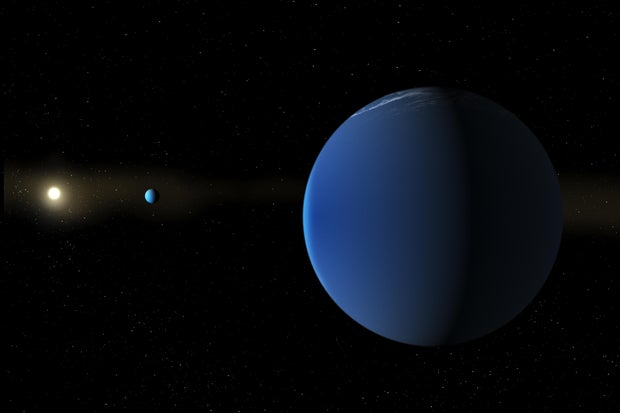
Cotton Candy Planets
This illustration provided by NASA depicts the Sun-like star TOI-791, background left, and two giant planets that NASA's TESS space telescope discovered in its orbit.  Daniel Rutter/NASA via AP

In 2024, researchers found a super-puff planet 1,200 light years from Earth, calling it a "cosmic mystery."

Jupiter, by comparison, is as much as 35 times denser than these two lightweights.

The newly found planets also have unusually long orbits, with one taking 139 days and the other taking 232 days to circle the host star, NASA said in a news release.

Considered rare in the cosmos, super-puffs are thought to form around the disk of gas and dust around a newborn star where there is more gas than dust. They shed much of the material over time, stripping down even more.

"The main reason these planets are interesting to study is that we didn't expect to see them at all," said Jon Jenkins, the science lead for the Science Processing Operations Center at NASA's Ames Research Center in California's Silicon Valley. "They represent a puzzle for us to solve about how giant planets like Jupiter and the super-puffs form."

NASA's tally of worlds outside our solar system currently stands at nearly 6,300 confirmed. Fewer than 40 are super-puffs, according to Dransfield.

"Ultimately, by studying exotic systems containing rare planet types, we add further pieces to the puzzle of planet formation and learn more about our place in the cosmos," she said.

In:

NASA celebrates Webb telescope anniversary

NASA celebrates James Webb telescope anniversary with new images 05:25

NASA celebrates James Webb telescope anniversary with new images

(05:25)