








By
/ CBS News
Hurtling back toward Earth after a historic loop around the moon, Artemis II commander Reid Wiseman said naming a crater after his late wife, an idea his crewmates came up with before launch, was the most deeply profound moment of an already memorable flight.
During a space-to-ground news conference late Wednesday, Wiseman said crewmates Victor Glover, Christina Koch and Canadian astronaut Jeremy Hansen proposed the out-of-this-world memorial when the crew was in medical quarantine a few days before launch.
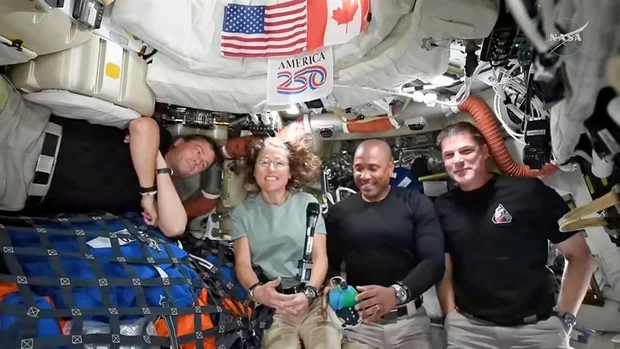
Wiseman said "that was an emotional moment for me, and I just thought that was just a total treasure." But he said he told his crewmates he wouldn't be able to talk about such an emotionally charged moment during the mission.
So, Hansen stepped in Monday and radioed mission control to describe the selection of a previously unnamed crater in honor of Wiseman's wife Carroll, a nurse who passed away in 2020. Wiseman later said raising his two daughters as a single dad was the greatest challenge of his life.
"When Jeremy spelled Carroll's name, C A R R O L L, I think for me that's when I was overwhelmed with emotion," Wiseman said. "We all pretty much broke down right there. For me personally, that was kind of the pinnacle moment of the mission. That was, I think, where the four of us were the most forged, the most bonded. And we came out of that really focused on that day ahead."
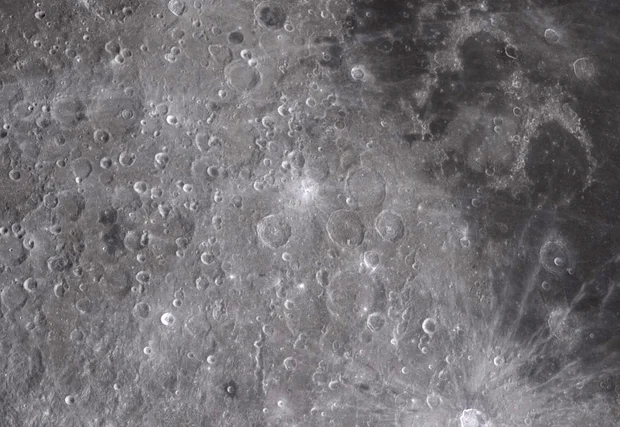
For Glover, the highlight was observing a solar eclipse, watching the sun disappear behind the moon, producing a ghostly glow around the entire moon as viewed from the Orion capsule.
"We saw great simulations made by our lunar science team, but when that actually happened, it just blew us all away," he said. "Launching on April 1 meant the far side (of the moon) wasn't as illuminated as we were hoping. And so (the eclipse) seemed to be a consolation, and it was one of the greatest gifts of that part of the mission."
Wiseman said that to him, it was watching the Earth set on the moon's horizon and disappear from view, leaving the crew out of contact with Earth for about 40 minutes.
"When we watched that Earth eclipse behind the moon, wow, I'm actually getting chills right now," he said. "It is amazing to watch your home planet disappear behind the moon...It was just an unbelievable sight. And then it was gone."
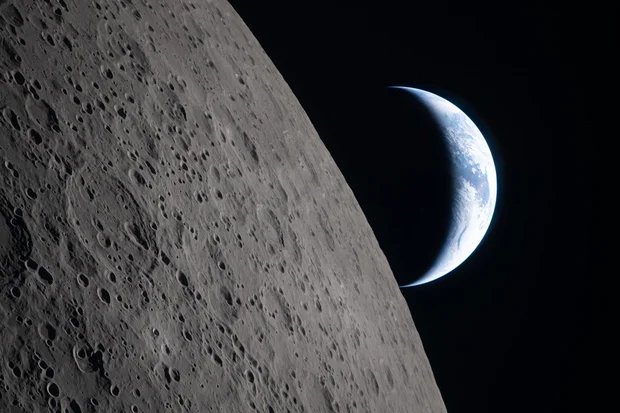
"We had a lot of scientific work to do right there," Wiseman went on. "That was probably the most critical lunar observations for our geology team. But the four of us took a moment. We shared maple cookies that Jeremy had brought, and we took about three or four minutes just as a crew to really reflect on where we were...It is a surreal feeling."
Asked if he was looking forward to re-entry and splashdown Friday, Glover said he's been thinking of that moment ever since he was assigned to the Artemis II crew, considering the 25,000-mph plunge back into the atmosphere and the fireball that will engulf the Orion capsule on the way down.
But, he reminded reporters, "all the good stuff is coming back with us. There (are) so many more pictures, so many more stories. And gosh, I haven't even begun to process what we've been through. We've still got two more days, and riding a fireball through the atmosphere is profound as well. I'm going to be thinking about and talking about all of these things for the rest of my life, for sure."
After the news conference, the crew had planned to take another turn at manually piloting their Orion capsule, testing their ability, as pilots and non-pilots, to precisely maneuver the spacecraft. NASA is considering opening up commander and pilot positions to a wider range of astronauts.
But Wednesday's test, the second to involve all four crew members, was called off to give flight controllers time to troubleshoot a liquid oxygen pressurization issue in the crew ship's service module that cropped up shortly after launch.
Like many spacecraft, Orion uses pressurized helium to force propellants to rocket engines and thrusters. For redundancy, Orion is equipped with two interconnected oxygen "manifolds," either of which can be isolated if problems develop. Only one is needed for normal operations.
Shortly after launch, the pressure in one manifold was higher than expected, so flight controllers closed valves to isolate that part of the system while they reviewed data. The test Wednesday was designed find out if helium was leaking into the oxygen lines of the isolated manifold, thus raising pressure as observed.
Mission managers said earlier the isolated manifold is not needed for the crew's return to Earth. But they wanted to better understand the issue to make sure it doesn't happen on downstream flights.
In the meantime, Navy recovery crews headed to the splashdown site off the southern California coast near San Diego where the Orion capsule is expected to splash down at 8:07 p.m. EDT Friday. Favorable weather is expected with light winds and moderate seas.
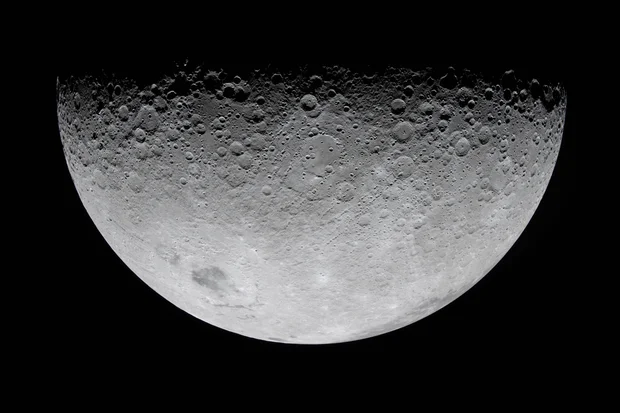
Back at the Johnson Space Center in Houston, scientists continued poring over thousands of photographs captured by the astronauts as they passed over the far side of the moon Monday, along with video and recorded audio descriptions of various high-priority targets.
Nine three-man Apollo crews flew over the moon's far side between 1968 and 1972, but those flights were launched when the near side was fully illuminated and the far side was in shadow.
The Artemis II astronauts were the first humans to see, with their own eyes, nearly a quarter of the far side in daylight, giving researchers insights that could lead to a better understanding of the moon's evolution.
So far, NASA's first piloted moon mission since the final Apollo landing in 1972 has gone off like clockwork, with only a small number of anomalies. One of those involved the ship's toilet, which has had problems dumping liquid waste overboard as required.
While an annoyance at times for the crew, it's been a relatively minor issue given the technical challenges of safely flying to the moon and back.
In: