
惯性聚合 高效追踪和阅读你感兴趣的博客、新闻、科技资讯
阅读原文 在惯性聚合中打开

推荐订阅源

AI
AI
K
KPMG report finds enterprise disconnect between AI and its ROI | CIO
H
Hacker News: Front Page
cs.CV updates on arXiv.org
Exploit-DB.com RSS Feed
Help Net Security
Help Net Security
The Hacker News
The Hacker News
PCI Perspectives
PCI Perspectives
S
Schneier on Security
H
Heimdal Security Blog
L
Lohrmann on Cybersecurity
F
Fortinet All Blogs
N
News and Events Feed by Topic
Cloudbric
Cloudbric
腾讯CDC
O
OpenAI News
V
Visual Studio Blog
The Cloudflare Blog
N
News and Events Feed by Topic
T
Tor Project blog
T
The Exploit Database - CXSecurity.com
C
Cisco Blogs
D
Darknet – Hacking Tools, Hacker News & Cyber Security
S
Securelist
小众软件
小众软件
奇客Solidot–传递最新科技情报
奇客Solidot–传递最新科技情报
H
Help Net Security
阮一峰的网络日志
阮一峰的网络日志
T
The Blog of Author Tim Ferriss
爱范儿
爱范儿
T
Threatpost
P
Privacy & Cybersecurity Law Blog
S
SegmentFault 最新的问题
The GitHub Blog
The GitHub Blog
Schneier on Security
NISL@THU
NISL@THU
cs.CL updates on arXiv.org
aimingoo的专栏
aimingoo的专栏
B
Blog
A
About on SuperTechFans
I
Intezer
SecWiki News
SecWiki News
G
GRAHAM CLULEY
T
Threat Research - Cisco Blogs
博客园 - 聂微东
Security Latest
Security Latest
Project Zero
Project Zero
V
V2EX
人人都是产品经理
人人都是产品经理
Engineering at Meta
Engineering at Meta

Latest from Space.com

Supreme Court ruling on mail-in ballots ensures astronauts can vote from space  — or anywhere else Get a year-long Peacock TV deal for just $9.16 a month Making history! China lands rocket during an orbital launch for 1st time ever Wally Funk, trailblazing pilot and astronaut, passes away at 87 Scientists have discovered the oldest quasar ever seen, and it shines with the light of a trillion suns SpaceX wants to launch 100,000 Starlink satellites to orbit 'Reckless' space-based data centers lack environmental review, drawing criticism www.space.com Could evidence of life on Mars be hiding in clay? Europe wants to send a rover to check Take a trip to the turquoise waters of the Bahamas (from space) | Space photo of the day for July 9, 2026 The US wants to build offshore rocket launch sites. Critics say China announces plan to build early-warning system for dangerous asteroids Staffing the moon base: How many astronauts should live in NASA's lunar outpost? SpaceX Falcon 9 rocket launches for record-breaking 36th time Japanese company books 1,100 pounds of cargo space on SpaceX Starship mission to the moon Dance of death between binary stars leads to an unusual supernova NASA begins funding hardware for 'Skyfall' Mars helicopter mission Trump gifts Artemis astronauts an American flag from the US Capitol to plant on the moon Shoebox-sized 'detector satellites' could sniff out a nuclear bomb in space Venus takes center stage with 2 easy-to-see sky shows this July. Here's when and where to look 'This is the future of spatial intelligence': Vantor unveils stunning 3D satellite views of Earth (photos) NASA's Roman Space Telescope prepares for launch | Space photo of the day for July 8, 2026 The US Space Force just got a new electromagnetic weapon to jam adversary satellites Revolutionary rocket engine company Venus Aerospace raises $91 million to scale design NASA's New Horizons probe just woke up from hibernation 6 billion miles away beyond Pluto. What's it doing out there? Earth may survive the sun's death after all, new study suggests James Webb Space Telescope celebrates its 4th birthday with stunning image of a galaxy crash site Our Milky Way galaxy might be larger than we thought 'Project Hail Mary' is finally streaming Amazon Prime Video, and we can't wait to watch it again Artemis 2's Jeremy Hansen stepping down from active astronaut duty after epic moon mission How public–private partnerships can turn Mars into an economic frontier (Op-Ed) China releases 1st photo of Earth's elusive 'quasi-moon' Kamo'oalewa 'That's going to come back and bite us': Former NASA chief questions Artemis moon lander plans Astronaut flexes his muscles mid-spacewalk | Space photo of the day for July 7, 2026 Chinese scientists find the best way to nuke an asteroid on its way to impact Earth SpaceX just launched the 1st-ever nuclear-powered commercial satellite The sun's atmosphere is way hotter than its surface. Scientists may finally know why Even astronauts in space saw America 250 fireworks on the Fourth of July. See their ISS view of Los Angeles (video) SpaceX launches 81 satellites to orbit from California, lands rocket on ship at sea More clues surface about the origins of interstellar comet 3I/ATLAS NASA just found a planet 'hiding' in TESS spacecraft data, all thanks to Einstein Black holes buried in mysterious 'little red dot' galaxies could blast cosmic ghosts at Earth Unidentified metal spheres found on Australian beach are 'debris from a foreign rocket body', space agency says 'Acceleration without fuel:' Revolutionary superconducting thruster harnesses Earth's magnetic field in 1st orbital test Japan's Hayabusa2 probe captures remarkable photo of a two-headed asteroid 62 million miles away Artemis moon astronauts visit Capitol Hill | Space photo of the day for July 6, 2026 NASA will have to find a way to service its new alien-hunting space telescope Astronomers discover radio signals coming from rare 'Blue Eye Pulsar' after decades of silence 'Once-in-a-millennium' asteroid flyby will be visible to much of the world in 2029 NASA tests advanced new Mars rover prototype in the California desert (video) He-Man and beyond: 20 sci-fi cartoons (some iconic, some weird) that transported '80s and '90s kids to strange new worlds 10 best Spanish cities to see the total solar eclipse 2026 America 250: From 1776 to the moon and beyond (A Space.com series) This Week In Space podcast: Episode 217 — America in Space Human flight was still 7 years away in 1776. Now, we're headed back to the moon What did the night sky look like on the 1st Independence Day 250 years ago? 30 years on, "Independence Day" still proves the versatility of the original "The War of the Worlds" How to find Uranus this week, the hardest planet I've ever tried to see As 'Terminator 2: Judgment Day' turns 35, it's time to accept the truth: Terminator shouldn't be back Could humans someday explore Saturn's moon Titan, or will humanoid robots do it for us? 'Independence Day' at 30: Roland Emmerich & Dean Devlin talk blowing up the White House and crafting a true sci-fi classic (interview) 1 private spacecraft intercepts another on Space Force's groundbreaking 'Victus Haze' mission
Astronomers may have heard the 1st
https://www.space.com/author/robert-lea · 2026-07-10 · via Latest from Space.com
An illustration shows a supernova explosion bombarding Earth with neutrinos
An illustration shows a supernova explosion bombarding Earth with neutrinos (Image credit: Super-Kamiokande Collaboration)

The universe is haunted by "cosmic ghosts" called neutrinos, and new research suggests they may be the "whispers" of stars that died in supernova explosions over the course of billions of years.

The discovery is an important step forward in our understanding of the life and death of stars and how they enrich their environments with metals, elements heavier than hydrogen and helium. It could also help better understand how black holes and neutron stars are born when massive stars die.

The second most common particles in the universe, neutrinos get their spooky nickname because they are chargeless and near-massless, so phantom-like that around 100 trillion neutrinos pass through you at nearly the speed of light every second, but over your entire life only one will interact with the atoms of your body, if you're lucky.

The newly suggested connection between neutrinos and a history of supernova blasts has emerged from the first detection of a flux of neutrinos called the Diffuse Supernova Neutrino Background (DSNB). It was detected by one of the world's largest neutrino detectors, the Super-Kamiokande, located 3,280 feet (1,000 meters) underground in Gifu Prefecture, Japan.

"Observing the world's first indication of the Diffuse Supernova Neutrino Background is a deeply meaningful achievement and has been a long-cherished goal since the beginning of the Super-Kamiokande project," Hiroyuki Sekiya of the University of Tokyo said in a statement.

Stars go out with a bang but continue with a whisper

Supernovas come in a range of types, but the ones this research concerns are so-called "

core-collapse supernovas.

" These occur when stars much more massive than the sun reach the end of nucleosynthesis in their cores. When they are no longer able to fuse elements to create metals heavier than iron, the stars become unable to produce the outward energy that for millions of years has balanced them against the inward push of gravity.

Thus, with gravity the ultimate winner of this cosmic tug of war, the star's core collapses, sending violent shockwaves rippling outward into the outer stellar layers, which are ripped away. This leaves the core as a stellar remnant, either a

neutron star

or a

black hole,

initially surrounded by an expanding shell of supernova debris.

The energy from these events is carried away by particles of light (photons) spread across the electromagnetic spectrum, but also by neutrinos. Yet, despite the fact that supernovas have been erupting every second over the course of 13 billion years or so to produce the neutrinos that accumulate as the DSNB, this ghostly signal is still faint, a whisper rather than a shout.
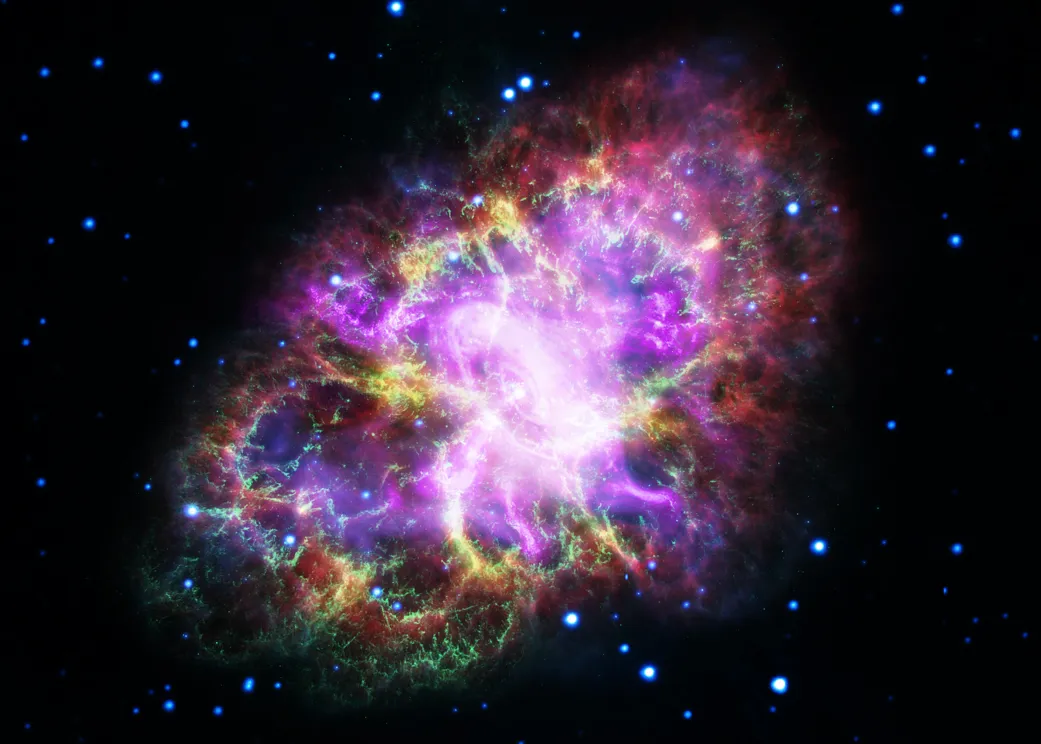
The Crab Nebula as seen by the Hubble Space Telescope and ground-based telescopes in a composite view The nebula is the aftermath of a brilliant supernova spotted in 1054.

The Crab Nebula as seen by the Hubble Space Telescope and ground-based telescopes in a composite view The nebula is the aftermath of a core-collapse supernova. (Image credit: NASA, ESA, NRAO/AUI/NSF and G. Dubner (University of Buenos Aires))

To "hear" these cosmic whispers, the team behind this research analysed almost 14 years of data from Super-Kamiokande in the form of

Cherenkov light

generated when neutrinos interact with 50,000 tons of ultrapure water.

This revealed a signal of neutrinos in line with what would be expected from the DSNB. This signal still needs to be confirmed, but it is a strong indicator of the DSNB, the first humanity has ever had.

Since the birth of the universe, neutrinos emitted by supernovas have diffused through space and accumulated over cosmic time.

Across the universe, supernova explosions occur several times per second. Since the birth of the universe, neutrinos emitted by these supernovae have diffused through space and accumulated over cosmic time. (Image credit: Kamioka Observatory, Institute for Cosmic Ray Research, The University of Tokyo)

"We are already planning on incorporating ongoing observations at Super-Kamiokande together with its successor detector, Hyper-Kamiokande, to further improve sensitivity in future collaborative studies," said team member Yosuke Ashida,of Tohoku University.

The team's results were presented on June 25, 2026, at Neutrino 2026: XXXII International Conference on Neutrino Physics and Astrophysics, held at the University of California, Irvine, USA.

Robert Lea is a science journalist in the U.K. whose articles have been published in Physics World, New Scientist, Astronomy Magazine, All About Space, Newsweek and ZME Science. He also writes about science communication for Elsevier and the European Journal of Physics. Rob holds a bachelor of science degree in physics and astronomy from the U.K.’s Open University. Follow him on Twitter @sciencef1rst.