
惯性聚合 高效追踪和阅读你感兴趣的博客、新闻、科技资讯
阅读原文 在惯性聚合中打开

推荐订阅源

P
Privacy International News Feed
云风的 BLOG
云风的 BLOG
Google DeepMind News
Recorded Future
Recorded Future
I
InfoQ
aimingoo的专栏
aimingoo的专栏
Microsoft Security Blog
MongoDB | Blog
MongoDB | Blog
Vercel News
Vercel News
D
DataBreaches.Net
Microsoft Azure Blog
H
Hackread – Cybersecurity News, Data Breaches, AI and More
A
About on SuperTechFans
博客园 - 聂微东
CTFtime.org: upcoming CTF events
Apple Machine Learning Research
博客园 - 司徒正美
博客园 - 三生石上(FineUI控件)
M
MIT News - Artificial intelligence
H
Help Net Security
B
Blog
J
Java Code Geeks
Y
Y Combinator Blog
Martin Fowler
Martin Fowler
IT之家
IT之家
WordPress大学
WordPress大学
OSCHINA 社区最新新闻
OSCHINA 社区最新新闻
freeCodeCamp Programming Tutorials: Python, JavaScript, Git & More
博客园 - 叶小钗
博客园_首页
The Cloudflare Blog
爱范儿
爱范儿
Hugging Face - Blog
Hugging Face - Blog
博客园 - Franky
小众软件
小众软件
量子位
酷 壳 – CoolShell
酷 壳 – CoolShell
C
Check Point Blog
L
LangChain Blog
Stack Overflow Blog
Stack Overflow Blog
Recent Announcements
Last Week in AI
Last Week in AI
U
Unit 42
雷峰网
雷峰网
P
Proofpoint News Feed
有赞技术团队
有赞技术团队
V
Visual Studio Blog
人人都是产品经理
人人都是产品经理
The Register - Security
罗磊的独立博客

Comments for The Eclectic Light Company

Comment on What does Activity Monitor measure? by hoakley Last Week on My Mac: Spotlight on semantics An American in Paris: paintings of Henry Ossawa Tanner 1880-1902 Great Ladies of Impressionism: Berthe Morisot 1874-1891 What to do with a hot Mac Deprecations and removals from Golden Gate Brushstrokes: From El Greco to Rembrandt Portraits of trees: Dutch Golden Age How to get the most from SilentKnight 3 Comment on Hero or hooligan: Achilles becomes the warrior by Deborah J. Brasket Solutions to Saturday Mac riddles 365 Comment on SilentKnight 3.0 for Apple silicon Macs running Sequoia and later (full release) by michaelriccioli Comment on Last Week on My Mac: Uncompressed compressed files by fds Comment on Explainer: Memory by jzonedotcom Comment on Colin Campbell Cooper painting America: 1896-1910 by House of Heart Brushstrokes: 16th century What can you do when an app uses too much memory? SilentKnight 3 second beta adds text and JSON reporting In the shadow: Caravaggism What to do with your encrypted HFS+ disks First beta-test version of SilentKnight 3 for Apple silicon Macs Hero or hooligan: Jason and Medea Comment on Fix documents that won’t open as expected using Quarant2 by EcleX Last Week on My Mac: The mystery of Safari’s Web Archives Last Week on My Mac: Why is it so hard to open a document? Explainer: Disk encryption In the shadow: Caravaggio Brushstrokes: innovators of the first century Changing Paintings: 36 Theseus and the Minotaur macOS virtualisation is leaping forward in Golden Gate Why can’t Preview open that PDF? Crossing the Golden Gate, Intel support, and an update to SystHist Reading the Finder’s Get Info dialog In memoriam Mary Cassatt: 2, 1880-81 Last Week on My Mac: What’s in a name? Explainer: Getting a location Get more from Get Info and the Finder’s contextual menu Stop your photos revealing your location Have you saved thousands of versions? Versatility 1.2 might be what you need Apple has released an update to XProtect for all macOS Apple has released macOS Tahoe 26.5.1 Comment on What Location Services do in macOS by Tristan Hubsch Comment on Protect files with the Locked or Immutable flag by markbot2zero Portraits of trees: Introduction Which tasks require mains power? Comment on Online reference to external displays for Apple silicon Macs by Brian What’s in that phishing email? How to search document versions Rubens’ Peace and War Comment on Last Week on My Mac: Syncing metadata in iCloud Drive by hoakley A weekend with Misia: 2 How to search Time Machine backups? Medium and message: Pottery Hero or hooligan: Theseus and the sandals How QuickLook provides thumbnails and previews Hunting extended attributes with an update to xattred Saturday Mac riddles 360 Comment on How to preserve versions, and how to create versioned PDFs by markbot2zero Comment on What gets synced in iCloud Drive? by hoakley Solutions to Saturday Mac riddles 359 Last Week on My Mac: snapshots, the elephant in APFS How to check whether Spotlight is getting the right metadata macOS Tahoe no longer fully supports Time Capsules The bicentenary of Frederic Edwin Church: 1857-77 macOS virtual machines and audio-video syncing Comment on Use Finder tags for categories by Chuck Last Week on My Mac: Dependency and skill fade Comment on Virtualisation on Apple silicon Macs is different by AndyS Painting Pandora and her box: 1883-1919 Mac Easter eggs Painting Spring blossom 2 Comment on The macOS Natural Language framework and Nalaprop by Ingo Comment on The MACL extended attribute by hoakley On Reflection: Cézanne Privacy: Which folders are protected in Tahoe? Last Week on My Mac: Root cause analysis and ClickFix Last Week on My Mac: Root cause analysis and ClickFix Last Week on My Mac: Root cause analysis and ClickFix Last Week on My Mac: Root cause analysis and ClickFix Why you can’t trust Privacy & Security How can I now have two apps named Pages? How to survive the loss of Rosetta Use Fallback Recovery on Apple silicon Macs Clean install macOS
An American in Paris: paintings of Henry Ossawa Tanner 1902-1930
Kenneth Grah · 2026-06-28 · via Comments for The Eclectic Light Company

Henry Ossawa Tanner (1859–1937), Daniel in the Lions' Den (1907-18), oil on paper mounted on canvas, 104.5 x 126.8 cm, Los Angeles County Museum of Art, Los Angeles, CA. Courtesy of Los Angeles County Museum of Art, via Wikimedia Commons.

In 1900, the African-American painter Henry Ossawa Tanner had been awarded a silver medal at the Exposition Universelle in Paris, and his unconventional religious paintings had been winning him acclaim at the Paris Salon. Although he did return to the US occasionally, he had worked in Paris for much of the previous decade.

tannergoodshepherd
Henry Ossawa Tanner (1859–1937), The Good Shepherd (1902-3), oil on canvas, 77 x 92 cm, Zimmerli Art Museum at Rutgers University, New Brunswick, NJ. Wikimedia Commons.

The Good Shepherd (1902-3) is an example of a painterly and almost monochromatic nocturne used to create ‘atmosphere’ in his religious works of this time.

tannerabrahamsoak
Henry Ossawa Tanner (1859–1937), Abraham’s Oak (1905), oil on canvas, 54.3 x 72.7 cm, Smithsonian American Art Museum, Washington, DC. Wikimedia Commons.

Abraham’s Oak from 1905 is a similar nocturne showing an ancient oak tree that survived until 1996. Tradition claimed this marked the place where three angels appeared to Abraham, or Abraham pitched his tent. The location is just south-west of Mamre, near Hebron. The story runs that Abraham washed the feet of three strangers who appeared there, and showed them hospitality. They revealed themselves to be angels, and informed Abraham that his wife would become pregnant and bear him a son. This is cited as an example of the importance of showing hospitality to others, although ironically the site is now centre to a dispute between the Russian Orthodox church and Palestinians.
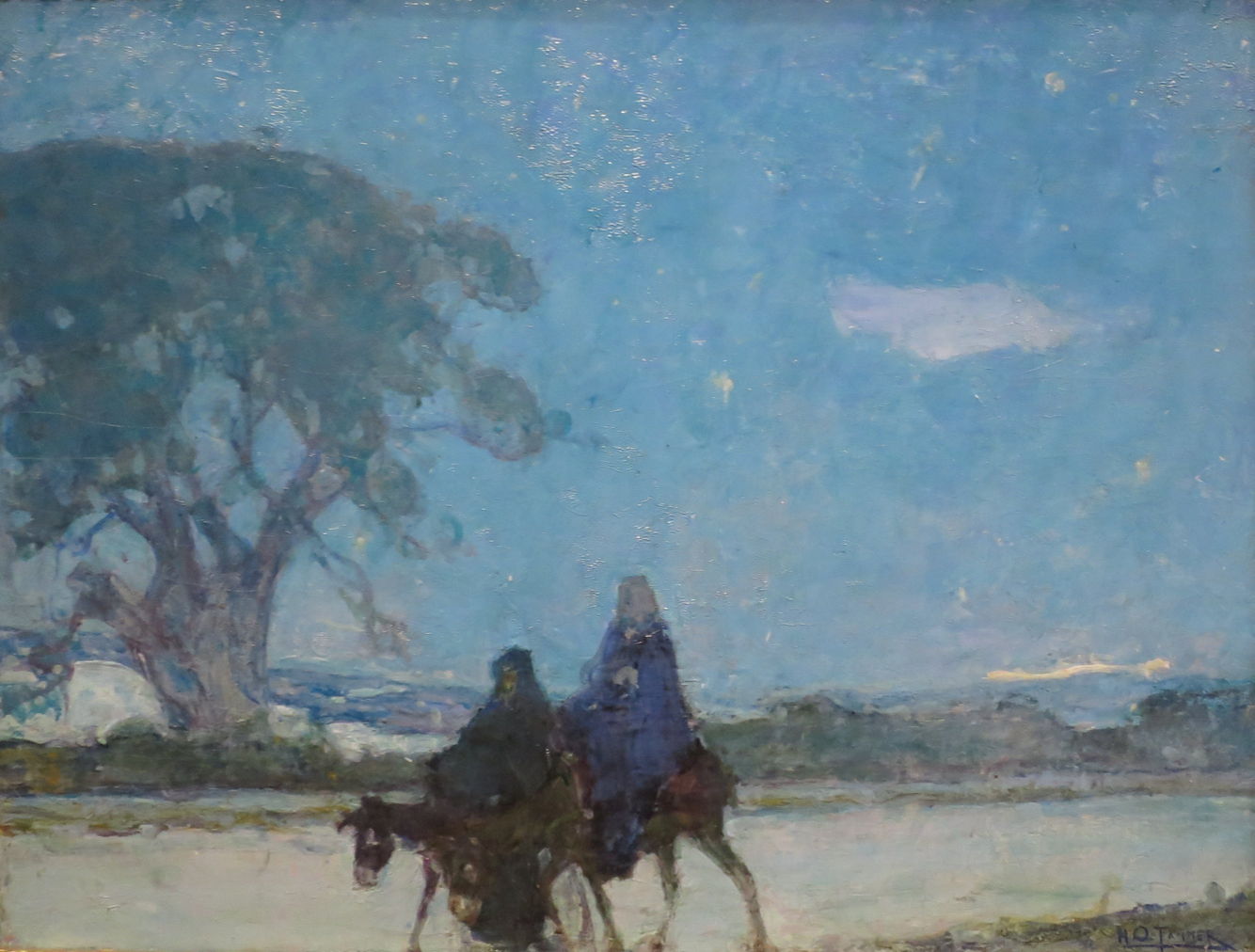
tannerflightegypt1907
Henry Ossawa Tanner (1859–1937), The Flight into Egypt (c 1907), oil on canvas, dimensions not known, Cincinnati Art Museum, Cincinnati, OH. Wikimedia Commons.

The Flight into Egypt (c 1907) is one of at least two paintings in which Tanner showed Christ’s family fleeing to Egypt to avoid Herod’s imminent massacre of infants, as described in the Gospel of Matthew (2:13-23). This has long been a popular story for paintings, which often incorporate a highly inventive landscape. With his recent experience of travel in both Palestine and Egypt, Tanner has clearly tried to be more geographically appropriate.

In early 1908, Tanner’s travels took him to Algiers. At the end of that year, he had his first major solo exhibition at the American Art Galleries in New York. In the following year, he was elected an associate member of the National Academy of Design, together with Mary Cassatt and George Bellows.

tannerangelsshepherds
Henry Ossawa Tanner (1859–1937), Angels Appearing before the Shepherds (c 1910), oil on canvas, 65.3 × 81.1 cm, Smithsonian American Art Museum, Washington, DC. Wikimedia Commons.

His Angels Appearing before the Shepherds (c 1910) brought his loose brushstrokes, rubbings, and scumbled passages closer to Symbolism, in telling this simple episode from the story of the nativity. He again limits his colours, with a single patch of orange at the lower right, indicating a small open fire, amid an abundance of blues and a few greens.
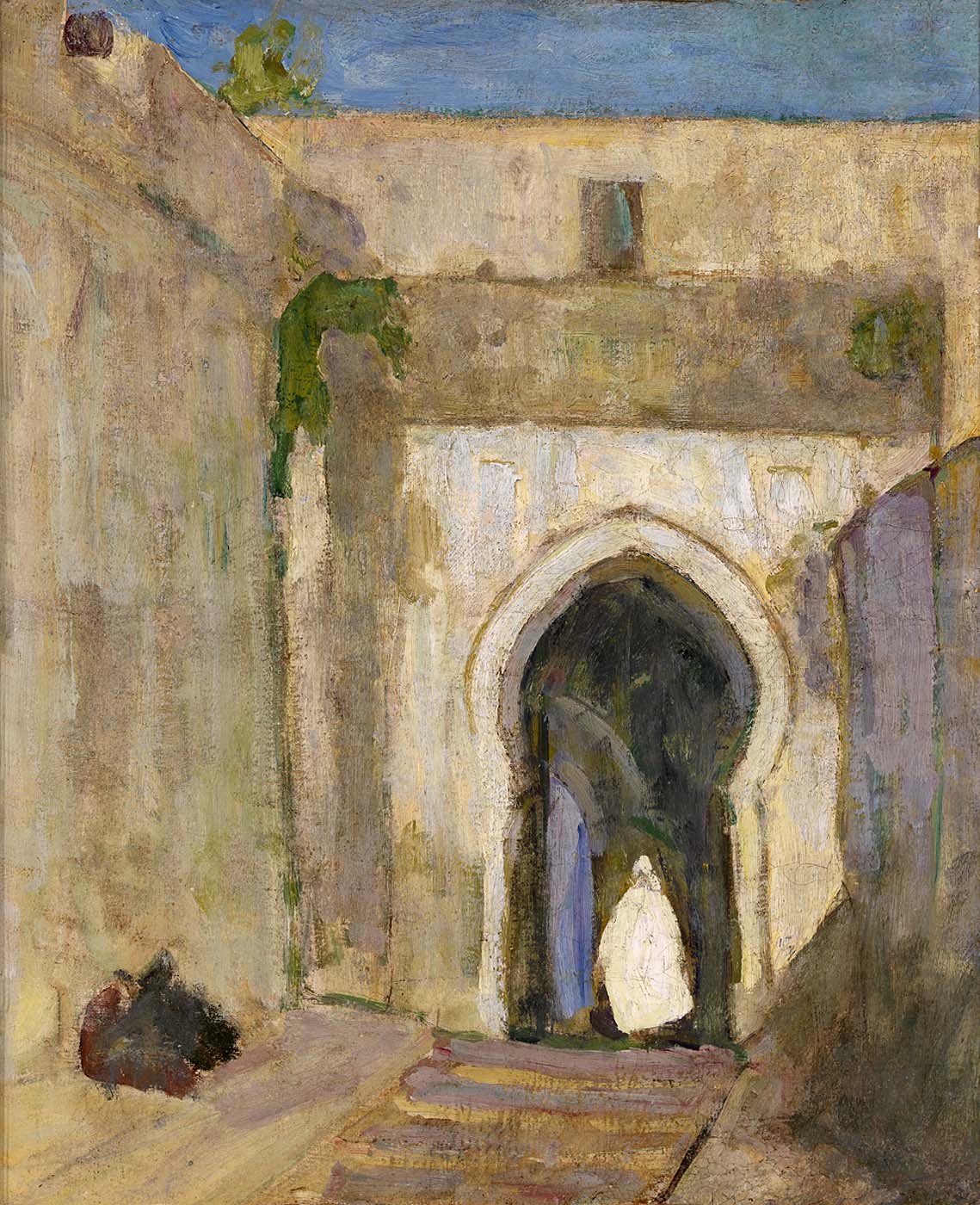
tannergatewaytangier
Henry Ossawa Tanner (1859–1937), Gateway, Tangier (c 1910), oil on plywood, 57.2 × 48.3 cm, Smithsonian American Art Museum, Washington, DC. Wikimedia Commons.

The keyhole-like Gateway, Tangier (c 1910) reveals a fascination with the shape of such entrances in north African architecture, which in turn may allude to Christ’s teachings.

tannerentrancecasbah
Henry Ossawa Tanner (1859–1937), Entrance to the Casbah (1912), oil on wood pulp paper mounted on canvas, 81.3 x 66 cm, Pennsylvania Academy of the Fine Arts, Philadelphia, PA. By Wmpearl, via Wikimedia Commons.

An apparently identical location appeared a couple of years later, in his Entrance to the Casbah (1912). In spite of its similarity with the earlier Gateway, Tangier, it’s presumed he painted this during his return visit to Tangier and other parts of Morocco that year.

Early in 1913, his works were shown in another major solo exhibition at the Thurber Art Galleries in Chicago, followed by a solo in Knoedler’s Gallery, New York.
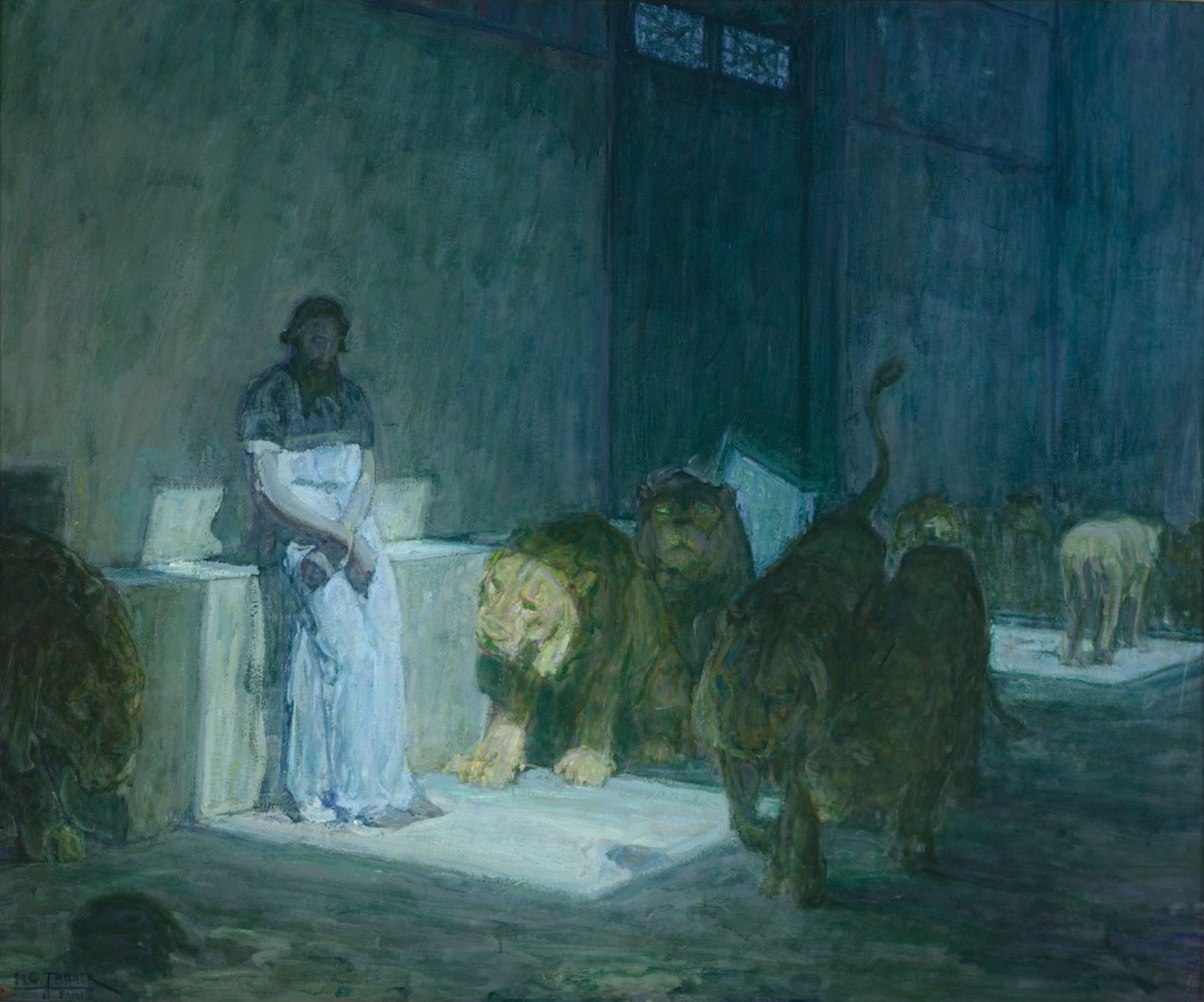
tannerdaniellionsden
Henry Ossawa Tanner (1859–1937), Daniel in the Lions’ Den (1907-18), oil on paper mounted on canvas, 104.5 x 126.8 cm, Los Angeles County Museum of Art, Los Angeles, CA. Courtesy of Los Angeles County Museum of Art, via Wikimedia Commons.

I have been unable to discover when his first painting of Daniel in the Lions’ Den became lost, but between about 1907 and the end of the First World War in 1918, he painted another version with looser brushstrokes, and cropped slightly differently. Tanner had a fondness for painting lions since his student days in Philadelphia, and had at first considered specialising in the painting of animals. Some have suggested that this painting might refer to Androcles and the Lion, Androcles being a slave who gained freedom and success. This is another example of his tightly constrained colour, and his skilled use of light, which must have been key to the original’s successful reception.

At the outbreak of war in 1914, Tanner and his family left France to take shelter in London, but he returned to carry out relief work in France during the autumn of that year. He openly admitted that he found the war very distressing, as he wanted to do something useful to help the war effort. From 1917-19, he did so by serving in France as an officer in the American Red Cross.
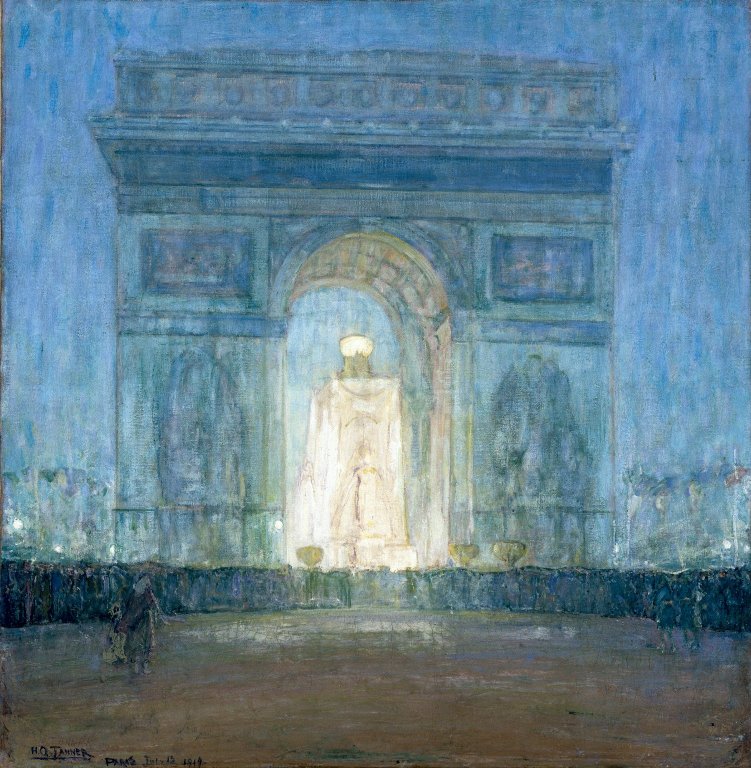
tannerarch
Henry Ossawa Tanner (1859–1937), The Arch (1919), oil on canvas, 99.7 × 97 cm, The Brooklyn Museum, New York, NY. Courtesy of The Brooklyn Museum, via Wikimedia Commons.

His The Arch (1919) is a record of events in the evening of 13 July 1919, when a cenotaph in memory of French soldiers was built under the Arc de Triomphe in Paris, and was lit dramatically for a large public gathering. His slight readjustment to that reality may have been the symbolic addition of a widow and orphan in the foreground at the left, and a couple of uniformed veterans to the right.

tannerflightegypt1923
Henry Ossawa Tanner (1859–1937), Flight into Egypt (1923), oil on canvas, 73.7 × 66 cm, Metropolitan Museum of Art, New York, NY. Wikimedia Commons.

Tanner’s second version of the Flight into Egypt (1923) is also set at night, but is composed to show the Holy Family as a group. Again this uses light skilfully, with the cast shadow creating the effect of a halo around Mary’s head, as she cradles the infant Jesus on her donkey.

That year Tanner received the accolade from the French government of election to the Legion of Honour, but two years later his world collapsed when his wife Jessie died. He found it difficult to paint after that, but recognition and honours continued, and in 1927 he was elected a full academician at the National Academy of Design.

tannerdestructionsodomgomorrah
Henry Ossawa Tanner (1859–1937), The Destruction of Sodom and Gomorrah (1929-30), tempera and varnish on cardboard, 52 x 91.4 cm, High Museum of Art, Atlanta, GA. Wikimedia Commons.

Among the paintings of his final years were several nocturnes on religious themes, and his more apocalyptic The Destruction of Sodom and Gomorrah (1929-30). Unusually he painted this in tempera and varnish on cardboard. In 1930, he exhibited in the Venice Biennale, and died just two years before the next World War, in France where he had painted for over forty-five years.

References

Wikipedia.

Marley AO ed. (2012) Henry Ossawa Tanner, Modern Spirit, Pennsylvania Academy of the Fine Arts & University of California Press. ISBN 978 0 520 27075 6.