
惯性聚合 高效追踪和阅读你感兴趣的博客、新闻、科技资讯
阅读原文 在惯性聚合中打开

推荐订阅源

U
Unit 42
C
Cybersecurity and Infrastructure Security Agency CISA
Exploit-DB.com RSS Feed
Know Your Adversary
Know Your Adversary
S
Securelist
I
Intezer
AWS News Blog
AWS News Blog
L
LINUX DO - 热门话题
P
Privacy International News Feed
Recent Announcements
cs.CL updates on arXiv.org
博客园 - 聂微东
Threat Intelligence Blog | Flashpoint
Attack and Defense Labs
N
News and Events Feed by Topic
The GitHub Blog
The GitHub Blog
C
Cyber Attacks, Cyber Crime and Cyber Security
Schneier on Security
N
Netflix TechBlog - Medium
爱范儿
爱范儿
B
Blog
CTFtime.org: upcoming CTF events
cs.CV updates on arXiv.org
C
CERT Recently Published Vulnerability Notes
Hacker News: Ask HN
Hacker News: Ask HN
Google DeepMind News
Engineering at Meta
Engineering at Meta
Blog — PlanetScale
Blog — PlanetScale
WordPress大学
WordPress大学
S
Secure Thoughts
K
Kaspersky official blog
N
News | PayPal Newsroom
O
OpenAI News
Last Week in AI
Last Week in AI
C
Check Point Blog
D
Darknet – Hacking Tools, Hacker News & Cyber Security
Cyberwarzone
Cyberwarzone
Application and Cybersecurity Blog
T
Tor Project blog
大猫的无限游戏
大猫的无限游戏
Vercel News
Vercel News
D
Docker
Hugging Face - Blog
Hugging Face - Blog
T
Threat Research - Cisco Blogs
Cisco Talos Blog
Cisco Talos Blog
The Register - Security
博客园 - 司徒正美
Martin Fowler
Martin Fowler
人人都是产品经理
人人都是产品经理
P
Palo Alto Networks Blog

Blog | Orca Security

Langflow RCE Actively Exploited to Deploy Cryptominers on AI Infrastructure Orca MCP: When Text Stops Scaling Kubernetes Compliance Tools: Automating CIS Benchmarks Risk-Based Vulnerability Management for the Cloud: A 2026 Guide Private Cloud Security: Top Risks and Best Practices (2026) What Is Generative AI in Cybersecurity? Best Vulnerability Management Tools and Software in 2026 2026 State of Application Security Report Recap: What the Data Says and What Security Teams Should Do About It AI Security for Sensitive Data: Best Practices and Guidelines Best AI Code Security Solutions 2026: How to Secure AI-Generated Code From Platform to Program: How to Ensure Your Cloud Security Solution Delivers Best AI Cybersecurity Providers 2026: A Buyer's Guide to AI-Powered Security Platforms Join Orca Security at Black Hat USA 2026 CNAPP Tools That Reduce Security Tool Sprawl: CNAPP vs. Dedicated Solutions What Is Container Runtime Security? A Practical Guide 2026 What Is Application Security Testing? Tools and Types What Is Managed Cloud Security? A Practical Guide What Is SaaS Security Posture Management? SSPM Guide Top 10 Cloud Security Standards for Compliance What is the MIT License? Compliance and Comparisons AI Agents vs. Agentless Security vs. Agent-based Security 144 Mastra npm Packages Compromised via Supply Chain Attack The Complete Guide to LLM Security: Risks, Best Practices, and Solutions Cloud Security LIVE 2026: Top 10 Takeaways Practitioners Can Use Now Cloud Security LIVE 2026: Top 10 Takeaways CISOs Can Use Now (and What to Do Next) How Orca Traced an nginx Flaw to 1.45 Million Tengine Servers All Running Vulnerable Code What to Look for in Container Security Tools Cloud Application Security Best Practices for DevSecOps Cloud Security Tools: 10 Types Explained for Teams What Is NIST CSF? Framework 2.0 Explained 7 Open Source Incident Response Tools by Category Critical PhpSpreadsheet RCE Patch Bypass Puts Millions at Risk Critical Splunk Enterprise Vulnerabilities Allow Unauthenticated File Operations and Remote Code Execution 16 Best Open Source Application Security Tools 2026 What Is Containerization? Security and Best Practices 8 Container Security Best Practices for 2026 Close the Cloud Identity Gap with Orca and AWS IAM Access Analyzer The 5-Step Context-Aware Cloud Vulnerability Prioritization Framework Critical Jupyter Enterprise Gateway Vulnerabilities Enable Full Kubernetes Cluster Takeover AI Security Best Practices for Regulated Industries Massive PyPI Supply Chain Attack Harvests Cloud Credentials via Python Startup Hooks SAST vs SCA: Key Differences for AppSec Teams What Is Cloud Security Architecture? Principles, Layers, and Frameworks What Is ASPM? A Guide to Application Security Posture Management What Is SaaS Security? A Practical Guide 2026 What Is a Man-in-the-Middle Attack? A Cloud Security Guide What Is Open Policy Agent? Best Practices and Use Cases 11 Best Open-Source DevSecOps Tools for 2026 How to Secure AI Workloads in Multi-Cloud Environments: A Complete Framework Critical WordPress Plugin Vulnerability Allows Unauthenticated Admin Takeover on 150K Sites What Is Kubernetes as a Service? KaaS Explained Critical Netlogon RCE Flaw Actively Exploited Against Windows Domain Controllers Your FedRAMP Continuous Monitoring Strategy Has a Gap. We Built Something to Fix It. How to Simplify Multi-Cloud Compliance Reporting: The 2026 Checklist Red Hat npm Packages Compromised in Supply-Chain Attack Spreading Credential-Stealing Worm Critical RCE in LiquidJS Lets Attackers Execute Arbitrary Commands on Unpatched Hosts Securing Shadow AI: How to Detect Unapproved LLMs in Your Cloud Data Security Posture Management (DSPM) for AI Gitea Container Registry Exposes Private Images to Unauthenticated Attackers Critical Unauthenticated RCE in Kopia Backup via SSH ProxyCommand Injection Best Palo Alto Networks Cortex (Prisma Cloud) Alternatives in 2026 7 Enterprise AI Security Risks to Manage Critical Pre-Auth RCE in ChromaDB Threatens AI Infrastructure Critical Coder Signature Bypass Exposes Developer Keys and Tokens New “PoolSlip” NGINX Exploit Revives Unpatched Remote Code Execution Risk Critical Drupal SQL Injection Exposes PostgreSQL-Backed Sites to Remote Code Execution AI Security Tools: How to Evaluate Them Across Every ML Attack Phase Massive npm Supply Chain Attack Compromises AntV Ecosystem, Steals CI/CD Secrets at Scale NIST AI Risk Management Framework (AI RMF) Explained: What It Is and How Organizations Use It The AI Data You Forgot to Lock: How Exposed Vector Databases Put Organizations at Risk GenAI Risks in Cloud Environments: What Security Teams Are Actually Missing in 2026 What Is Multi-Cloud Security? What Is Cloud Detection and Response (CDR)? Linux kernel vulnerability enables local theft of SSH host keys and /etc/shadow 18-Year-Old NGINX Rewrite Module Flaw Enables Unauthenticated DoS and Potential RCE Announcing Cloud Security Agent Skills for Orca’s MCP Server TanStack and 160+ npm/PyPI Packages Compromised in Supply Chain Worm Attack Dirty Frag: Linux Kernel Vulnerability Chain Enables Local Privilege Escalation to Root Critical Apache HTTP Server HTTP/2 Vulnerability Could Enable Remote Code Execution Skill Issues: How We Discovered Supply Chain Attack Vectors in an AI Agent Skills Marketplace What Is an Incident Response Plan? What Is Cloud Data Security? Risks, Challenges, and 12 Best Practices Remote Code Execution in GitHub Enterprise Server via Git Push Injection (CVE-2026-3854) Linux Kernel Bug (Copy.Fail) Enables Local Privilege Escalation to Root (CVE-2026-31431) Xinference PyPI package compromise leads to full environment takeover What is Application Security? When AI Accelerates the Offense, Coverage Gaps Become Catastrophic Orca Security Recognized in the 2026 TAG Enterprise AI Security Handbook Navigating Cloud Security in 2026: Join Cloud Security LIVE Anthropic’s Project Glasswing Is a Positive Step Toward Cleaner, Safer Production Kyverno SSRF: Breaking Kubernetes Namespace Isolation (CVE-2026-4789) Streamline Compliance Reporting with Orca and Drata’s Integrated Vulnerability Management CVE-2026-23226: How a Missing Lock in ksmbd’s Channel List Exposes Your Linux SMB3 Server 2026 State of AppSec: When Development Velocity Outpaces Security AI Is Entering Your Infrastructure. Now what? Orca Security Featured in SACR’s 2026 Unified Agentic Defense Platforms Report Supply Chain Attack on Axios Delivers Cross-Platform RAT via Compromised npm Account Credential‑Stealing Malware in LiteLLM Supply Chain Attack Mission Accomplished: Orchestrate Your Remediation Strategy With Orca Missions The Orca Approach to Runtime AI Security
Critical Langflow Path Traversal Flaw Exploited for Unauthenticated RCE
The Orca Research Pod · 2026-06-12 · via Blog | Orca Security

Executive Summary

A high-severity vulnerability (CVE-2026-5027, CVSS 8.8) was disclosed affecting Langflow, an open-source low-code platform widely used for building AI applications, allowing attackers to achieve remote code execution via a path traversal in the file upload endpoint. Due to the potential for full system compromise and the trivial nature of exploitation, immediate patching is required.

About the Vulnerability: CVE-2026-5027

The issue originates from Langflow’s POST /api/v2/files endpoint, where the upload_user_file() function in the backend fails to sanitize the filename parameter in multipart form data. By sending specially crafted filenames containing directory traversal sequences (../), attackers can write arbitrary files to any location on the server’s filesystem. Because Langflow enables unauthenticated auto-login by default, a single request is all that is needed to obtain a valid session token and exploit the vulnerability — no credentials required.

The following versions are affected:

  • langflow-base versions below 0.8.3
  • Langflow versions up to and including 1.8.4

These components are used across AI development workflows and production pipelines, particularly when Langflow is deployed with default auto-login settings and exposed to the network. Censys scans have identified approximately 7,000 publicly exposed Langflow instances, primarily in North America, underscoring the breadth of potential exposure.

Risk Impact

Tenable discovered the vulnerability and attempted responsible disclosure, contacting Langflow maintainers three times between January and February 2026 before publicly disclosing as advisory TRA-2026-26 on March 27, 2026. VulnCheck has since confirmed active exploitation in the wild, with honeypots detecting attackers dropping test files onto vulnerable instances. A public proof-of-concept exploit is available. Prior Langflow vulnerabilities, including CVE-2026-0770, CVE-2026-33017, and CVE-2025-34291 (weaponized by the MuddyWater threat group), demonstrate sustained adversary interest in agentic AI applications infrastructure.

Successful exploitation could allow attackers to write malicious files to arbitrary filesystem locations, escalate to full remote code execution through cron job injection or overwriting configuration files, and potentially pivot across the environment, leading to service disruption, data exposure, or full infrastructure compromise.

Mitigation Recommendations

Upgrade to the following patched versions immediately:

  • Langflow 1.10.0 (released June 10, 2026) or at minimum version 1.9.0 / langflow-base 0.8.3

Organizations should also:

  • Disable the default auto-login configuration to require authentication
  • Restrict network exposure by placing Langflow behind a VPN or firewall
  • Monitor for suspicious file write activity, unexpected cron job modifications, and anomalous requests to /api/v2/files

How can Orca help?

Orca enables customers to quickly identify assets running vulnerable versions of Langflow, understand their exposure in context — including internet accessibility, runtime reachability, and asset criticality — and prioritize remediation based on real risk rather than CVSS alone. Orca’s agentless scanning detects Langflow installations across cloud environments through software composition analysis, while Orca’s platform highlights affected assets directly in the alert view, helping security teams focus on the most critical remediation paths first.
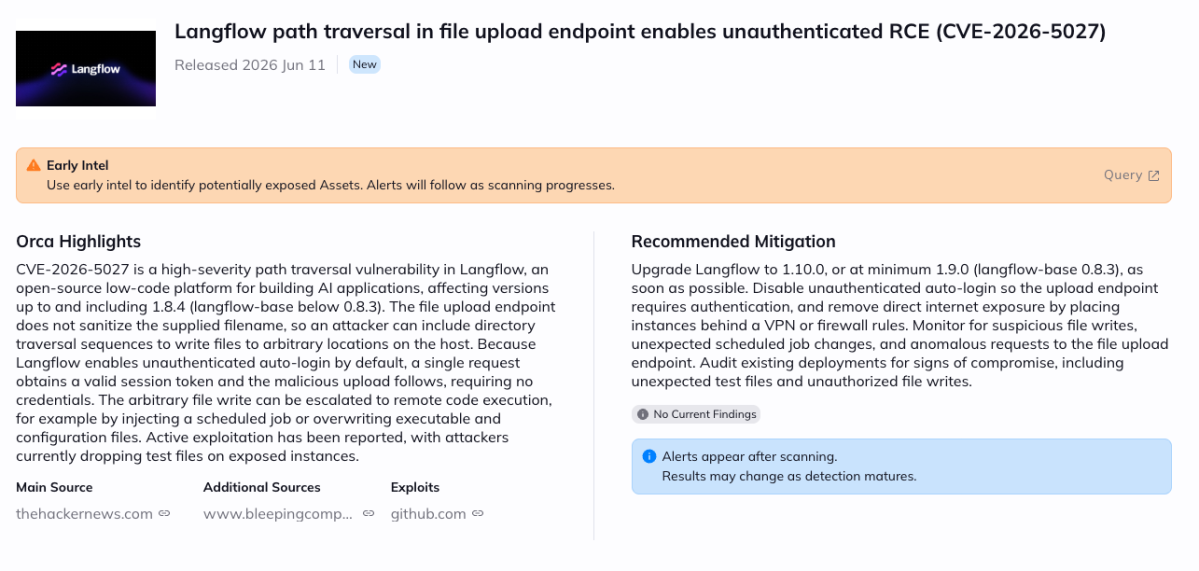
A screenshot of the Langflow RCE announcement in the Orca Platform