





Risk-based vulnerability management (RBVM) is the practice of prioritizing vulnerabilities by the actual risk they pose to your environment, rather than by raw severity, so your team fixes what is genuinely dangerous before what merely scores high. It evaluates vulnerabilities in the context of the asset they affect, its exposure, and the data it can reach, then keeps that assessment current as those conditions change.
The model breaks in a predictable place: the cloud moves faster than the score. A vulnerability that was reachable from the internet this afternoon may be isolated tonight after a deploy, and a Critical that mattered yesterday can become noise by the next sprint. Most programs never notice, because the finding was evaluated once and the ticket never reflected the change.
This guide answers two questions. First, what RBVM actually is and how it differs from the prioritization methodology that feeds it. Second, how to run it as a cloud program, where static scores and rule-based alert views stop being trustworthy and dynamic scoring, alert-lifecycle trust, remediation ownership, and metrics take over.
Risk-based vulnerability management (RBVM) is a program that scores, ranks, and remediates vulnerabilities according to the risk each one creates for a specific asset, not according to the CVSS base score printed on the CVE. Two assets can carry the identical vulnerability and deserve completely different responses, because risk depends on where the flaw lives, who can reach it, and what sits behind it.
Legacy vulnerability management treated severity as destiny. A scanner found a Critical, the Critical became a ticket, and the team worked the Criticals top to bottom until the window closed. That worked when assets were long-lived servers in a data center you controlled. It collapses when a single misconfiguration changes an asset’s exposure between two scans.
RBVM replaces severity-first triage with risk-first triage. The shift is less about a new scoring method and more about a new operating model: the program decides what to fix based on exposure and blast radius, keeps those priorities current, and proves the backlog is shrinking where it counts.
| Dimension | Legacy Vulnerability Management | Risk-Based Vulnerability Management |
|---|---|---|
| Primary sort | CVSS severity | Risk to the specific asset (exposure plus blast radius) |
| Scope of a score | The CVE, in the abstract | The CVE on this asset, in this configuration |
| Update cadence | Recomputed at the next scan | Recomputed when cloud state changes |
| Team output | A severity-sorted backlog | A short list of genuinely exposed findings |
| Success measure | Number of Criticals closed | Risk reduction on high-exposure assets over time |
For the broader fundamentals of building and running the underlying process, Orca’s guide to vulnerability management covers the lifecycle this program sits on top of.
Context-aware prioritization is the scoring method
RBVM is the program; context-aware prioritization is the method inside it. Prioritization decides how to score and rank one vulnerability against another. RBVM is the operating layer that keeps those scores current, assigns the work, and measures whether risk is actually falling.
Think of it as scoring versus running the program around the score. The methodology answers “which of these two findings is more dangerous, and why.” It weighs asset criticality, exploitability, threat intelligence, reachability, and attack paths into a single rank. That five-signal approach is explained in the context-aware cloud vulnerability prioritization framework, and this article focuses on the program that runs around it.
RBVM picks up where the ranking stops. A perfect rank is worthless if the score never updates after a deploy, if the ticket goes stale before anyone opens it, or if no one owns the fix. Those are program problems, and they are what the rest of this guide solves. Read the prioritization framework to learn how to score; read this to learn how to run the program that the score feeds.
A saved filter is a photograph, and the cloud is a film. Teams build rule-based views like “show every Critical CVE on a public-facing asset” and treat the result as a worklist. The query is correct the instant it runs and wrong by the next configuration change, because it captures a state, not a trajectory.
The mechanics are the problem. A static rule evaluates a condition against the data in front of it and returns rows. It cannot express “this was Critical until the security group closed an hour ago,” so the row either stays and misleads or vanishes with no signal that anything changed. Either way the analyst loses the thread.
That gap produces the backlog every program owner recognizes. Cyentia’s research has long shown that only a small fraction of published vulnerabilities are ever exploited in the wild, a theme the Zen guide to vulnerability prioritization explores through EPSS data. A rule-based view cannot tell the exploited few from the harmless many, so it surfaces volume and calls it coverage. Your team drowns in technically-true alerts, alert fatigue sets in, and the genuinely exposed finding sits three pages down. The fix is not a better filter. It is a score that moves on its own.
A static risk score is calculated at scan time and remains unchanged until the next scan. A dynamic risk score updates when the conditions that determine risk change, helping priorities reflect real exposure rather than a point-in-time snapshot.
Here is a common scenario. At 4 p.m., a scanner finds a critical remote-code-execution flaw on an internet-facing workload and creates a ticket. Overnight, a platform engineer closes the security group that exposed the asset. The exploit path is gone, but the ticket still reads Critical.
A static program never hears about the change. A dynamic program re-scores the finding as soon as the asset’s exposure changes, lowering its priority and keeping the queue aligned with real risk. The missing variable was never severity. It was time.
| Property | Static Risk Scoring | Dynamic Risk Scoring |
|---|---|---|
| Computed | Once, at scan time | Continuously, as state changes |
| Reacts to a closed security group | No, until the next scan | Yes, within the change |
| Reacts to a new public IP or role grant | No | Yes |
| Failure mode | Confident but stale priorities | Priorities that follow real exposure |
| Best fit | Stable, long-lived infrastructure | Ephemeral cloud assets that change hourly |
Dynamic scoring leans on signals like exploit probability and reachability rather than the base CVE number alone; the EPSS scoring system is one such input, and the exact 1-to-10 calculation lives in Orca’s write-up on granular alert scoring. The decision rule for a program owner is simple: if your assets change faster than your scan interval, a static score is wrong more often than it is right, and you should treat re-scoring as a requirement, not a feature.
Dynamic scoring fixes the number. The alert lifecycle decides whether anyone still believes it. An alert is not a static fact; it moves through detect, score, ticket, remediate, re-score, verify, and close. Most tools manage the first three stages well and abandon the alert after it becomes a ticket, which is where trust goes to die.
The stale-ticket scenario is the common one. A finding opens as Critical on Monday. By Thursday the workload has been redeployed from a patched image, but the ticket still sits in the queue exactly as written. An engineer finally picks it up on Friday, spends an hour reproducing a vulnerability that no longer exists, and learns to discount the next Critical that lands. One stale ticket teaches a whole team to distrust the queue.
Duplicates do the same damage from the other side. The same flaw reappears after the next scan, and without lifecycle tracking the system cannot tell whether this is a new finding, a duplicate of the open ticket, or the same issue escalating because exposure increased. The analyst sees three rows, cannot tell which is which, and triages by guesswork.
A working lifecycle closes the loop. When the cloud changes, the alert re-scores; when the fix lands, the alert verifies the asset and closes itself; when the same issue returns with more exposure, it escalates the existing ticket instead of spawning a new one.
Getting there means wiring remediation into the systems your team already lives in, the pattern Orca describes for remediation with Orca Missions and the monday.com workflow integration. The goal is a queue where an open ticket is always true right now, not true at the moment it was filed.
A score nobody owns is a score nobody fixes. Operationalizing RBVM means answering three questions the methodology cannot: who remediates, where the work happens, and how you prove it is working.
Get these right and the program runs smoothly; skip them and even perfect scoring produces a backlog that never shrinks.
Security rarely holds the keys to fix a finding. The asset owner does, whether that is a platform team, a service team, or an application group. Run RBVM by routing each high-risk finding to the team that can deploy the fix, with security acting as the broker that sets priority and tracks closure rather than the bottleneck that patches everything itself. Tie ownership to the asset tag so a re-scored finding always reaches the same accountable team.
Remediation that lives in a security console gets ignored by the engineers who do the work. Push findings into the ticketing and collaboration tools those teams already use, so a high-risk vulnerability arrives as a ticket in their board with the context and the fix attached. The bar to clear: an engineer should never log into a separate tool to learn why a finding matters or what to do about it.
You cannot manage what you do not measure, and severity counts measure the wrong thing. Track a small set of program metrics that prove risk is actually falling:
These outcomes are what a mature program produces. After consolidating onto a context-based platform, the team at Swiggy replaced thousands of uncontextual alerts with risk-based prioritization across 10,000+ containers; the Swiggy case study documents the shift. Stakeholder buy-in follows the same metrics: when an executive can see risk falling on the assets that matter, the program earns its budget.
Everything above describes the program; Orca is one way to run it. The Orca Cloud Security Platform uses agentless SideScanning™ to read your workloads, configurations, identities, and data with no sensors to deploy, then scores every vulnerability on a single context graph rather than in isolation. Because the graph updates as the cloud changes, risk scores update with it, making dynamic re-scoring and a trustworthy alert lifecycle possible in practice.
The screenshots below show the program principles working in product. For how the underlying signals are weighed into a rank, follow the context-aware prioritization framework; the captions here stay on what RBVM does, not how to score.
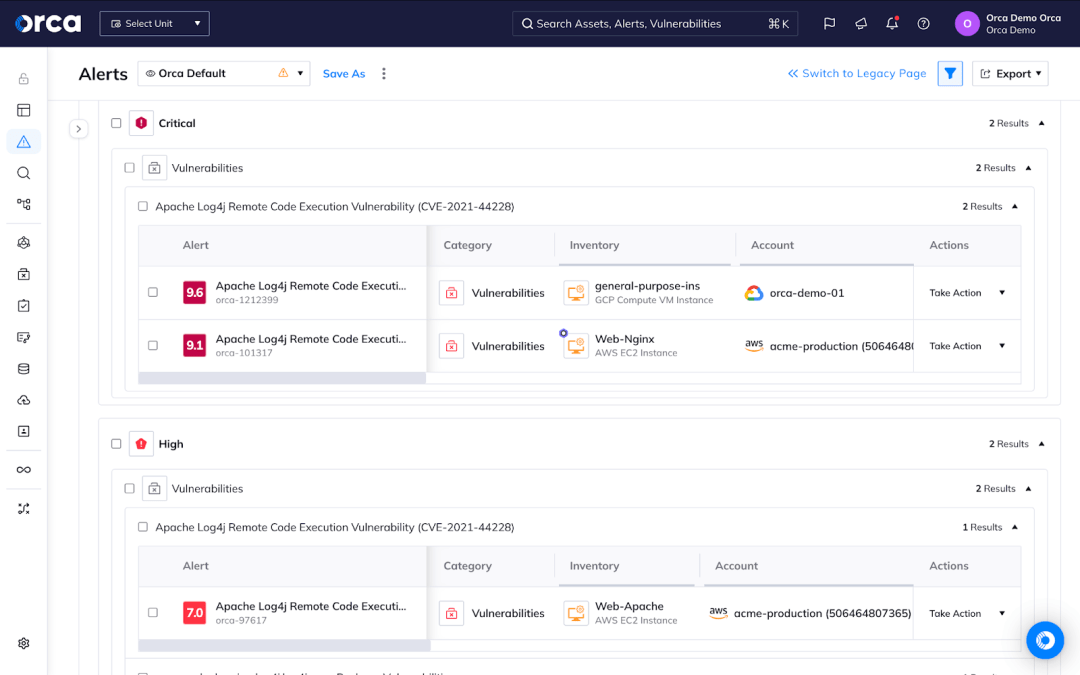
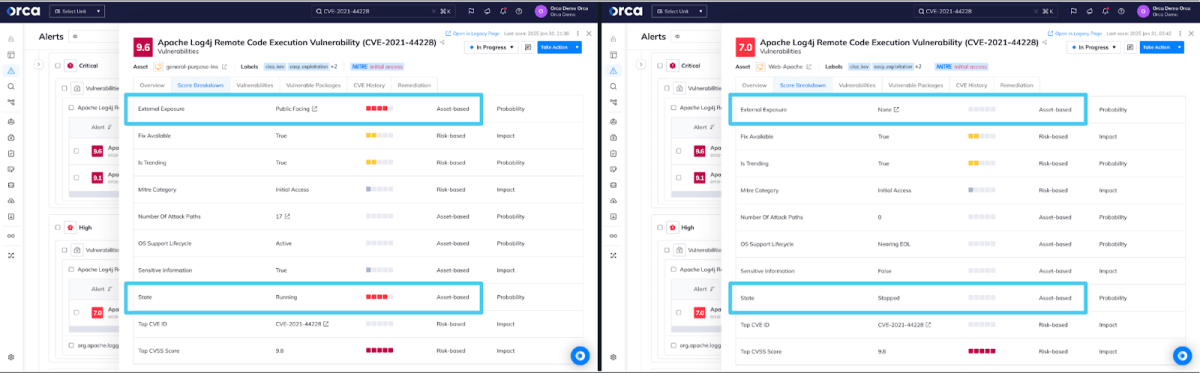
The same Log4j vulnerability (CVE-2021-44228) can carry very different Orca risk scores on two different assets, because the platform scores the flaw on the asset, not the CVE in the abstract. One instance sits on an isolated internal workload; the other has a path to the internet.
When an asset’s context changes, its score changes with it. An exposed, internet-facing workload scores higher than the identical workload behind a closed security group, which is exactly the overnight-fix scenario resolving itself without a human re-triaging the ticket.
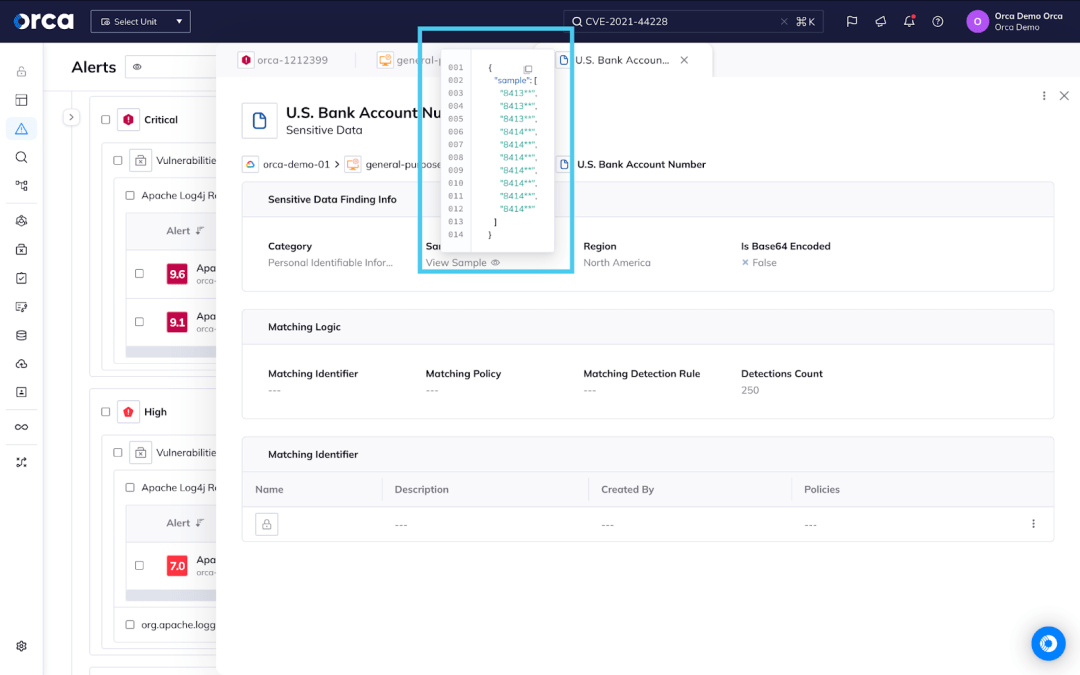
A vulnerability that opens a path to sensitive data outranks one that leads nowhere. Orca traces attack path analysis and data sensitivity into the score, so a finding on a workload that can reach a customer-data store rises above an equally severe finding that is contained.
Risk-based vulnerability management is about more than scoring. The score still matters, but in the cloud it is only true for as long as the asset stays the way the scanner found it, which is rarely more than a few hours. Running RBVM as a program means accepting that the work is continuous: re-score as the cloud moves, keep the alert lifecycle honest, give every high-risk finding an owner, and measure risk reduction where exposure is real.
That is the difference between a backlog you fight and a short list you finish. See how Orca scores vulnerabilities in context and keeps that score current as your cloud changes.
Does RBVM replace CVSS?
No. CVSS remains a useful severity signal, but RBVM treats it as one input rather than the final answer. A high-CVSS vulnerability on an isolated asset may pose less risk than a lower-severity flaw on an internet-facing workload with access to sensitive data. RBVM combines severity with context such as exposure, exploitability, and asset criticality to determine remediation priority.
Can RBVM work without dynamic risk scoring?
Yes, but its effectiveness is limited in cloud environments. If risk scores remain static while assets, identities, and network exposure change, prioritization quickly becomes outdated. Dynamic risk scoring helps ensure that remediation efforts stay aligned with current risk rather than conditions captured during the last scan.
Which vulnerabilities should be fixed first in an RBVM program?
The highest-priority vulnerabilities are typically those that combine real-world exploitability, active exposure, and access to critical systems or sensitive data. For example, a medium-severity vulnerability on an internet-facing production workload may deserve attention before a critical vulnerability on an isolated development asset.
Is RBVM only relevant for cloud environments?
No. RBVM can improve prioritization in on-premises, hybrid, and cloud environments. However, it becomes especially valuable in cloud environments because infrastructure, identities, and network exposure can change rapidly, making static prioritization less reliable.
How do you measure whether RBVM is working?
Effective RBVM programs measure outcomes rather than activity. Common metrics include mean time to remediate (MTTR) for high-risk findings, high-risk closure rates, risk reduction on critical assets, and the amount of alert noise removed through dynamic re-scoring. The goal is not to close the most vulnerabilities, but to reduce the most risk.
此内容由惯性聚合(RSS阅读器)自动聚合整理,仅供阅读参考。 原文来自 — 版权归原作者所有。