





Cloud environments move fast, and attackers know it. Traditional security tools built for static infrastructure often fail to detect the complex, multi-stage threats that unfold across cloud workloads, identities, APIs, and containers. Cloud Detection and Response (CDR) was designed to close that visibility gap by providing real-time threat detection, attack correlation, and rapid response capabilities tailored specifically for modern cloud-native environments. In this article, we explore how CDR works, why it matters, and what organizations should look for when evaluating a solution.
Most security teams can tell you exactly what their CSPM tool found last week. Ask them what happened inside their cloud workloads at 2 am on Tuesday, and the answer gets much murkier. That visibility gap is the core problem CDR solves. Misconfigurations matter. But attackers who are already inside your environment, moving laterally and escalating privileges, require a different class of detection entirely. This article covers what CDR is, why existing tools fall short, how CDR works technically, and what to look for when evaluating a solution.
Cloud detection and response (CDR) is a security discipline that continuously monitors cloud environments for active threats, correlates signals across workloads, control planes, identities, and APIs, and triggers automated or guided response actions to contain incidents before they cause material damage.
CDR is purpose-built for cloud-native attack patterns that traditional endpoint detection and response (EDR) tools miss. EDR agents monitor processes and files on individual hosts. CDR monitors behavior across VMs, containers, serverless functions, Kubernetes clusters, cloud APIs, and IAM activity simultaneously. A lateral movement path that crosses from a compromised EC2 instance through an IAM role assumption into an S3 bucket containing PII does not look like a single host event. CDR detects it as one multi-step cloud attack.
The IBM’s 2025 Cost of a Data Breach Report found that the global average cost of a data breach reached $4.44 million, while breaches that took longer than 200 days to contain cost organizations significantly more on average.
Legacy detection tools were built for environments with stable perimeters and long-lived hosts. Cloud environments are ephemeral, multi-tenant, and API-driven. A containerized workload may exist for 30 seconds. A serverless function invocation may last 500 milliseconds. Traditional tools that rely on persistent agents and endpoint telemetry produce coverage gaps across exactly these workload types.
MITRE ATT&CK for Cloud documents 71 techniques across 14 tactics specific to cloud environments, including API-based initial access (T1190), IAM credential theft (T1552.001), container escape to host (T1611), and data exfiltration via cloud storage (T1537). None of these techniques produce the host-level signals that EDR tools are designed to detect.
CDR addresses this by collecting telemetry from cloud provider APIs (CloudTrail, Azure Activity Log, GCP Audit Logs), workload runtime sensors, container runtime events, and network flow data, then correlating them into unified incident timelines that show attacker movement across the full cloud environment. For a foundational understanding of the posture management layer that CDR sits on top of, see What Is CSPM (Cloud Security Posture Management)?
CDR reduces alert fatigue by correlating low-fidelity individual signals into high-confidence incident findings, rather than forwarding every raw event to a SIEM for manual triage. A single lateral movement incident in a cloud environment may generate hundreds of individual API call events, IAM permission checks, and network connection logs. Without correlation, each event is a separate alert. With CDR, they become one prioritized incident with an attack timeline and a recommended response action.
Orca Security’s 2025 State of Cloud Security Report found that 36% of organizations have at least one cloud asset supporting more than 100 attack paths, highlighting how difficult it has become for security teams to prioritize the risks that matter most. CDR’s correlation engine reduces that burden by surfacing only findings tied to confirmed attack progression patterns.
CDR compresses mean time to respond (MTTR) by providing responders with pre-built attack context at the time of alert. Instead of spending hours reconstructing an attacker’s movement path from raw logs, a CDR platform presents the full incident timeline: initial access vector, lateral movement steps, resources accessed, data touched, and current attacker position in the environment.
NIST SP 800-61 Rev 2 (Computer Security Incident Handling Guide) defines the four phases of incident response as preparation, detection and analysis, containment, and recovery. CDR automates the detection and analysis phase by correlating signals into structured incident reports. It accelerates the containment phase by providing one-click response actions like isolating a compromised VM, revoking an IAM role, or blocking a malicious IP at the network layer.
CDR works by collecting telemetry from every layer of the cloud environment, applying behavioral detection rules and anomaly detection models to identify threat patterns, and producing prioritized incident findings with response guidance. The detection pipeline runs in four stages.
Telemetry collection. CDR ingests data from cloud provider audit logs, workload runtime sensors, container runtime events, Kubernetes audit logs, network flow records, and identity activity logs. The scope covers the control plane (who changed what in the cloud configuration) and the data plane (what happened inside workloads at runtime).
Behavioral analysis. Detection rules mapped to MITRE ATT&CK for Cloud techniques identify known attack patterns. Anomaly detection models identify deviations from established behavioral baselines, such as a service account that has never made cross-region API calls suddenly doing so at 3am.
Signal correlation. Individual detection signals are correlated across data sources and time to reconstruct attacker movement paths. A CDR platform identifies that the same actor who authenticated using a stolen credential (T1078.004) also performed an IAM role assumption (T1548.005) and accessed a sensitive S3 bucket (T1530) within a 20-minute window.
Response orchestration. Prioritized incidents are delivered to security teams with pre-populated response playbooks. Automated containment actions including suspending a compromised compute instance or revoking a service account’s active sessions can be triggered manually or fired automatically based on incident severity thresholds.
A CDR solution must provide continuous, real-time coverage across all cloud providers in use, not just the primary provider. According to Orca Security’s 2025 State of Cloud Security Report, multi-cloud adoption is now the norm, with 55% of organizations operating across two or more cloud providers. A CDR tool that covers only AWS while leaving Azure and GCP unmonitored creates a blind spot attackers can exploit.
Coverage must extend to all workload types: VMs, containers, serverless functions, Kubernetes clusters, managed services, and APIs. MITRE ATT&CK for Cloud technique T1610 (Deploy Container) documents how attackers use unauthorized container deployments as a persistence mechanism. A CDR solution that monitors EC2 instances but not ECS or EKS tasks will miss this technique entirely.
CDR response capabilities separate tools that detect threats from tools that help you contain them. Effective response features include one-click workload isolation, IAM credential revocation, security group modification, and integration with SOAR platforms for automated playbook execution.
Response actions should be scoped to limit blast radius. Isolating a compromised container should not take down the entire Kubernetes node. Revoking a service account’s credentials should not break dependent workloads that share those credentials. A CDR platform that provides targeted, granular response actions rather than coarse isolation is operationally safer during active incidents.
Effective CDR correlates signals across the cloud control plane, workload runtime, network layer, and identity systems. An attacker who gains initial access via an exposed API key (MITRE T1552.001), escalates privileges through an IAM role assumption (T1548.005), and then exfiltrates data through a misconfigured S3 bucket (T1537) produces signals in three separate data sources. CDR connects those signals into one incident timeline.
Identity correlation is especially important. CISA Advisory AA23-061A (March 2023) documented SVR (APT29) using compromised service account credentials to move laterally across Azure AD and access Microsoft 365 data. Without correlation between cloud API activity and IAM events, this movement pattern looks like normal service account behavior until data exfiltration is already complete.
A CDR solution should ship with detection coverage for the full MITRE ATT&CK for Cloud technique set, including remote code execution on cloud workloads, cryptomining via unauthorized compute provisioning, container escape to host, privilege escalation through IAM misconfiguration, and lateral movement across VPC boundaries.
Detection rules should be transparent. When a CDR tool fires an alert for “suspicious IAM activity,” the alert should specify which API calls triggered it, which MITRE technique it maps to, and what threshold was exceeded. Opaque detection rules that produce alerts without explainable evidence slow investigation and erode responder trust in the tool.
CDR platforms that include network exposure simulation allow security teams to validate which attack paths are actually reachable from outside the environment, rather than relying on theoretical risk assessments. Simulating external access to an API endpoint can confirm whether a misconfigured security group allows unauthenticated requests or whether a suspected exposure is blocked by an upstream control.
This is not the same as penetration testing. Exposure simulation runs continuously against the current state of the cloud environment, so a new security group rule that inadvertently opens port 8443 to the internet is flagged within minutes of the change, not at the next quarterly pentest.
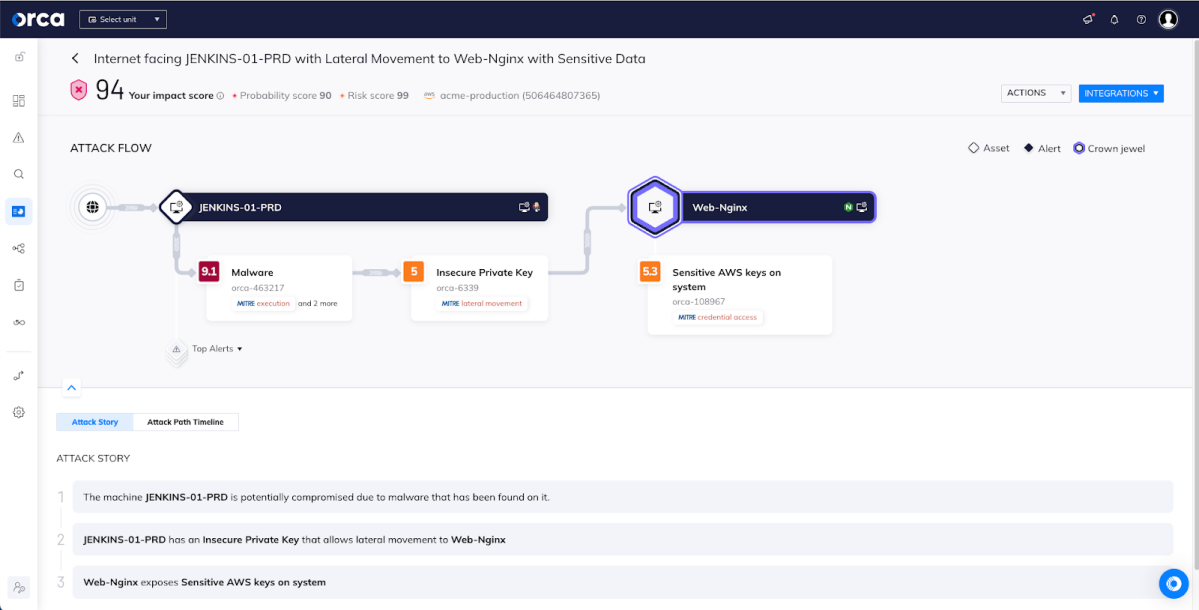
Orca provides a visual representation of validated attack paths, as shown in the diagram above, with detailed MITRE ATT&CK tags for each step. As you can see, the path begins with an internet-facing entry point (potentially simulated/validated for external reachability), moves laterally via insecure credentials, and ends in exposure of sensitive AWS keys, highlighting how exposure simulation confirms these chains are live and exploitable in the current environment.
CDR should integrate with SIEM platforms (Splunk, Microsoft Sentinel, IBM QRadar), SOAR platforms (Palo Alto XSOAR, Swimlane), ticketing systems (Jira, ServiceNow), and cloud provider native security services (AWS Security Hub, Azure Defender, Google Security Command Center). NIST SP 800-137 (Information Security Continuous Monitoring) specifies that detection tools must feed normalized data to centralized monitoring systems to enable enterprise-wide visibility.
A CDR tool that produces findings only within its own console, with no export or integration capability, creates a parallel security workflow that fragments the incident response process. For context on how CDR fits within a broader cloud workload protection strategy, see What Is CWPP (Cloud Workload Protection Platform)?
Cloud forensics at scale is a capability that many organizations discover they lack only after an incident. In traditional environments, forensic investigation means imaging a disk, capturing memory, and analyzing logs from a known persistent host. In cloud environments, the workload may be gone by the time the investigation starts.
This scenario is common in real incident responses. A containerized application is compromised, the container terminates as part of normal orchestration, and the forensic evidence terminates with it. Without pre-collection of runtime telemetry and memory snapshots, the investigation starts from partial evidence.
Effective CDR addresses this by collecting forensic data continuously during normal operations, not only after an incident is declared. Runtime behavioral snapshots, process trees, network connection histories, and file access logs are retained and available for forensic analysis regardless of whether the workload that generated them is still running.
NIST SP 800-86 (Guide to Integrating Forensic Techniques into Incident Response) recommends that organizations define data retention requirements for forensic evidence before incidents occur and implement automated collection mechanisms that do not depend on the availability of the affected system. CDR platforms that retain workload-level telemetry for 30 to 90 days meet this requirement for most cloud incident investigation timelines.
Scale matters here. A large cloud environment with thousands of workloads generates forensic data volumes that cannot be manually reviewed. CDR forensics capabilities must include search and correlation tools that let investigators query across all retained telemetry, filter by time range, workload identity, network destination, or process name, and reconstruct attacker timelines without manual log parsing.
CDR closes the visibility gap that CSPM and EDR leave open: runtime attacker behavior inside cloud environments, across workloads that may exist for seconds. The core requirement is correlation, bringing together cloud API events, workload telemetry, identity activity, and network data into incident timelines that tell you what happened, in what order, and what to do next.
Start with the workload types that EDR cannot cover: containers, serverless functions, and managed services. Those are where cloud-native attackers move when they know agent-based tools are watching the endpoints. For a broader view of where CDR fits within a mature cloud security program, see Where to Start Your Cloud Security Program.
Orca Security’s CDR capabilities combine agentless SideScanning™ with an optional runtime sensor to provide coverage across the full cloud attack surface. SideScanning™ reads workload artifacts and cloud metadata directly from block storage and cloud APIs, delivering visibility into software, vulnerabilities, secrets, malware, and misconfigurations without requiring a deployed agent on each VM, container, or function. This produces immediate coverage of every workload in the environment, including unmanaged assets and shadow IT deployments that agent-based tools miss.
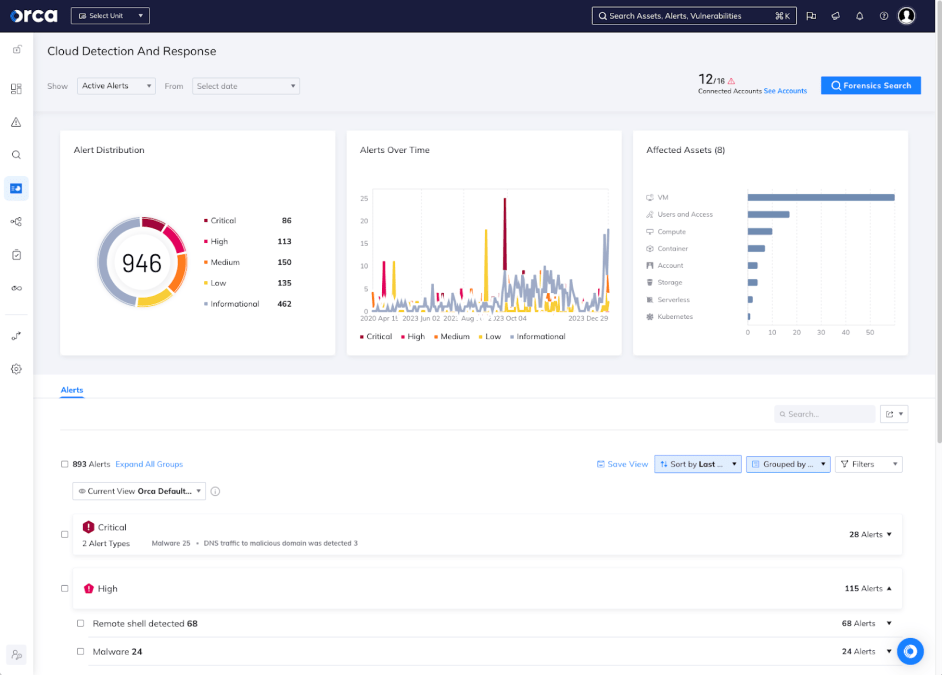
Orca Security’s runtime sensor adds behavioral detection at the workload level for organizations that require process-level and file-level telemetry alongside cloud API monitoring. Both collection methods feed a unified detection engine that correlates signals across the control plane, workload runtime, network layer, and identity systems into single incident timelines. Each incident finding includes the MITRE ATT&CK technique mapping, the full attack timeline, and a prioritized list of affected resources sorted by business impact. Orca Security was named a Representative Vendor in the 2025 Gartner® Market Guide for Cloud-Native Application Protection Platforms (CNAPP), evaluated on criteria that include runtime threat detection, agentless coverage, and multi-cloud support.
What Are the Biggest Challenges When Deploying CDR?
Deploying CDR can be challenging because cloud environments are highly dynamic and generate large volumes of telemetry. Security teams often struggle with achieving full visibility across multi-cloud environments while reducing false positives and alert fatigue.
Can CDR Replace SIEM or CSPM?
CDR does not replace SIEM or CSPM because each serves a different purpose. CSPM identifies misconfigurations, SIEM centralizes log management, and CDR focuses on detecting and responding to active cloud threats at runtime.
Does CDR Require Agents?
Not necessarily. Many modern CDR platforms use agentless approaches that collect telemetry directly from cloud provider APIs. Some organizations also deploy lightweight runtime sensors for deeper process and workload visibility.
How Much Telemetry Does CDR Generate?
CDR platforms generate significant telemetry from cloud APIs, workloads, containers, identities, and network activity. Effective platforms reduce noise by correlating events into prioritized incidents instead of surfacing raw alerts individually.
What Skills Are Needed to Operate a CDR Platform?
Operating a CDR platform requires knowledge of cloud infrastructure, IAM security, containers, Kubernetes, and incident response. Security teams also need experience analyzing cloud-native attack techniques and behavioral telemetry.
What Are Common False Positives in CDR?
Common false positives include legitimate DevOps automation, backup operations, infrastructure deployments, and administrative API activity that may resemble attacker behavior without proper context.
How Does CDR Support Compliance Investigations?
CDR supports compliance investigations by retaining audit logs, forensic telemetry, and incident timelines that help organizations investigate security events and demonstrate continuous monitoring during audits.
此内容由惯性聚合(RSS阅读器)自动聚合整理,仅供阅读参考。 原文来自 — 版权归原作者所有。