


惯性聚合 高效追踪和阅读你感兴趣的博客、新闻、科技资讯
阅读原文 在惯性聚合中打开

推荐订阅源

IT之家
IT之家
A
About on SuperTechFans
OSCHINA 社区最新新闻
OSCHINA 社区最新新闻
N
Netflix TechBlog - Medium
Microsoft Security Blog
钛媒体:引领未来商业与生活新知
钛媒体:引领未来商业与生活新知
博客园 - 三生石上(FineUI控件)
博客园 - 聂微东
博客园 - Franky
D
Docker
Martin Fowler
Martin Fowler
Engineering at Meta
Engineering at Meta
The Cloudflare Blog
人人都是产品经理
人人都是产品经理
Last Week in AI
Last Week in AI
U
Unit 42
F
Fortinet All Blogs
H
Help Net Security
Blog — PlanetScale
Blog — PlanetScale
Microsoft Azure Blog
罗磊的独立博客
P
Proofpoint News Feed
月光博客
月光博客
G
Google Developers Blog

Blog | Orca Security

Langflow RCE Actively Exploited to Deploy Cryptominers on AI Infrastructure Orca MCP: When Text Stops Scaling Kubernetes Compliance Tools: Automating CIS Benchmarks Risk-Based Vulnerability Management for the Cloud: A 2026 Guide Private Cloud Security: Top Risks and Best Practices (2026) What Is Generative AI in Cybersecurity? Best Vulnerability Management Tools and Software in 2026 2026 State of Application Security Report Recap: What the Data Says and What Security Teams Should Do About It AI Security for Sensitive Data: Best Practices and Guidelines Best AI Code Security Solutions 2026: How to Secure AI-Generated Code From Platform to Program: How to Ensure Your Cloud Security Solution Delivers Best AI Cybersecurity Providers 2026: A Buyer's Guide to AI-Powered Security Platforms Join Orca Security at Black Hat USA 2026 CNAPP Tools That Reduce Security Tool Sprawl: CNAPP vs. Dedicated Solutions What Is Container Runtime Security? A Practical Guide 2026 What Is Application Security Testing? Tools and Types What Is Managed Cloud Security? A Practical Guide What Is SaaS Security Posture Management? SSPM Guide Top 10 Cloud Security Standards for Compliance What is the MIT License? Compliance and Comparisons AI Agents vs. Agentless Security vs. Agent-based Security 144 Mastra npm Packages Compromised via Supply Chain Attack The Complete Guide to LLM Security: Risks, Best Practices, and Solutions Cloud Security LIVE 2026: Top 10 Takeaways Practitioners Can Use Now Cloud Security LIVE 2026: Top 10 Takeaways CISOs Can Use Now (and What to Do Next) How Orca Traced an nginx Flaw to 1.45 Million Tengine Servers All Running Vulnerable Code What to Look for in Container Security Tools Cloud Application Security Best Practices for DevSecOps Cloud Security Tools: 10 Types Explained for Teams What Is NIST CSF? Framework 2.0 Explained
Critical PhpSpreadsheet RCE Patch Bypass Puts Millions at...
The Orca Research Pod · 2026-06-12 · via Blog | Orca Security

Executive Summary

A critical vulnerability (CVE-2026-45034, CVSS 9.8) was disclosed affecting PhpSpreadsheet, the widely-used PHP library with over 312 million downloads, allowing attackers to achieve remote code execution via a bypass of the previous wrapper protection mechanism. Due to the potential for full server compromise and data exposure, immediate patching is required.

About the Vulnerability: CVE-2026-45034

The issue originates from the File::prohibitWrappers() function introduced to fix CVE-2026-34084, where a quirk in PHP’s parse_url() function leads to a complete bypass of stream wrapper detection. When a path contains three or more slashes after the scheme (e.g., phar:///path/to/exploit.phar/dummy.csv), parse_url() returns false instead of the expected scheme string. This causes the is_string($scheme) check to be skipped entirely, while PHP’s stream layer still recognizes the path as a valid phar wrapper. By sending a specially crafted filename containing triple slashes to IOFactory::load(), attackers can trigger automatic phar metadata deserialization on PHP 7.x, potentially gaining full remote code execution. On PHP 8.x, the same technique yields a file read primitive, with RCE restored if the application later invokes Phar::getMetadata(). No authentication is required to exploit this issue when the filename argument is user-controlled.

The following versions are affected:

  • phpoffice/phpspreadsheet, all 1.x versions through 1.30.4

These components are used by thousands of PHP applications and frameworks that rely on PhpSpreadsheet for reading and writing Excel, CSV, and other spreadsheet formats, particularly when file upload or import functionality is enabled. Other frameworks or services relying on PhpSpreadsheet’s IOFactory::load() with user-supplied filenames may also be impacted.

Risk Impact

At the time of writing, a working proof-of-concept and full exploit chain (exploit.phar) are publicly available, disclosed by researcher @everping. While no confirmed exploitation in the wild has been reported yet, the public availability of the PoC significantly increases the likelihood of active exploitation. Organizations that previously patched against CVE-2026-34084 should be aware that the earlier patch was proven incomplete.

Successful exploitation could allow attackers to execute arbitrary code on the server, read sensitive files from the filesystem, and potentially pivot to compromise additional infrastructure, leading to service disruption, data exposure, or full infrastructure compromise.

Mitigation Recommendations

Upgrade to the following patched version immediately:

  • PhpSpreadsheet 1.30.5, which addresses this bypass

Additionally:

  • Organizations that previously patched against CVE-2026-34084 should verify they have also applied this latest fix, as the earlier patch was proven incomplete
  • Replace parse_url()-based wrapper detection with string containment checks (such as str_contains($filename, ‘://’)) in any custom validation code
  • Ensure that IOFactory::load() never receives unsanitized user-controlled filenames

How can Orca help?

Orca enables customers to quickly identify assets running vulnerable versions of PhpSpreadsheet, understand their exposure in context, including internet accessibility, runtime reachability, and asset criticality, and prioritize remediation based on real risk rather than CVSS alone. Orca’s platform highlights affected assets directly in the newItem view, helping security teams focus on the most critical remediation paths first.
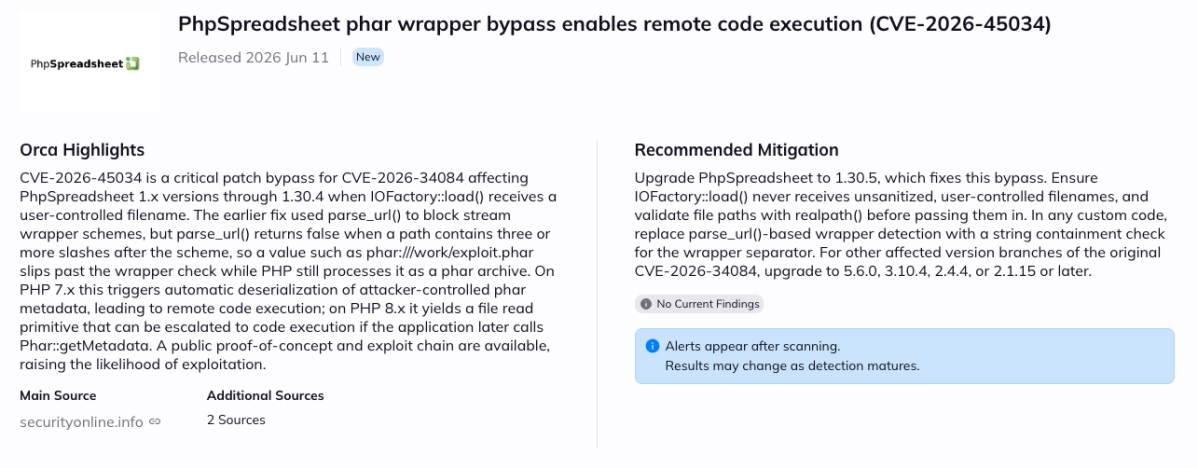
A screenshot of the PHPspreadsheet CVE alert in the Orca Platform