








A lot happens under this administration, but a lot un-happens, too.
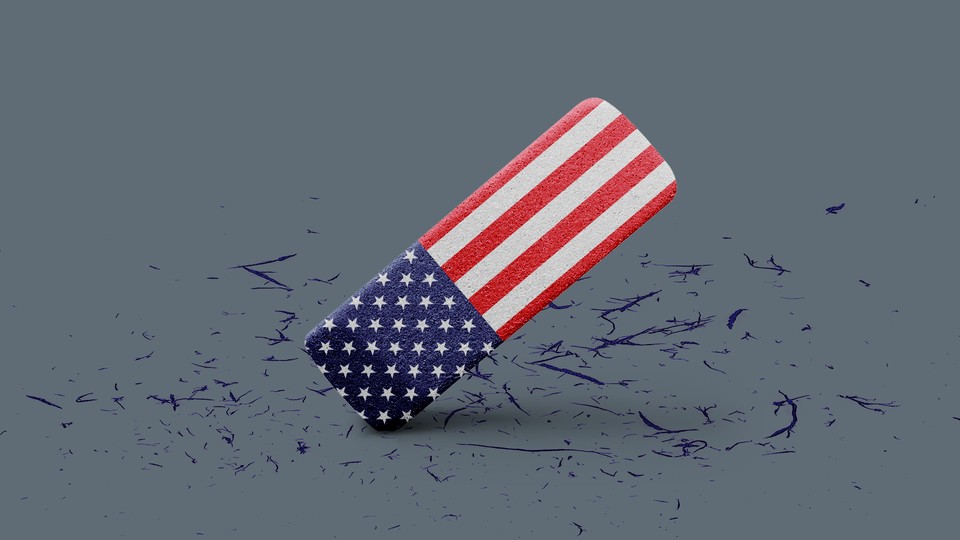
A useful one-sentence guide to the second Trump administration might go something like this: A lot happens under Donald Trump, but a lot un-happens, too.
In the past four months, President Trump has announced tariffs on Canada, paused tariffs on Canada, restarted tariffs on Canada, ruled out tariffs on certain Canadian goods, and then ruled in, and even raised, tariffs on Canadian steel and aluminum.
And that’s just for starters. On April 2, so-called Liberation Day, Trump announced a broader set of tariffs on almost every country in the world. Soon after, the plan was half-suspended. Then Trump announced a new set of elevated tariffs on China, from which he backtracked as well. Next the courts, as often happens, took over the job of erasing the president’s previously announced policies. Last week, a trade court struck down the president’s entire Liberation Day tariff regime as unconstitutional, only for a federal circuit court to reinstate the tariffs shortly thereafter. Now a higher court has the opportunity to do the funniest thing: undo the undoing of the undoing of the tariffs, which have been in a permanent state of being undone ever since they were created.
Got all that? No, you most certainly do not, and neither does anybody else. Economists and corporate executives I’ve interviewed to understand future tariff policy have communicated to me a combination of confusion, fury, and resignation. Commentators have noticed the chaos too, of course. Observing how frequently Trump seems to back out of his own brinkmanship, the Financial Times columnist Robert Armstrong memorably deemed this trend TACO, or “Trump Always Chickens Out.”
David A. Graham: The TACO presidency
Un-happening doesn’t affect just trade and economic policy. In the realm of foreign policy, the Trump administration paused intelligence sharing with Ukraine after the ignominious on-camera spat between Ukrainian President Volodymyr Zelensky and Vice President J. D. Vance. Trump went further, claiming that Ukraine had started the war and that Zelensky was a dictator—raising the prospect that the administration was on the verge of explicitly aligning with Russia. Days later, the administration reversed course and resumed intelligence sharing and security assistance. Trump has since attacked Russian President Vladimir Putin for being “absolutely CRAZY!”
Un-happening also affects media, immigration, science, and education policy. Judges have ruled that the administration improperly froze grant money, inappropriately blocked the Associated Press from the White House press pool, and illegally sought to place sanctions on law firms that have done work, or employed lawyers, that Trump found unsuitable. On immigration, judges have blocked several of the administration’s measures, including its invocation of the Alien Enemies Act to remove migrants and its attempt to bar Harvard’s international students. Federal judges have blocked so much of the Trump agenda that White House Deputy Chief of Staff Stephen Miller has described the constitutional balance of power as a form of “judicial tyranny.” “I know this is inflammatory,” Vance said in an interview with The New York Times, “but I think you are seeing an effort by the courts to quite literally overturn the will of the American people.”
The administration’s claims to monarchical power are a real threat to America’s constitutional order. But its executive orders and policy feints are so haphazard and poorly articulated that they amount to a kind of autocratic takeover written in smudge-able crayon: terrifying, cartoonish, and vulnerable to erasure, all at once.
J. Michael Luttig: The end of rule of law in America
This is not to say that Americans should ignore Trump’s efforts to make confetti of the Constitution. Rather, when evaluating any one Trump policy, one has to keep front of mind the possibility that it simply won’t exist by the end of the week. Despite an energetic effort by some right-wing intellectuals to make Trump out to be some kind of 14-dimensional-chess player, his approach doesn’t resemble chess so much as a denial-of-service attack on a functioning government.
All this un-happening shows both the upside and the downside of Trump’s political instincts. The president’s slippery relationship to his own policy agenda can serve as a kind of superpower, as Ross Douthat wrote in The New York Times. The TACO reputation is “crucial to Trump’s political resilience,” because “the willingness to swerve and backpedal and contradict himself is a big part of what keeps the president viable.” The constant backtracking gives Trump the ability to both bend the Constitution to its breaking point and always step back to claim that “anything extreme is also provisional,” Douthat wrote. Indeed, Trump’s approval rating for trade has rebounded since its Liberation Day implosion, according to several polls.
Questions of popularity aside, however, businesses tend to prefer certainty over promises and threats that keep disappearing. At some point, Trump’s pledge to reinvigorate American industry and energy will require fat investments in factories and supply chains. Multi-hundred-million-dollar investments require clear expectations of financial return. Those aren’t going to happen in a world where each policy idea boasts a half-life of 48 hours. Steve Bannon coined one of the most famous Trump-world truisms when he revealed MAGA’s media strategy to “flood the zone with shit.” Far stranger, however, is the administration’s insistence on flooding the policy zone with Schrödinger’s cats—executive orders and Truth Social posts that exist in a liminal state among existence, nonexistence, and imminent radioactive decay.
The substantive problem with the MAGA agenda isn’t just that too much is happening for any median voter to follow; it’s that too much is un-happening for employers, investors, and consumers to know what the hell to do about it.
此内容由惯性聚合(RSS阅读器)自动聚合整理,仅供阅读参考。 原文来自 — 版权归原作者所有。