




Welcome to the reading list, a weekly roundup of news and links related to buildings, infrastructure, and industrial technology. This week we look at city permitting speeds, more efficient ground source heat pump drilling, an Amazon Air crash in Miami, cooling paint, and more. Roughly 2/3rds of the reading list is paywalled, so for full access become a paid subscriber.
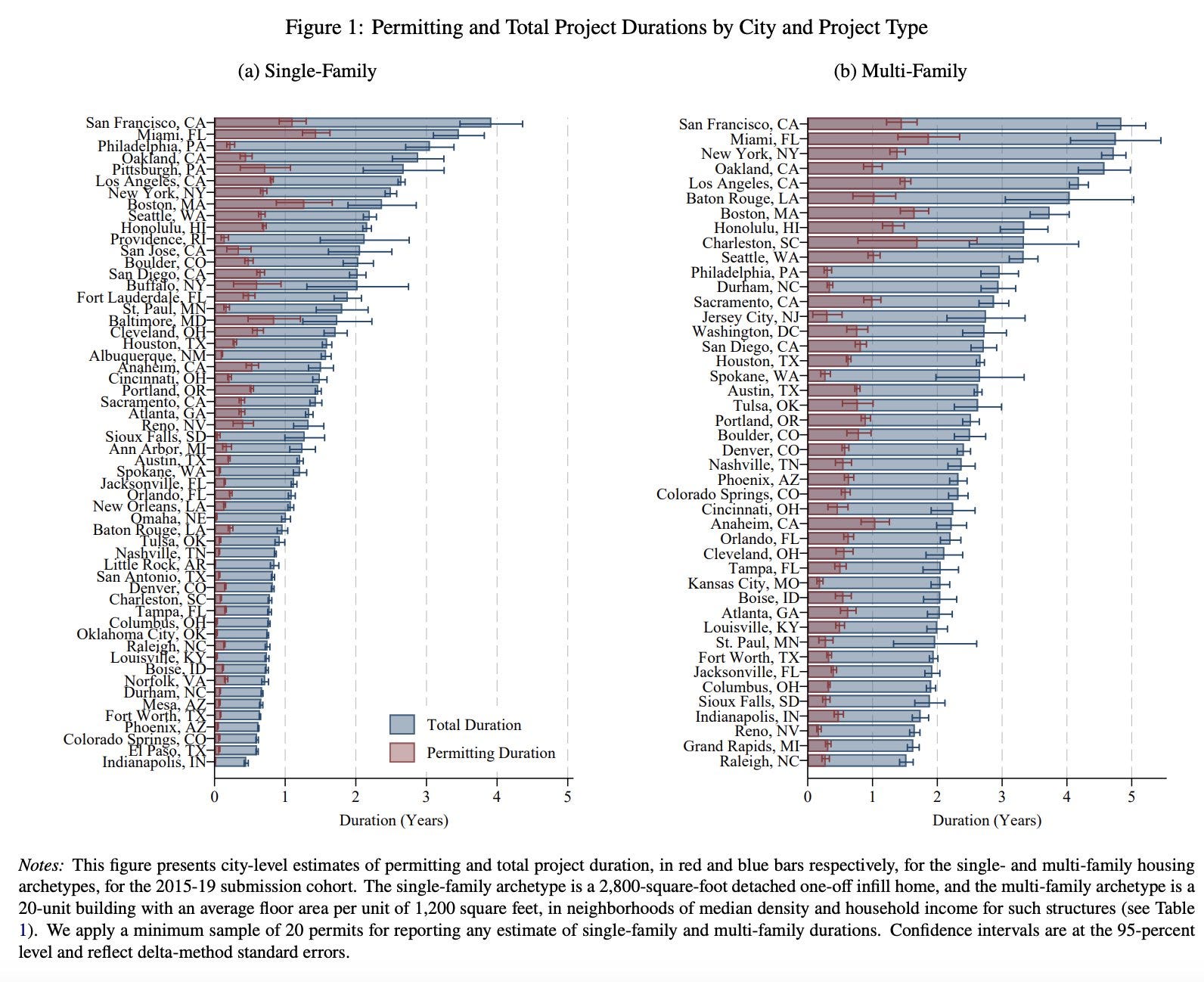
Economists Evan Soltas and Leonardo D’Amico have a new paper looking at permitting and construction speeds for housing in various cities in the US. The fastest cities are done with construction before the slowest cities have even issued a permit! [X]
Another setback for California Forever, the California city being planned in Solano County. A proposal to let the planned shipyard avoid completing a CEQA-required years-long environmental review (by using an existing environmental impact report) has been punted “to an unspecified date,” effectively killing the proposal for the rest of the year. [NYT]
A recent study suggests that home values don’t decline when a wind or solar farm is built nearby. “Researchers at Ball State University analyzed Indiana home sales from 2004 through 2024, comparing prices before and after large wind and solar projects came online. They also compared homes close to the projects with those farther away. The researchers found no statistically significant negative effect on residential sale prices near either commercial wind turbines or utility-scale solar farms.” [Electrek]
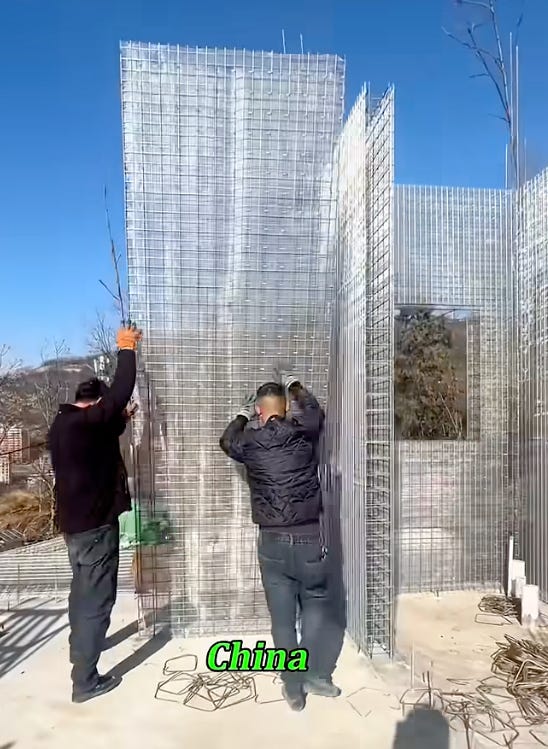
An interesting building technology, supposedly used in China for residential construction: hollow prefabricated wall panels lined with steel mesh and (it looks like) plastic sheets. Once in place, the panels are filled with concrete. [YouTube]
A cool map which shows how LA got built year by year, starting in 1880. [Parcelscope]
Fab2, the semiconductor equipment startup co-founded by Sam Zeloof (who famously made transistors in his parents garage) raised $500 million in funding at a $3.7 billion valuation. [X]
ASML begins construction of a new production facility in the Netherlands. “The investment will eventually add space for up to 20,000 workers, with a first phase targeting completion by 2029 that will add offices, logistics and a so-called cleanroom space — a controlled environment for specialist equipment manufacturing. ASML said the design of a new “Flow Factory” will enable it to build and assemble its giant chip-printing tools more quickly and efficiently.” [Reuters]
Intel has processed more than 1 million wafers using ASML’s most advanced High NA EUV machines, more than the rest of the semiconductor industry combined. [Tom’s Hardware]
A huge, nine-year long investigation to find evidence of cold fusion turned up nothing. “We searched a wide swath of the loading, stimulation, and material parameter space associated with LENR. Although we didn’t test every possible corner of the parameter space, we consider our null result definitive in the spaces we did search. We found no evidence for any variety of cold fusion phenomenon. Furthermore, we found prosaic (non-nuclear) explanations for most prior reports of “excess heat” in electrochemical cells.” [Callisto Report]
We’ve previously noted how advances in drilling technology, such as the PDC drill bit, have enabled the rise of enhanced geothermal energy (EGS). EGS requires a lot of drilling footage, and so the economics only work when drilling gets sufficiently cheap. Interestingly, another type of geothermal energy, ground source heat pumps, might also be made cheaper by a different type of declining drilling costs. Ground source heat pumps work by drilling holes into the earth, tapping the soil as a heat source/sink. A startup, Dig Energy, thinks it can make these systems cheaper by reducing the cost of drilling. “In the standard process, the borehole is drilled first, typically with a metal bit or compressor, and shored up along the way with a casing to prevent collapse before a heat exchange pipe is inserted. Dig’s system, by contrast, uses a high-pressure nozzle that sprays water at 10,000 pounds per square inch to bore through soil and rock. The approach was explored by the oil and gas industry decades ago, but never gained traction because it didn’t increase productivity in those sectors, Madden said.” [Canary Media]
此内容由惯性聚合(RSS阅读器)自动聚合整理,仅供阅读参考。 原文来自 — 版权归原作者所有。