
惯性聚合 高效追踪和阅读你感兴趣的博客、新闻、科技资讯
阅读原文 在惯性聚合中打开

推荐订阅源

AI
AI
K
KPMG report finds enterprise disconnect between AI and its ROI | CIO
H
Hacker News: Front Page
cs.CV updates on arXiv.org
Exploit-DB.com RSS Feed
Help Net Security
Help Net Security
The Hacker News
The Hacker News
PCI Perspectives
PCI Perspectives
S
Schneier on Security
H
Heimdal Security Blog
L
Lohrmann on Cybersecurity
F
Fortinet All Blogs
N
News and Events Feed by Topic
Cloudbric
Cloudbric
腾讯CDC
O
OpenAI News
V
Visual Studio Blog
The Cloudflare Blog
N
News and Events Feed by Topic
T
Tor Project blog
T
The Exploit Database - CXSecurity.com
C
Cisco Blogs
D
Darknet – Hacking Tools, Hacker News & Cyber Security
S
Securelist
小众软件
小众软件
奇客Solidot–传递最新科技情报
奇客Solidot–传递最新科技情报
H
Help Net Security
阮一峰的网络日志
阮一峰的网络日志
T
The Blog of Author Tim Ferriss
爱范儿
爱范儿
T
Threatpost
P
Privacy & Cybersecurity Law Blog
S
SegmentFault 最新的问题
The GitHub Blog
The GitHub Blog
Schneier on Security
NISL@THU
NISL@THU
cs.CL updates on arXiv.org
aimingoo的专栏
aimingoo的专栏
B
Blog
A
About on SuperTechFans
I
Intezer
SecWiki News
SecWiki News
G
GRAHAM CLULEY
T
Threat Research - Cisco Blogs
博客园 - 聂微东
Security Latest
Security Latest
Project Zero
Project Zero
V
V2EX
人人都是产品经理
人人都是产品经理
Engineering at Meta
Engineering at Meta

HackerNoon

Who inherits your bitcoin when you die? Kresus wants an answer built into the wallet | HackerNoon AI Is Changing Schema Matching in Ways Rule-Based Systems Couldn't | HackerNoon UKey Unveils The Seed Ring: Bringing Hardware Signing Into Everyday Life | HackerNoon Krea-2-Realism-LoRA Brings Candid Photorealism to Krea 2 | HackerNoon I Built a Framework to Keep Coding Agents Disciplined | HackerNoon DeepSeek’s Inference Chips Push AI Power Into the Deployment Stack | HackerNoon The Hidden Cost of Overriding Your Trading Plan | HackerNoon The Economic Forces That Turned Chicken Wings Into a National Obsession | HackerNoon Why London Must Model Density Before Building It | HackerNoon From Automation to Autonomous Operations: Designing Trustworthy AI Infrastructure for Enterprise AI | HackerNoon Fable 5 Was Jailbroken Again. The Bigger Story Is AI Safety at Scale | HackerNoon Your AI Film Is Beautiful and Invisible. Distribution Is the New Pre-Production. | HackerNoon Hyperithm Curates New USDC Vault on Leading Solana Protocol Kamino | HackerNoon Why Behavioural Data Matters More Than User Feedback | HackerNoon How We Built a Dynamic Notion Sprint Backlog Manager using Model Context Protocol | HackerNoon I Said One Sentence, and My Agent Did the Rest | HackerNoon Rising Need for Intelligent Fraud Protection Using Generative AI, Agentic AI, and Real-Time Decision | HackerNoon How Modern Browsers Crop Images Without Uploading Them | HackerNoon Build A Blockchain That Survives The Crypto Winter: Lessons From A Technical Founder | HackerNoon How to Build a Highly Available AWS Architecture Using Terraform | HackerNoon Home Assistant’s Config: Two Nasty Surprises to Be Aware of | HackerNoon Advanced Redis Architecture Patterns for High-Throughput Applications | HackerNoon How to Reduce Digital Fatigue in Interfaces | HackerNoon Educational Byte: Can Someone Guess Your Crypto Seed Phrase? | HackerNoon Best AI Editors of 2026: Which WYSIWYG Editor Has the Smartest AI Assist? | HackerNoon 50 Blog Posts To Learn About Aspnet | HackerNoon Refactoring 012 - Convert Your Key/value Into Full Behavioral Objects Stop Measuring Test Automation by the Bugs It Finds | HackerNoon Beyond Chatbots: How "Agentic AI" Will Revolutionize Tech Marketing in 2026 | HackerNoon The HackerNoon Newsletter: The Open Chip Revolution Has Reached the Real World (7/9/2026) | HackerNoon Telegram Now Has 1 Billion Users. Telebiz Just Built The First Real Business Layer On Top Of It | HackerNoon The 2030 Post-Algorithm Reset | HackerNoon The TechBeat: NetNut Shut Down by the FBI? Here’s What Happened and What to Do Next (7/9/2026) | HackerNoon Everyone Has the Same AI Now, How Do You Stand Out From the Crowd? | HackerNoon 195 Blog Posts To Learn About Architecture | HackerNoon Uphold and XDC Launch the First On-Chain XDC Staking Offering on a Major U.S. Digital Asset Trading | HackerNoon Discord Teases Immersive “Living Room” Beta to Revamp Voice Hangouts Why Are Tech Giants Spending $700 Billion on AI Infrastructure If the Race Is About Models? Before Your Business Appears in Google LSAs, Three Decisions Have Already Been Made Where Context Lives in a Cascading Voice Agent — and Why the STT Layer Quietly Decides Your Accuracy AI Made Marketing Bland. Creativity Is the Moat Now, Says WalletConnect's Dayana Aleksandrova Is Bitbanker a Scam? A Fact-Based Review After Testing the Platform AI is failing because of Energy gatekeeping How Agentic AI Is Starting to Fix the Disconnect Between Field and Office in 2026 How We Automated Xcode Organizer Performance Monitoring The Open Chip Revolution Has Reached the Real World Fable 5 Global Revival! 7-Day Limited Window, Usage Quota Slashed by 50% Secure MCP Server Deployment Using Docker Containers You Don't Need Temporal Yet: Durable Execution for AI Agents in 150 Lines Open Source Maintainers Are Burning Out Under User Hostility The Tech Hype Cycle Is Making Developers Feel Behind AI Is Killing the Training Ground for Entry-Level Workers Building a Zero-Cost ICS/OT Security Lab: Overriding a PLC with 10 Lines of Python 5 Mindset Shifts That Turn Good Leaders Into Great Ones What Entity Component Systems Can Teach Us About Ego, Identity, and Emptiness Turning Internal Link Audits From a 3-Week Project Into a Command
Why Cost Per Token Is the Wrong AI Metric | HackerNoon
samir · 2026-07-10 · via HackerNoon

Cost per token is an infrastructure metric. Cost per successful task is a business metric. Here's the one equation that connects them — and why it flips the model you should deploy.


Every model you can call — GPT, Gemini, Claude, Qwen, DeepSeek — is sold on cost per token and paid for on cost per successful task. Those are not the same number, and the gap between them is where AI budgets quietly die. Modern systems increasingly route each request to a different model by complexity instead of using one model for everything — so which number you optimize is a live architectural decision.

The reason: a frontier model is priced against labor substitution, not compute. Its anchor isn't a GPU-hour — it's an engineer's hourly rate. So once output can be wrong in a way a human must fix, the token bill becomes a rounding error next to the fix.

Cost per token is an infrastructure metric. Cost per successful task is a business metric.

The Real Cost of One Attempt

TCO = Ctoken + P(fail) × L
  • Ctoken — Token cost for one attempt.
  • P(fail) — Probability the output requires human intervention (won't compile, breaks a schema, hallucinates a column, etc.).
  • L — Fully loaded human repair cost (hourly rate × repair time).

A cheap model minimizes the first term and quietly inflates the second. The first appears on your API invoice. The second appears on your payroll.

The Equation That Decides Everything

Take any budget model (B) and any frontier model (F).

The frontier model is cheaper whenever:

CF + PF × L < CB + PB × L

Rearranging gives the entire decision framework:

ΔC < Δp × L

Where:

  • ΔC = Additional token cost of the frontier model.
  • Δp = Reduction in failure probability.
  • L = Human repair cost.

Pay the premium only when the labor it saves is worth more than it costs.

That saved labor (Δp × L) is the reliability dividend.

It grows when:

  • the cheaper model fails more often, or
  • your engineers become more expensive.

Nothing vendor-specific appears in the equation. It survives every pricing change the AI labs make.
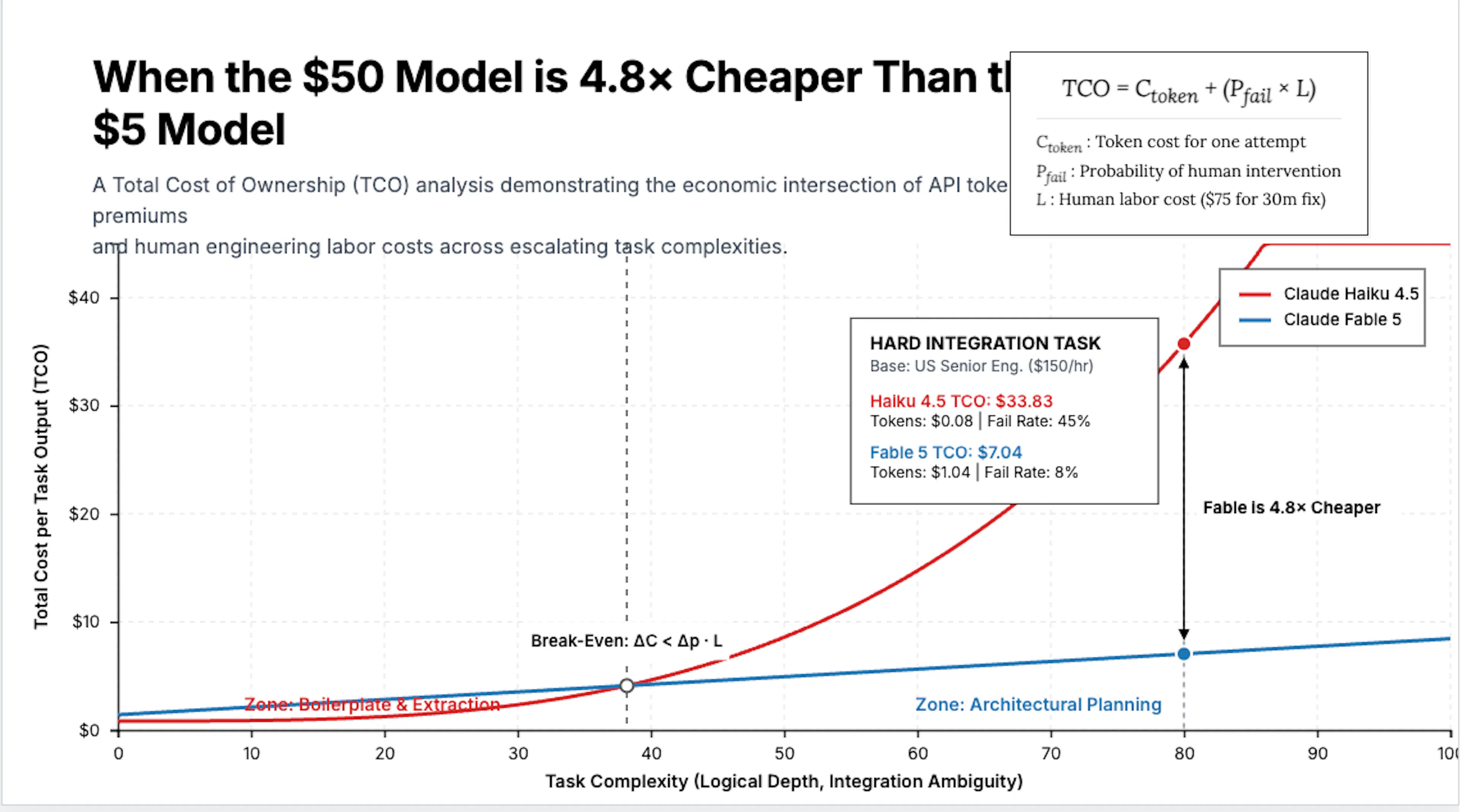

TCO crossover: the budget model overtakes the frontier model as tasks get harderTCO crossover: the budget model overtakes the frontier model as tasks get harder

The budget model stays cheaper until task complexity drives its expected rework cost high enough that Δp × L exceeds the token premium. Left of the break-even, route to the cheaper model. Right of it, route to the frontier model. The crossover depends on ΔC / L, not on any specific vendor.

One Example (The Only Part That Expires)

Using Anthropic's current pricing:

Model

Input / MTok

Output / MTok

Claude Haiku 4.5

$1

$5

Claude Fable 5

$10

$50

Accounting for Fable's ~30% tokenizer expansion, one hard agentic request (40k input / 8k output) costs roughly:

  • Budget model: $0.08
  • Frontier model: $1.04

Therefore:

ΔC ≈ $0.96

Assume (illustratively):

  • Budget model failure rate = 45%
  • Frontier model failure rate = 8%
  • US senior engineer = $150/hr
  • Average repair = 30 minutes

Therefore:

L = $75
Δp = 0.37

Token Cost

Expected Rework

Total Cost

Budget Model

$0.08

0.45 × $75

$33.83

Frontier Model

$1.04

0.08 × $75

$7.04

Despite costing 13× more per token, the frontier model is 4.8× cheaper per completed task.

If pricing changes tomorrow, only these numbers change.

The equation does not.

The Break-Even Depends on Payroll

Solve for the minimum reliability improvement required:

Δp* = ΔC / L

Engineer

Repair Time

L

Required Δp

US Senior ($150/hr)

60 min

$150

0.6 percentage points

US Senior ($150/hr)

15 min

$37.50

2.6 percentage points

Offshore Senior (~$15/hr)

30 min

$7.50

12.8 percentage points

Offshore Senior (~$15/hr)

15 min

$3.75

25.6 percentage points

A San Francisco engineering team can justify the frontier model with almost any measurable reliability improvement.

A lower-cost engineering team only benefits on genuinely difficult work.

Same models.

Same pricing.

Completely different routing decision.

Where the Framework Breaks

  • On raw API cost, the budget model is still dramatically cheaper.
  • On simple tasks, both models succeed almost every time, so human repair cost approaches zero.
  • Most production systems compare against mid-tier models rather than the absolute cheapest one. The extreme example simply makes the economics easier to see.
  • Your own evaluation pipeline should measure Δp. The equation is universal; the numbers belong to your workload.

Route on Complexity, Not on Price

The optimal architecture is straightforward.

Route boilerplate work—CRUD operations, SQL generation, extraction, classification—to the cheapest model, where both failure probability and repair cost remain low.

Route ambiguous integrations, system design, architecture, planning, and difficult reasoning to the frontier model, where preventing even one expensive engineering mistake easily pays for the additional token cost.

Using an expensive model for trivial work wastes API budget.

Using a cheap model for architectural work wastes engineering time.

Only one of those appears on your cloud invoice.

Cost per token is what you're billed.

Cost per successful task is what you actually pay.


Prices use Anthropic's published pricing for Claude Fable 5 and Claude Haiku 4.5. Failure rates and labor costs are illustrative assumptions. Replace them with your own measurements—the decision rule ΔC < Δp × L remains the same.