


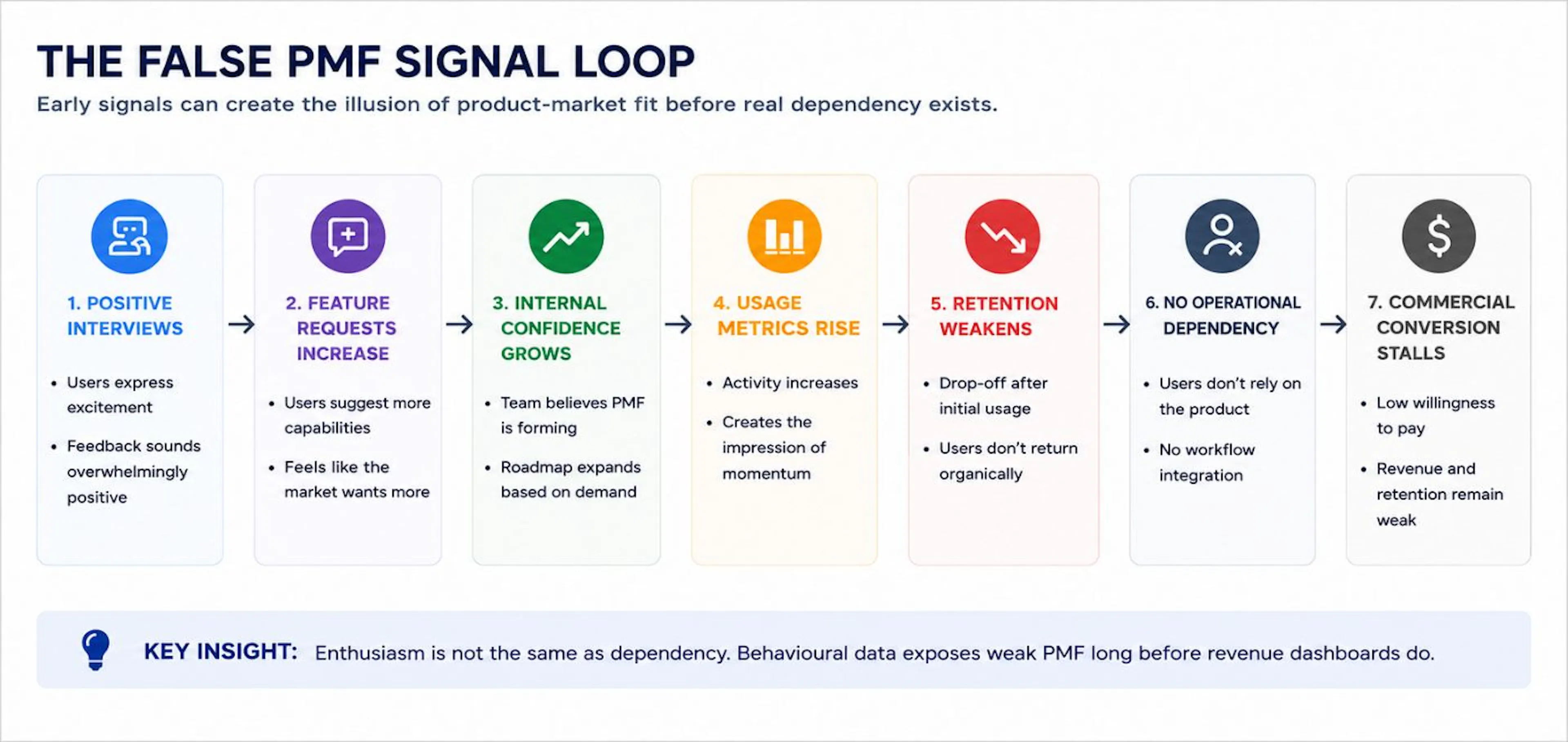
Internally, it felt like momentum. Users were active, the interview feedback sounded positive, and feature requests kept piling up fast enough to create the impression that the market was pulling the product forward.
Commercially, very little underneath was compounding properly.
Users struggled through onboarding, disappeared after testing, and rarely converted into long-term retention or meaningful revenue. The behavioural signal and the interview feedback were describing two completely different realities.
That contradiction taught me more about product-market fit than any growth dashboard ever did.
I was building the early commercial motion for an AI voice platform from zero: sourcing beta users, diagnosing onboarding failures, shaping acquisition strategy, converting subscriptions, and building the B2C2B commercial strategy that later secured enterprise distribution through a $200B telecommunications company while the business remained in stealth.
The technology worked, but the commercial assumptions around who actually needed it did not.
One of the biggest startup myths is that early users tell you exactly what they think.
Most don’t.
Particularly in AI products where users know real people are actively building the system they are testing.
Once users spent weeks inside the testing group, the feedback softened noticeably. Nobody wanted to sound overly negative about something they knew real people were building, particularly when compensation was involved.
The direct feedback sounded incredibly positive:
“This is really cool.”
“I love what you’re building.”
“This is exciting.”
Then I started comparing the interview notes against what happened after onboarding.
One user spent twenty minutes telling me how excited they were about the product and asked for several additional features during the same conversation.
They never completed setup.
Another described the product as “the future” and referred a friend to the testing group.
They disappeared within two weeks.
At first I assumed we simply needed more features. Then the pattern repeated often enough that it became difficult to ignore.
The interview notes looked encouraging, but the usage data did not.
The same names kept appearing in positive feedback conversations and churn reports. That was the first time I realised the interviews and the behaviour were describing two different realities.
Paid beta users were still extremely useful for identifying onboarding friction, setup failures, conversational issues, and activation blockers. But at a certain point, paid testing started distorting product direction because the company naturally begins optimising around sentiment instead of operational dependency.
Behavioural signals expose weak product market fit long before revenue dashboards do. Most teams simply ignore it because the early numbers still look exciting.
What made this even harder inside Voice AI was how socially influenced the feedback became.
One user spent several weeks actively using the product, providing feedback and advocating for new features. After a friend reacted negatively to the idea of “talking to a robot,” their enthusiasm disappeared almost overnight. Over time they interacted with the AI less, stopped encouraging others to try it, and eventually changed their settings so close contacts no longer had to interact with it.
This aligns closely with decades of technology adoption research. Both the Technology Acceptance Model (TAM) and UTAUT frameworks consistently show that social familiarity, trust, and perceived acceptance heavily influence whether users continue adopting new technology.
Most teams still frame adoption primarily as a technical challenge.
In practice, social psychology becomes the barrier much earlier than system capability does.
The market actually positioned the product more clearly than we did ourselves.
Internally, we called it an AI assistant.
Users kept calling it “AI voicemail.”
The first few times I heard it, I corrected them. It felt like an oversimplification of what the product was actually doing conversationally underneath.
Then it kept happening.
After hearing the same description repeatedly, I stopped treating it as a misunderstanding and started paying attention to why people were using it.
What became obvious was that users who described it as AI voicemail understood the value proposition almost immediately. Users who heard “AI assistant” often needed additional explanation before they understood why they should care or how it could create value.
The market had simplified the category for us.
What I initially saw as a less sophisticated description was actually reducing onboarding friction. Users could understand the benefit within seconds.
That shift materially improved adoption.
This pattern shows up repeatedly in successful products. Users often discover the real use case before the company does. Instagram experienced something similar during the Burbn era. The original product bundled check-ins, gaming mechanics, location sharing, and photo sharing before behavioural usage patterns revealed users overwhelmingly returned for one thing: photos. The company stripped everything else away and rebuilt around the behaviour users naturally repeated.
Slack emerged from an internal communication system built during an entirely different gaming direction. Markets rarely reward the original founder narrative. They reward the workflow users adopt naturally.
Every time users returned to the same workflow, overcame setup friction, referred another user, or paid without extensive persuasion, they were revealing more about product market fit than any interview response ever could.
Behaviour scales more reliably than opinion.
The pattern first appeared during onboarding calls.
Some users would hit a forwarding issue and disappear. Others treated the same problem completely differently.
One realtor called back multiple times over several days until forwarding was configured correctly.
A legal professional spent nearly half an hour troubleshooting setup because missing a consultation carried real financial consequence.
Construction and automotive businesses pushed through the same onboarding issues that caused casual users to disappear.
Meanwhile, personal users encountering the same friction simply stopped using the product.
The product had not changed.
The cost of missing a call had.
For those users, a missed call could mean:
• a missed lead
• a lost booking
• a lost consultation
• a lost deal
That became the real PMF signal.
The real customer was not “someone who receives calls.” It was someone whose missed calls created measurable commercial loss.
Once the ICP narrowed properly, roadmap prioritisation became dramatically easier.
Earlier users wanted everything:
• calendar integrations
• CRM syncing
• advanced conversational workflows
• email integration
• text integrations
Some of those requests eventually mattered. Most did not matter yet.
Without ICP clarity, every feature request sounds strategically important.
With ICP clarity, prioritisation becomes far more disciplined:
• Does this reduce friction?
• Does this improve responsiveness?
• Does this deepen workflow dependency?
• Does this create measurable operational value?
If not, it waits.
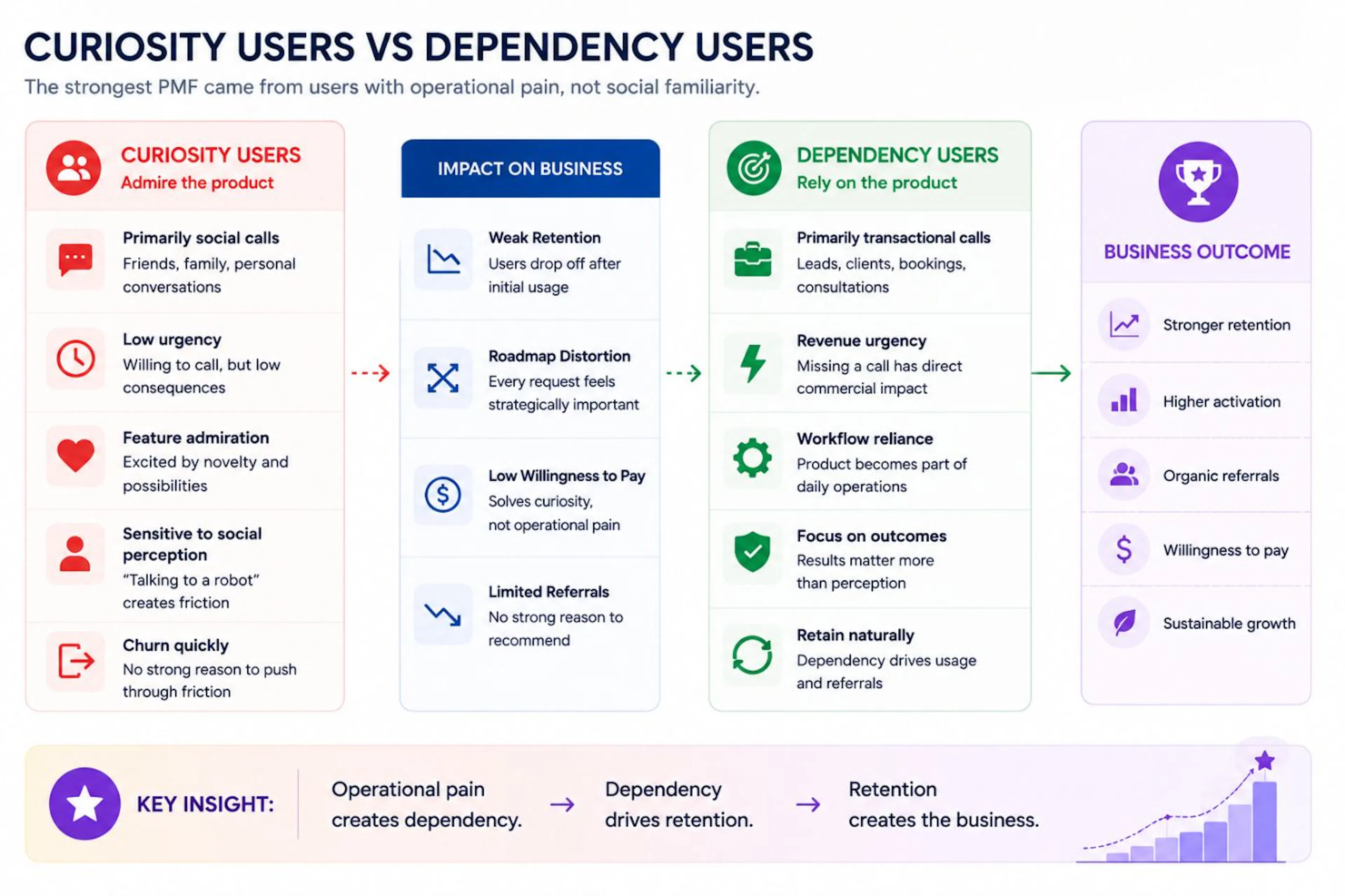
Once workflow dependency formed naturally, retention improved, referrals increased, pricing conversations became easier, and usage became habitual.
Users stopped treating the product like an experiment and started integrating it into operational behaviour.
That distinction mattered far more than feature excitement.
One of the clearest early warning signs came from onboarding.
Users downloaded the app, then contacted me days later unable to configure forwarding properly. Carrier inconsistencies repeatedly surfaced. Users dropped before meaningful value was ever realised.
Most companies would classify this as support overhead.
I treated it as commercial leakage.
So I approached it operationally.
I mapped forwarding behaviour across carrier systems, visited stores, called telecom support teams, and escalated inconsistencies wherever they appeared. The goal was simple: remove friction before users abandoned the product.
The more onboarding issues I investigated, the harder it became to ignore the pattern. Users whose revenue depended on responsiveness kept pushing through the friction. Users who were simply curious rarely did.
That distinction changed how I thought about onboarding completely.
If setup requires extensive hand-holding, you usually do not have product-market fit yet. You have assisted adoption.
Most startups over-invest in aesthetics before reducing operational friction. They redesign interfaces, refine animations, optimise branding, and polish flows while users still leak before reaching value.
The UX came first, then the UI. That frustrated people occasionally, but it was still the correct commercial decision.
Eventually I stopped relying primarily on interviews and started building behavioural analysis systems around live usage instead.
At startup stage, none of the infrastructure existed yet, so I built the earliest feedback loops manually. I originally started reviewing calls because I was trying to understand why enthusiastic users kept disappearing.
The interview feedback was overwhelmingly positive, but retention remained inconsistent. Without mature analytics infrastructure, the fastest way to understand what was happening was to review the interactions directly.
With user permission, I reviewed and categorised thousands of calls, interruptions, transcripts, hesitation patterns, failed transfers, conversational drop-off points, and caller reactions.
I introduced interaction tagging across conversations to identify:
• interruption handling failures
• awkward pacing
• incorrect name usage
• caller frustration
• successful lead capture
• conversational continuation
• retention-linked behaviours
That changed prioritisation far faster than subjective feedback ever did because observable behaviour exposed where trust collapsed operationally.
The roadmap shifted toward:
• onboarding reduction
• interruption handling
• conversational pacing
• customisation
• reducing friction during the first seconds of interaction
Users often said they wanted the AI to feel “less robotic.”
What they actually retained for was operational leverage.
The emotional layer accelerated trust and the workflow layer created dependency.
Most AI teams are still optimising for successful outputs. Users are deciding whether they trust the interaction long before the output matters.
When evaluating adoption, I now prioritise four signals before almost everything else:
1. Activation without assistance
Can users reach value without extensive hand holding?
2. Repeat workflow usage
Do users return naturally when the same problem appears?
3. Willingness to pay
Does the product solve a problem important enough to justify spend?
4. Operational dependency
Does the workflow become harder without the product than with it?
Interviews help explain behaviour.
Behaviour should outweigh opinion when product decisions are made.
The strongest PMF signals were never compliments.
They were:
• activation without assistance
• repeat workflow usage
• retention without incentives
• organic referrals
• willingness to pay quickly
• operational dependency
Everything else was noise until behaviour proved otherwise.
User interviews still matter, they help explain what users are experiencing.
Behaviour tells you what they actually value. If the two disagree, trust the behaviour first. That is usually where the real roadmap is hiding.
If you enjoyed this article, subscribe to From Model to Money, where I write about AI commercialisation, product adoption, and the operational decisions that turn models into measurable business outcomes.
此内容由惯性聚合(RSS阅读器)自动聚合整理,仅供阅读参考。 原文来自 — 版权归原作者所有。