








Even as CIOs devote time to modernization and optimization, their primary charter is as changemakers championing and leading business transformation.
After years of discourse on the CIO’s evolving role, Tim Dickson landed a chance to spring into action. The veteran IT leader jumped from a high-profile CIO post to a newly-created Chief Digital Information Officer (CDIO) role at an industrial equipment manufacturer to practice what is regularly being preached, that CIO responsibilities transcend technology and are as much about driving business transformation.
The new opportunity at Regal Rexnord, a manufacturer of electric motors and power transmission components, allowed Dickson to officially formalize a role he’s played for some time. “In this day and age, a CIO needs to be able to do more than the traditional job description, including leading large transformation efforts,” he says. “This job gave me the opportunity to formally move into a position that demonstrates how the CIO role is changing.”
While modernization and optimization work still tops the CIO agenda, IT leaders are just as busy directing business strategy, prepping the organization for the next wave of innovation fueled by AI, and expanding their remit. In their broader capacity, CIOs are taking oversight of additional functional areas, managing a fresh crop of high-level executive reports, and taking responsibility for new revenue streams.
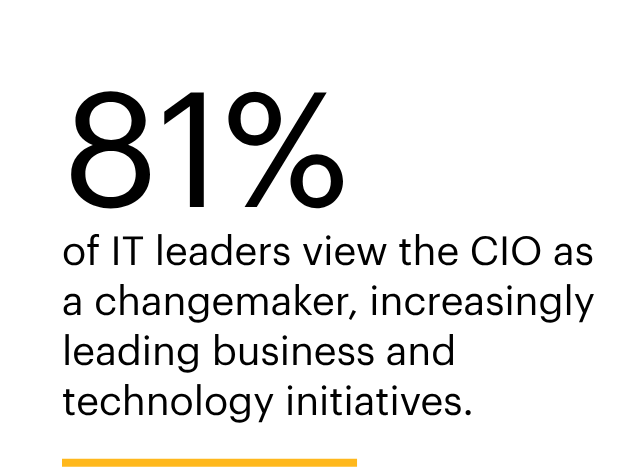
According to the 2025 State of the CIO study, which surveyed 906 IT leaders and 250 line of business (LOB) participants, the CIO role is more digital and innovation focused, cited by 82% of respondents. CIOs are now more involved in leading digital transformation initiatives compared to their business counterparts (82%), and 81% of IT leaders surveyed view the CIO role as a changemaker, increasingly taking the lead on business and technology initiatives.
Even more telling, LOB is finally recognizing CIOs’ enhanced status—seventy-six percent view the CIO role as more digital and innovated focused. Three-quarters of IT leaders and 69% of LOB respondents said the CIO role has been elevated due to the current state of the economy and this increased visibility within the organization is expected to continue.
In fact, the business continues to draw on CIOs to guide both technology and business strategy decisions. This year’s research found that 50% of IT leaders and 56% of LOB respondents look to the CIO to proactively identify business opportunities as well as make technology and provider recommendations. Twenty-one percent of IT leaders and 18% of LOB respondents view the CIO role as a consulting advisor, providing input on business needs along with the standard technology and provider recommendations. Thirteen percent of IT leaders and 10% of LOB respondents view the CIO as a risk assessor because of their ability to advise through risk management or a governance lens.
CIOs are also capitalizing on hard-won efforts to secure their spot in the C-suite corridors. Almost half (48%) of respondents now report directly into the CEO. CIOs are also being awarded oversight of some of the newly established technology-oriented C-level roles: 46% of Chief Transformation Officers report to the CIO, as do 42% of Chief Innovation Officers and 40% of Chief AI Officers. Chief Technology Officers and Chief Information Officers were more likely to report into the CEO, at 56% and 58% respectively.
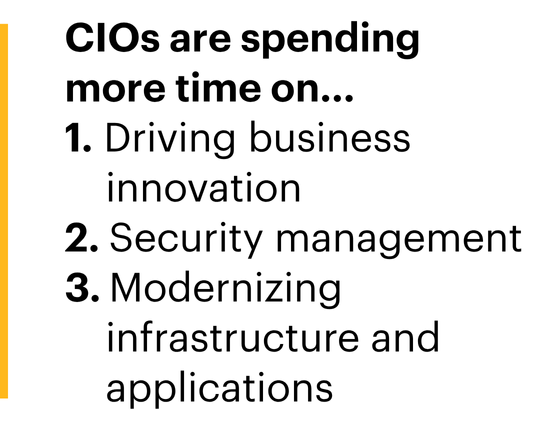
Outside of the expansive CIO leadership capacity, the IT organization itself is becoming more business-driven. With a future focus on business innovation, IT leader respondents pointed to driving business innovation (31%), security management (27%), and modernizing infrastructure and applications (27%) as the activities they plan to spend more time on in the next 1-3 years, the 2025 State of the CIO research found.
The lines that separate `IT’ and ‘the business’ continue to blur. We’re all members of the same business, striving to achieve the same goals.
Angela Yochem, Global CIO at Krispy Kreme
While CIOs take the lead in directing future business and technology strategy, they remain immersed in the work of optimizing, modernizing, and securing technology infrastructure. This year, 41% of IT leaders’ time is spent on strategic tasks, followed by transformational (38%), and functional (21%). Looking out over the next one to three years, more than half (52%) of IT leader respondents expect to play more of a strategic role, with 32% anticipating an emphasis on transformational responsibilities and a narrow 16% expecting their dockets to be consumed by functional activities.
Much like last year, the 2025 State of the CIO research found CIOs still caught up in functional duties like security management (38%), improving IT operations and systems performance (38%), and cost control/expense management (30%). Transformational-related tasks also dominated their agenda, with a focus on modernizing infrastructure and applications (32%), aligning IT initiatives with business goals (31%), and redesigning business processes (26%). Business strategist work is centered around driving business innovation (27%), developing and refining business strategy (27%), and studying market trends/customer needs to identify commercial opportunities (22%), the 2025 research found.
This year’s top CEO priorities for the CIO role indicate a swing back towards advancing business strategy to bolster innovation. Twenty-six percent of respondents said the No. 1 objective voiced by CEO leadership is for CIOs to research and implement AI products/projects. Improving the customer experience (23%) and fortifying IT and business collaboration (22%) were next-up on the CEO agenda, according to respondents.
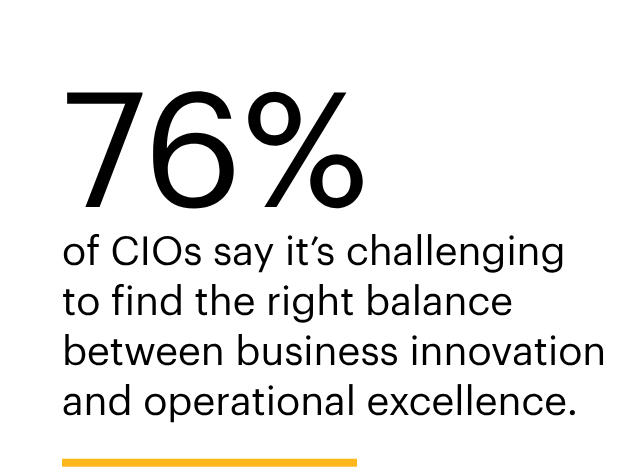
Given the accelerated pace of change and the centrality of technology and digital platforms to every facet of the business, it’s no wonder CIOs continue to walk a fine line balancing all the demands of their ever-expanding remit. Seventy-six percent of respondents to this year’s survey said it was a challenge to balance the demands for business innovation with operational excellence, in line with last year’s findings.
Deepa Soni, CIO at The Hartford, says the need for IT leaders to be adept at leading and orchestrating functional, strategic, and transformational responsibilities simultaneously won’t change any time soon, regardless of industry shifts or CIOs’ continued ascension in the enterprise. “I see the role as encompassing all three today with the highest focus for me now on strategist work,” says Soni, citing her ongoing efforts to develop new business models and explore how and where the insurance giant can leverage Generative AI for competitive advantage.
Under Soni’s direction, The Hartford’s IT group is defining and implementing digital opportunities designed to deliver a “step-change” in business value as opposed to an incremental return. Yet those innovation activities are happening in tandem with ongoing modernization and will continue to do so for the foreseeable future. “For us, modernization and innovation are not sequential…and without modernization, innovation doesn’t mean much,” she explains. “We spend time collaborating, codesigning, and strategizing with the business to determine how modernization will help business outcomes.”
For us, modernization and innovation are not sequential…and without modernization, innovation doesn’t mean much.
Deepa Soni, CIO at The Hartford
As organizations emerge from the post-pandemic period, there remains a significant emphasis on optimizing and transforming business operations. Thirty-five percent of IT leaders are anticipating a full docket of initiatives keyed to meeting compliance requirements (GDPR, etc.), with 32% earmarking projects to develop new digital revenue streams.
Despite some economic uncertainty this last year, IT budgets remain flush. Sixty-five percent of CIOs surveyed for the 2025 State of the CIO anticipate budget increases, while 24% expect IT investments to remain the same. On average, companies report a 6.8% budget increase, which is much lower than the 17.4% increase reported last year. For the 11% expecting IT spending cuts, the average dip was 6.7%.
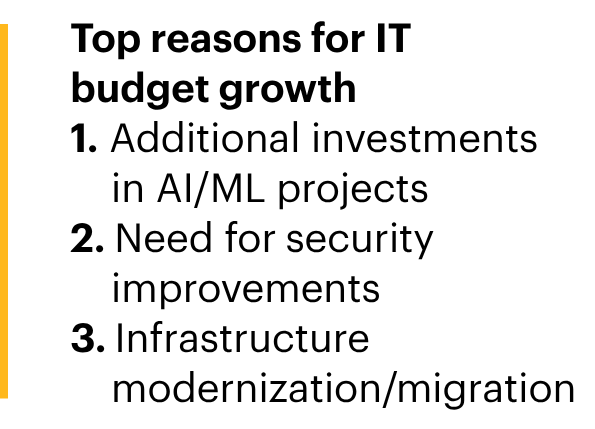
Companies are expanding IT budgets for a variety of reasons. Most cited additional investments in AI and machine learning (ML) projects (31%) along with the need for security improvements (27%) and infrastructure modernization/migration (26%). Those respondents who said their firms were tightening the IT purse strings called out economic uncertainty (54%), company finances/performance (50%), and a reduction in employee headcount (31%) as the primary culprits.
IT budgets are being directed to a number of leading technology areas. Among the more prominent are machine learning and AI technologies along with security/risk management, cited by 42% and 34% of respondents in the 2025 State of the CIO research. Data/business analytics (31%), business process automation and IT automation offerings (29%) customer experience technologies (25%), and application modernization (24%) are also on the shortlist for technology initiatives driving IT investments in 2025, the research found.

Given the focus on securing and automating operations and parlaying AI technologies for future innovation, CIOs are reprioritizing where and when they get involved. In addition to upping their presence on AI/ML initiatives (75%), IT leaders expect to ramp up participation in efforts tied to cybersecurity (65%), product development/innovation (56%), data analysis (56%), and data privacy/compliance (53%).
At Casey’s, the third largest convenience store chain in the United States, the last couple of years have been devoted to IT transformation initiatives, including moving from a project to a product mindset to drive digital innovation, according to CIO Sanjeev Satturu. Now operating with 2,900 stores in 19 states, the $15.9 billion chain continues to scale its technology foundation, rationalize legacy systems, and deploy edge infrastructure to support frictionless customer experiences and advanced analytics for data-driven decision-making. It’s also actively working to reduce the complexity of Point of Sale (POS) systems to improve transaction speeds to better serve customers hungry for flexibility and convenience.
“The business of convenience requires us to continually transform,” Satturu says. “Modernization is not one-time done. You have to continuously work on modernizing platforms and solutions because with the rate technology moves, everything becomes legacy really quickly.”
While increasing cybersecurity protections and operational efficiency headlined the list of business initiatives last year, 2025 technology spend is being directed to more strategic business initiatives. Monetizing company data was the No. 1 business initiative for 38% of 2025 respondents followed up by improving the customer experience, cited by 35% of IT leaders and 30% of LOB respondents.
Upleveling cybersecurity, particularly as it relates to fraud management, remains a top priority at TIAA, according to Upendra Mardikar, CISO for the financial services provider. The firm has a four-pronged strategy to address the continuously changing threat and regulatory landscape: Embrace Zero Trust principles; leverage AI to automate and elevate its defenses against attacks; upskill and reskill cyber talent and make cybersecurity a team sport; and collaborate with consortia and CISO peers to develop security best practices and strategies, he explains.
“We’re seeing exponential growth in the threat landscape, including cyber threats coming from nation-states,” Mardikar says. “We continue to incorporate advanced capabilities and controls, protection and recovery capabilities, and Zero Trust so our platform is trustworthy, safe, and secure for clients and customers.”
“Modernization is not one-time done. You have to continuously work on modernizing platforms and solutions because with the rate technology moves, everything becomes legacy really quickly.”
Sanjeev Satturu, CIO, Casey’s
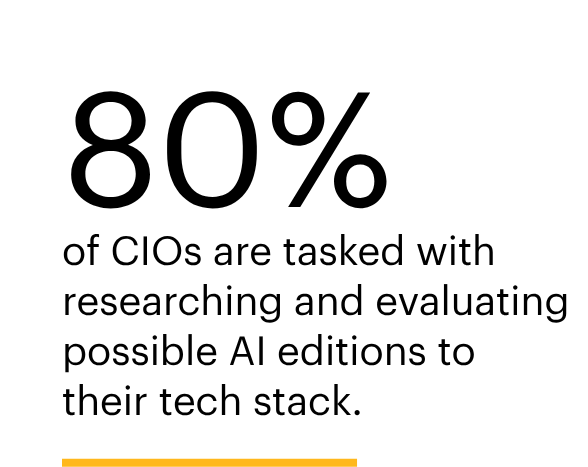
As AI, especially generative AI, moved into the mainstream last year, it cast a brighter spotlight on the strategic nature of the CIO role. CIOs are front and center charting the AI roadmap, from working closely with the business to formulate AI applications and use cases, cited by 75% of 2025 State of the CIO respondents, to researching and evaluating possible AI additions to the technology stack (80%). Sixty-eight percent of IT leaders and 69% of LOB respondents confirmed IT and LOB were aligned on the adoption and use of generative AI, in particular.
Over the next year, IT leaders anticipate increased involvement in AI/ML endeavors, cited by 75% of IT leader respondents. Business users also want to see greater CIO involvement in planning and executing AI initiatives. Three-quarters (75%) of LOB respondents in the 2025 State of the CIO research said IT leaders are spearheading the research of AI solutions to augment the technology stack.

There is mounting desire to capitalize on AI to reimagine the business in new and compelling ways. Forty-two percent of CIOs and 32% of LOB respondents called out AI/ML as the technology initiatives that will be most strategically important this upcoming year. AI is also a top reason for companies to increase their IT budgets, cited by 31% of respondents. Already, AI technologies are being used to reshape data center operations—an evolution cited by 68% of IT leaders.
While deep into AI deployment at his previous CIO engagement, Regal Rexnord’s Dickson is back at square one, exploring where to apply AI for industrial manufacturing and identifying potential use cases. To that end, Dickson’s team has pinpointed three areas where AI can deliver a competitive edge: For orchestrating more effective production scheduling and planning; for buying the right parts to produce orders for customers; and for demand forecasting.
With the initial game plan established, Regal Rexnord is sailing right along on its AI journey. The company has hired its first data scientist, built a base collection of models, and instituted MLOps (Machine Learning Operations), a set of practices for deploying and operationalizing the AI model lifecycle, Dickson says.
We’re starting from scratch, trying to figure out where AI can move the needle.
Tim Dickson, CIO at Regal Rexnord
As CIOs struggle to balance optimization and innovation, they face a number of challenges—the biggest being ongoing staffing and skills shortages. Fifty-four percent of IT leader respondents said dealing with the talent problem caused them to redirect time and energy away from strategic and innovation tasks. Changing business conditions (43%), the need to address security threats (33%), and budgetary constraints, coupled with the ability to demonstrate ROI, were hurdles for 31% of respondents.
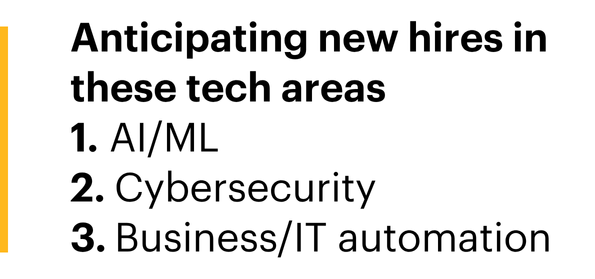
On the talent front, organizations are targeting the usual areas to build out their skills pipeline. Acquiring AI/ML expertise is a major priority, cited by 36% of IT leaders. Companies are also ramping up cybersecurity talent over the next six to 12 months, cited by 34% of respondents, followed up by hires with business and IT automation skills, at 25%.
Because AI/ML expertise is in hot demand, it’s also where IT leaders expect to have the most trouble attracting talent. Thirty-eight percent expect to have difficulty finding professionals with the appropriate AI/ML skill sets, followed up by cybersecurity (33%), data science/analytics (21%), and business/IT automation (16%).
As CIOs reach for the mantle of leading business strategy and transformation, they need to do so prepared to balance the growth agenda with continuous IT optimization and modernization. “You don’t get to drive digital transformation with the ship running smoothly,” Dickson says.
The 24th annual State of the CIO survey was fielded online with the objective of understanding the current parameters of the CIO role and how it may be changing over time. To be considered qualified, respondents must’ve identified themselves as the head of IT for their company or a division within it. Results are based on 906 qualified IT respondents and 250 LOB responses. This study was fielded globally, with the response base being 41% North America, 37% APAC, 15% EMEA, 6% LATAM and 1% other.
此内容由惯性聚合(RSS阅读器)自动聚合整理,仅供阅读参考。 原文来自 — 版权归原作者所有。