


/ CBS News
Indian authorities are hoping to launch an operation to recover the frozen body of a climber who died on Mount Everest nearly 30 years ago in one of the deadliest disasters ever seen on the world's highest peak.
The Indo-Tibetan Border Police (ITBP) is soliciting bids from high altitude recovery agencies for a mission to retrieve the remains of a climber long known only as "Green Boots" from the mountain's northern slope.
A tender document says the contracted team must bring the body to Delhi by October.
It would be one of the most technically demanding recovery operations ever attempted on Everest — "double the danger of normal climbing," according to Tshiring Jangbu Sherpa, the founder of Nepal-based Everest Sherpa Expedition.
"For the whole rescue team this is high risk," Sherpa told CBS News.
Tshiring has reached Everest's summit multiple times, and he led expeditions in 2024 to recover five bodies from various mountains in the region. He told CBS News it could take a highly-trained, 10-person team up to a week to recover Green Boots' body.
He added that, in his opinion, it would be impossible to even attempt the operation until the spring due to the weather conditions, which raises questions about the Indian authority's June-October timeframe noted in the tender document.
The Indo-Tibetan Border Police did not reply to CBS News' request for comment on the plans.
Who is Green Boots?
The body of Green Boots — a nickname derived from the deceased climber's bright green footwear — has been one of Everest's most recognizable features for decades. Located at an altitude of about 27,000 feet, Tshiring said the remains have become a grim waypoint for climbers ascending from the Tibetan side of the iconic mountain.
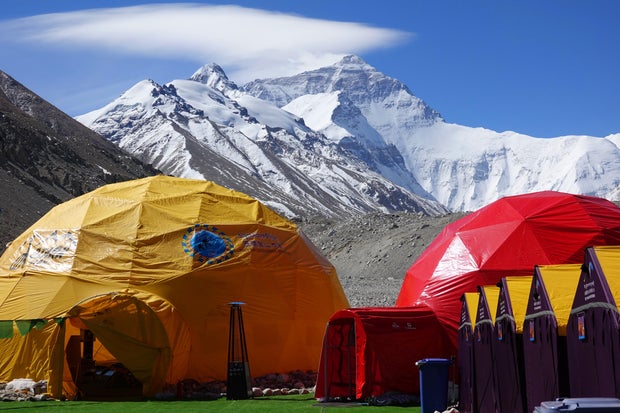
"When they communicate with the basecamp and other climbers, they say, 'Okay, we are now very close to the Green Boots,'" he told CBS News.
The area is within Everest's "death zone," above 26,200 feet, where oxygen levels are too low to sustain human life for long, making even basic tasks hazardous.
Green Boots was long widely believed to be 28-year-old Tsewang Paljor, an ITBP member who was among a group that attempted to summit Everest on May 10, 1996, when they were hit by a sudden storm near the peak that was chronicled in Jon Krakauer's book "Into Thin Air."
Three climbers from the group continued the ascent despite the worsening conditions, and none returned. Green Boots is the only one of the three whose remains have been found.
The tender documents showed, however, the body in question being identified as Indian soldier Dorje Morup, who was one of Paljor's fellow climbers. The Guardian newspaper of Britain and the French news agency AFP said they had seen documents showing DNA testing confirmed the remains were Morup's.
"We must bring them down"
One of the best-known cases of remains being recovered from Everest involves Francys Arsentiev, a mountaineer who died during her descent in 1998 after becoming the first American woman to summit the mountain without supplemental oxygen.
Her body remained on the mountain for years, visible to climbers along a main route. She became known as Everest's "Sleeping Beauty."
In 2007, a team led by Sherpas and other climbers managed to move her remains out of sight, effectively giving her a burial on the mountain rather than attempting a full recovery.
More than 200 bodies are believed to remain on Mount Everest, many left where the climbers died because recovery is considered too dangerous or expensive.
The issue continues to fuel debate within the global mountaineering community, with some arguing that the dead should be respected and retrieved, while others say the operations required to do so are not worth the risk to living climbers. Some climbers say in advance that they would prefer to be left on the mountain if they die on the slopes.
But Tshiring is adamant that recovery missions are necessary because they bring the deceased back to their loved ones.
"My opinion is we must bring them down," he told CBS News.
Arshad R. Zargar contributed to this report.
In: