


惯性聚合 高效追踪和阅读你感兴趣的博客、新闻、科技资讯
阅读原文 在惯性聚合中打开

推荐订阅源

V
Visual Studio Blog
I
InfoQ
H
Help Net Security
GbyAI
GbyAI
博客园 - 叶小钗
Recent Announcements
Engineering at Meta
Engineering at Meta
让小产品的独立变现更简单 - ezindie.com
爱范儿
爱范儿
Y
Y Combinator Blog
L
LangChain Blog
腾讯CDC
酷 壳 – CoolShell
酷 壳 – CoolShell
WordPress大学
WordPress大学
Stack Overflow Blog
Stack Overflow Blog
F
Fortinet All Blogs
G
Google Developers Blog
Apple Machine Learning Research
The GitHub Blog
The GitHub Blog
T
The Blog of Author Tim Ferriss
博客园 - Franky
D
Docker
Jina AI
Jina AI
罗磊的独立博客

World - CBSNews.com

Rat poison found in HiPP baby food in Austria, prompting recall Strait of Hormuz remains closed, as Iran blames U.S. blockade Attempted arson at London synagogue is 3rd attack on Jewish site in past week: "Sustained campaign of violence" Trump says Iranians have "agreed to everything," including removal of enriched uranium Trump says U.S. officials heading to Pakistan for talks but Iran says it doesn't plan to take part Senior U.S. officials could be back in Pakistan for Iran talks within days, sources say We took a boat into the Strait of Hormuz. Here's what we saw. Mexican environmentalist survives assassination attempt caught on video: "I told the hitman 'good morning'" Hidden cave, prehistoric hippo bones found under Welsh castle called a "once-in-a-lifetime discovery" 4/16: The Takeout with Major Garrett Israel-Lebanon ceasefire could impact U.S. deal with Iran Trump tries to change conversation from war to the economy U.S. intelligence detects signs China is weighing giving Iran advance radar systems 4/16: CBS Evening News Cuba will "be ready" for possible U.S. attack amid Trump threats, leader says Latest effort to rein in Trump on Iran falls short in House vote Latest on the Strait of Hormuz blockade as fragile ceasefire holds Cybersecurity firm shows how hackers are using AI to breach networks Meghan Markle says she was "the most trolled person in the world" Israel-Lebanon ceasefire begins as Iran keeps Strait of Hormuz gridlocked Caine warns "we will use force" if Iran does not comply with blockade on Strait of Hormuz Former U.S. Marine pilot accused of training Chinese aviators loses extradition appeal in Australia House breaks with Trump, voting against ending deportation protections for Haitians Partner held in Zanzibar after American influencer Ashly Robinson dies under mysterious circumstances Russia launches deadliest aerial assault of the year on Ukraine, killing 16, officials say Trump says Iran war 4/15: The Takeout with Major Garrett Eighth grade student kills 10 people, wounds 12 in Turkey's 2nd school shooting in 2 days Back-to-back deadly school shootings in Turkey Powerful Typhoon Sinlaku​ barrels over remote U.S. islands in Pacific: "Hitting us hard"
NASA maps show Earth's brightest and darkest regions at n...
Kerry Breen · 2026-05-15 · via World - CBSNews.com

By

Kerry Breen is a news editor at CBSNews.com. A graduate of New York University's Arthur L. Carter School of Journalism, she previously worked at NBC News' TODAY Digital. She covers current events, breaking news and issues including substance use.

Read Full Bio

/ CBS News

Add CBS News on Google

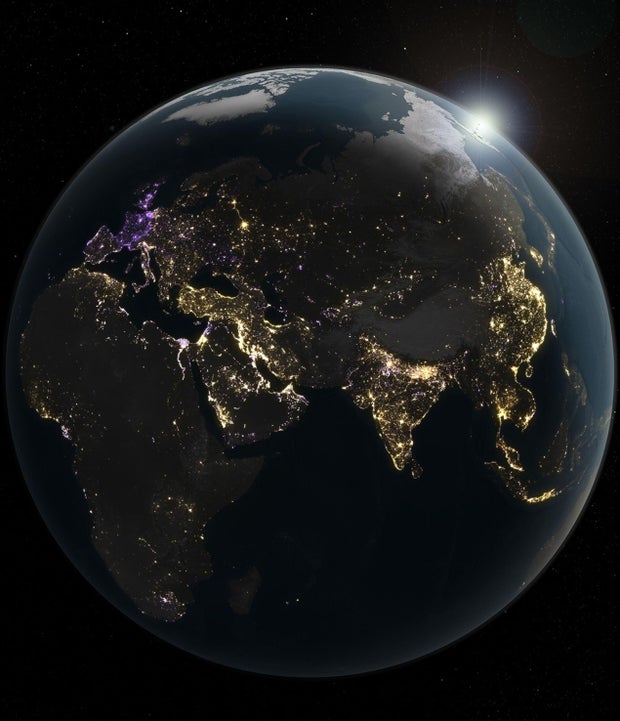
New maps from NASA using nearly a decade's worth of data show how the use of artificial light has shifted over the years.  

To make the maps, NASA researchers analyzed data collected by its "Black Marble" program, which uses a specialized sensor to capture low-light imagery of Earth at night. The data was collected by three different satellites between 2014 and 2022. 

Researchers expected to find "a gradual increase in artificial light at night" over the years, NASA said in a news release. What they discovered was "much more nuanced patterns" of light radiance. 

"The analysis portrays a world flickering with industrial booms and busts, construction, and blackouts, as well as more gradual shifts, such as policy-driven retrofits," NASA said. 
nightlights-20142022.jpg
A rendition of the Black Marble data collected by NASA. Purple shows spots of dimming, while gold shows spots of brightening.  NASA Earth Observatory/Michala Garrison

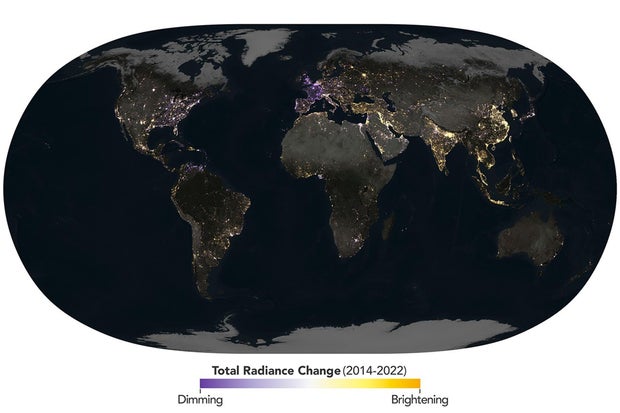
The researchers found that each location examined by the sensors underwent several distinct shifts over the nine years data was collected. During that time, radiance increased 34%, while dimming offset it by 18%, the researchers said. Both lighting and dimming "markedly intensified over the past decade," the researchers said in a study published in the academic journal Nature

"This evidence of increasing volatility in human night-time activity provides an important dynamic dimension for understanding urban evolution, energy transitions, policy impacts and ecological consequences of rapidly changing illuminated nights," the researchers wrote. 

In the United States, West Coast cities grew brighter as populations increased. On the East Coast, there was more dimming, which the researchers attributed to the use of energy-efficient lightbulbs and "broader economic restructuring." 
nightlights-global-20142022.jpg
An analysis of the Black Marble data collected by NASA. Purple shows spots of dimming, while gold shows spots of brightening.  NASA Earth Observatory/Michala Garrison

Worldwide, nights grew brighter in China and northern India, as urban development expanded. Throughout Europe, there was a pattern of dimming likely caused by energy conservation measures, and a sharp drop-off in 2022 after the war in Ukraine led to a regional energy crisis. 

"This global, high-resolution analysis ... refines and expands our understanding of how humanity is altering the night environment," the researchers wrote in their published paper. "Our findings show that the human light footprint is not a universally expanding entity but a dynamic system, characterized by the pervasive coexistence of brightening and dimming." 

In: