


惯性聚合 高效追踪和阅读你感兴趣的博客、新闻、科技资讯
阅读原文 在惯性聚合中打开

推荐订阅源

小众软件
小众软件
让小产品的独立变现更简单 - ezindie.com
WordPress大学
WordPress大学
月光博客
月光博客
Hugging Face - Blog
Hugging Face - Blog
博客园 - 聂微东
博客园 - 【当耐特】
博客园_首页
The Cloudflare Blog
freeCodeCamp Programming Tutorials: Python, JavaScript, Git & More
Apple Machine Learning Research
Last Week in AI
Last Week in AI
酷 壳 – CoolShell
酷 壳 – CoolShell
大猫的无限游戏
大猫的无限游戏
雷峰网
雷峰网
量子位
钛媒体:引领未来商业与生活新知
钛媒体:引领未来商业与生活新知
T
Tailwind CSS Blog
IT之家
IT之家
OSCHINA 社区最新新闻
OSCHINA 社区最新新闻
GbyAI
GbyAI
V
Visual Studio Blog
F
Fortinet All Blogs
Martin Fowler
Martin Fowler

World - CBSNews.com

Rat poison found in HiPP baby food in Austria, prompting recall Strait of Hormuz remains closed, as Iran blames U.S. blockade Attempted arson at London synagogue is 3rd attack on Jewish site in past week: "Sustained campaign of violence" Trump says Iranians have "agreed to everything," including removal of enriched uranium Trump says U.S. officials heading to Pakistan for talks but Iran says it doesn't plan to take part Senior U.S. officials could be back in Pakistan for Iran talks within days, sources say We took a boat into the Strait of Hormuz. Here's what we saw. Mexican environmentalist survives assassination attempt caught on video: "I told the hitman 'good morning'" Hidden cave, prehistoric hippo bones found under Welsh castle called a "once-in-a-lifetime discovery" 4/16: The Takeout with Major Garrett Israel-Lebanon ceasefire could impact U.S. deal with Iran Trump tries to change conversation from war to the economy U.S. intelligence detects signs China is weighing giving Iran advance radar systems 4/16: CBS Evening News Cuba will "be ready" for possible U.S. attack amid Trump threats, leader says Latest effort to rein in Trump on Iran falls short in House vote Latest on the Strait of Hormuz blockade as fragile ceasefire holds Cybersecurity firm shows how hackers are using AI to breach networks Meghan Markle says she was "the most trolled person in the world" Israel-Lebanon ceasefire begins as Iran keeps Strait of Hormuz gridlocked Caine warns "we will use force" if Iran does not comply with blockade on Strait of Hormuz Former U.S. Marine pilot accused of training Chinese aviators loses extradition appeal in Australia House breaks with Trump, voting against ending deportation protections for Haitians Partner held in Zanzibar after American influencer Ashly Robinson dies under mysterious circumstances Russia launches deadliest aerial assault of the year on Ukraine, killing 16, officials say Trump says Iran war 4/15: The Takeout with Major Garrett Eighth grade student kills 10 people, wounds 12 in Turkey's 2nd school shooting in 2 days Back-to-back deadly school shootings in Turkey Powerful Typhoon Sinlaku​ barrels over remote U.S. islands in Pacific: "Hitting us hard"
Remarkable photos show ancient human burials uncovered in...
Ahmed Shawkat · 2026-06-25 · via World - CBSNews.com

By

Ahmed Shawkat is a CBS News producer based in Cairo. He has worked for CBS News since 2016, prior to which he worked with several European networks including TVE, ZDF, SVT and Yle.

Read Full Bio

/ CBS News

Add CBS News on Google

Cairo — Egyptian archaeologists say they've uncovered remains and a myriad of artifacts in part of a Greco-Roman cemetery that dates back more than 2,300 years, revealing the evolution of funerary practices over some six centuries and showing the importance of the site itself. 

Burials discovered at the Tell Kom Aziza site, in the Nile Delta in Egypt's northern Beheira province, near the Mediterranean coast, date from about 332 B.C. to 395 A.D. Remains and artifacts found at the site show widely varying burial practices and they point to the site itself morphing over its long period of use from a settlement into a cemetery.

"This is a very important discovery because it sheds light on and reveals more details about the site," Nevine El-Aref, media adviser to the Minister of Tourism and Antiquities, told CBS News. "It is a unique example that shows the transformation of a settlement hub into a major burial ground spanning different ancient eras."
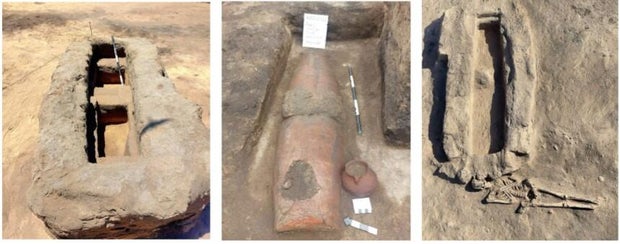
ancient-egypt-burials-nile.jpg
Burials discovered at the Tell Kom Aziza burial site in Egypt's Nile Delta range from simple pits to graves lined with mudbricks to painted plaster coffins. Egyptian Ministry of Tourism and Antiquities

Excavations revealed burial practices ranging from simple pit burials, with bodies placed directly in the ground, to graves lined with mudbricks and burials in painted plaster coffins.

There were also individual and collective burials, according to Dr. Hisham El-Leithy, Secretary General of the Supreme Council of Antiquities, and burials oriented along both north–south and east–west axes. 

The hand positions of those interred also differed. Some individuals were buried with their hands folded or crossed over the pelvic region, while others were put in the "Osirian pose," with their arms crossed over the chest, or with their arms extended and aligned alongside the thighs, El-Leithy said.
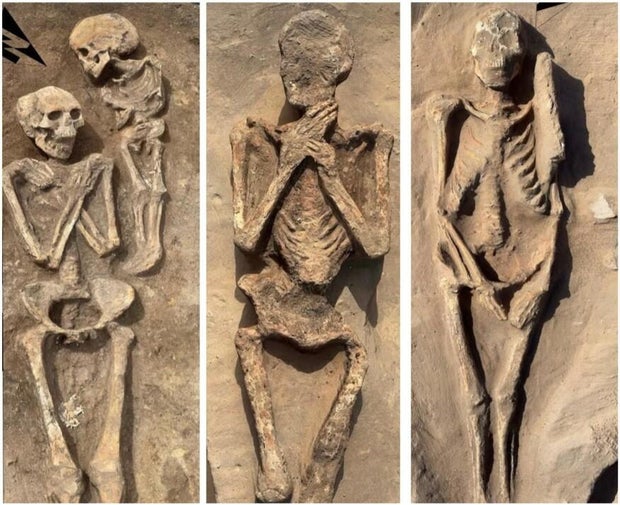
egypt-burials-2026.jpg
Human remains discovered at the Tell Kom Aziza site in Egypt's Nile Delta show widely varying burial practices. Egyptian Ministry of Tourism and Antiquities

"This diversity can be interpreted in several ways: It may reflect social differences among the individuals buried, variations in ritual practices, or a limited development within the same funerary tradition," Khaled Abdel Ghany Farhat, the head of the team, told CBS News.

Among the significant discoveries were the complete skeletal remains of two wild boars, a rare find at ancient Egyptian funerary sites. Boars were representative at the time with Seth (or Set), a deity associated with chaos and violence in ancient Egyptian mythology.
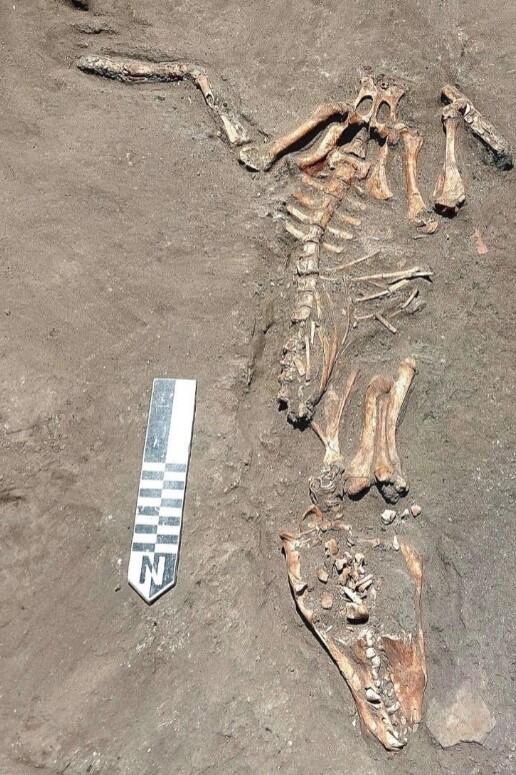
wild-boar-ancient-egypt-burial.jpg
Among the discoveries at the Tell Kom Aziza burial site were the skeletal remains of two wild boars. Boars were representative of Seth (or Set), a deity associated with chaos and violence. Egyptian Ministry of Tourism and Antiquities

"Even though it's not possible yet to determine with certainty whether these remains represent intentional animal burials, remnants of domestic and economic activity, or an element with ritual significance, their presence within this context requires linking the direct archaeological evidence with the cultural and religious significance of the boar in ancient Egypt," Mohamed Abdel Badi, Head of the Egyptian Antiquities Sector, told CBS News.

Pottery fragments dating from the Egyptian Old Kingdom — the time of the great pyramids' construction, between around 2686 and 2181 B.C. — to the Greco-Roman period that followed some 2,000 years later, were also discovered at the site.
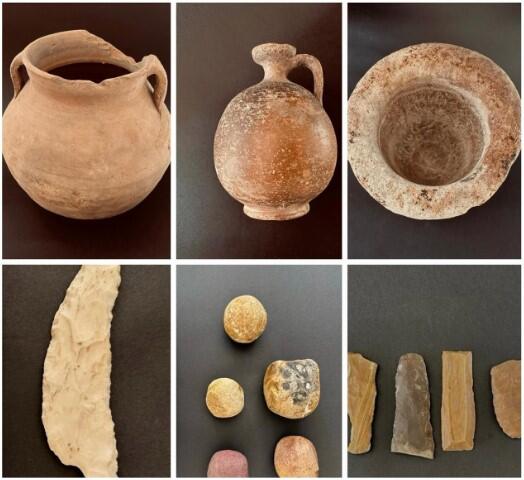
ancient-egypt-artifacts-nile.jpg
Pottery fragments and fragments dating from the Egyptian Old Kingdom, between around 2686 and 2181 B.C., and the Greco-Roman period that followed some 2,000 years later. Egyptian Ministry of Tourism and Antiquities

The largely domestic items, including amphorae, burial jars, bread molds and bread trays, indicate continued or repeated use of the site over not just centuries, but millenia. 

"Excavation work at the site is still ongoing in order to uncover more secrets, understand the history of the location and its development over time, and put all the puzzle pieces together to decipher patterns of human activity in the area," El-Aref, at the Ministry of Tourism and Antiquities, told CBS News.

In: