




惯性聚合 高效追踪和阅读你感兴趣的博客、新闻、科技资讯
阅读原文 在惯性聚合中打开

推荐订阅源

D
DataBreaches.Net
N
Netflix TechBlog - Medium
F
Fortinet All Blogs
让小产品的独立变现更简单 - ezindie.com
宝玉的分享
宝玉的分享
Y
Y Combinator Blog
博客园 - 聂微东
WordPress大学
WordPress大学
酷 壳 – CoolShell
酷 壳 – CoolShell
B
Blog RSS Feed
小众软件
小众软件
The GitHub Blog
The GitHub Blog
S
SegmentFault 最新的问题
Hugging Face - Blog
Hugging Face - Blog
Jina AI
Jina AI
Microsoft Azure Blog
V
V2EX
B
Blog
H
Help Net Security
D
Docker
钛媒体:引领未来商业与生活新知
钛媒体:引领未来商业与生活新知
罗磊的独立博客
月光博客
月光博客
博客园 - 司徒正美

World - CBSNews.com

Rat poison found in HiPP baby food in Austria, prompting recall Strait of Hormuz remains closed, as Iran blames U.S. blockade Attempted arson at London synagogue is 3rd attack on Jewish site in past week: "Sustained campaign of violence" Trump says Iranians have "agreed to everything," including removal of enriched uranium Trump says U.S. officials heading to Pakistan for talks but Iran says it doesn't plan to take part Senior U.S. officials could be back in Pakistan for Iran talks within days, sources say We took a boat into the Strait of Hormuz. Here's what we saw. Mexican environmentalist survives assassination attempt caught on video: "I told the hitman 'good morning'" Hidden cave, prehistoric hippo bones found under Welsh castle called a "once-in-a-lifetime discovery" 4/16: The Takeout with Major Garrett Israel-Lebanon ceasefire could impact U.S. deal with Iran Trump tries to change conversation from war to the economy U.S. intelligence detects signs China is weighing giving Iran advance radar systems 4/16: CBS Evening News Cuba will "be ready" for possible U.S. attack amid Trump threats, leader says Latest effort to rein in Trump on Iran falls short in House vote Latest on the Strait of Hormuz blockade as fragile ceasefire holds Cybersecurity firm shows how hackers are using AI to breach networks Meghan Markle says she was "the most trolled person in the world" Israel-Lebanon ceasefire begins as Iran keeps Strait of Hormuz gridlocked Caine warns "we will use force" if Iran does not comply with blockade on Strait of Hormuz Former U.S. Marine pilot accused of training Chinese aviators loses extradition appeal in Australia House breaks with Trump, voting against ending deportation protections for Haitians Partner held in Zanzibar after American influencer Ashly Robinson dies under mysterious circumstances Russia launches deadliest aerial assault of the year on Ukraine, killing 16, officials say Trump says Iran war 4/15: The Takeout with Major Garrett Eighth grade student kills 10 people, wounds 12 in Turkey's 2nd school shooting in 2 days Back-to-back deadly school shootings in Turkey Powerful Typhoon Sinlaku​ barrels over remote U.S. islands in Pacific: "Hitting us hard"
Robot exploring France's deepest shipwreck finds cannons ...
2026-04-30 · via World - CBSNews.com

/ CBS/AFP

Add CBS News on Google

Deep below the surface of the Mediterranean Sea off the French coast, the pincer of a remotely guided underwater robot delicately closes around a centuries-old jug lying near a 16th-century shipwreck.

"You have to be extremely precise so as not to damage the site, so as not to stir up sediment," says navy officer Sebastien, who cannot give his second name for security reasons.

A two-hour journey from the French Riviera, Sebastien is overseeing the first of several archaeological missions on the deepest shipwreck in French territorial waters.

A routine army survey of the seabed uncovered the 16th-century merchant ship by chance last year in waters off the coast of Ramatuelle, close to Saint-Tropez.
FRANCE-ARCHAEOLOGY-SCIENCE-HISTORY-RESEARCH
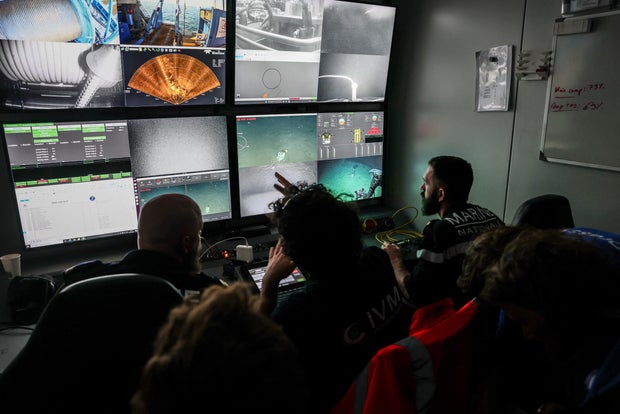
Pilots specializing in underwater robots from the French Navy, along with researchers, watch live feeds on screens showing the "ROV C 4000," a remotely operated vehicle, during an archaeological mission on the wreck of the CAMARA 4 in southeastern France, April 7, 2026. Thibaud MORITZ /AFP via Getty Images

Archaeologists believe the ship was sailing from northern Italy loaded with ceramics and metal bars before it sank.

Now the French navy and the culture ministry's underwater archaeology department are back to inspect the surviving artifacts lost more than 1.5 miles below sea level.

Cannons and piles of jugs

The navy is keeping secret the location of the wreckage site, which they have dubbed "Camarat 4"  — even if most people would unlikely have the means to reach a site so deep.

The sun has barely risen when the mission's navy tugboat arrives on site, carrying an underwater robot and two large containers acting as makeshift offices for marine archaeologists.

Its crew lower the robot — which is equipped with cameras as well as pincers — into the water.

A navy officer guides the robot down, linked to the ship through a long cable, as experts monitor its slow descent on screens.

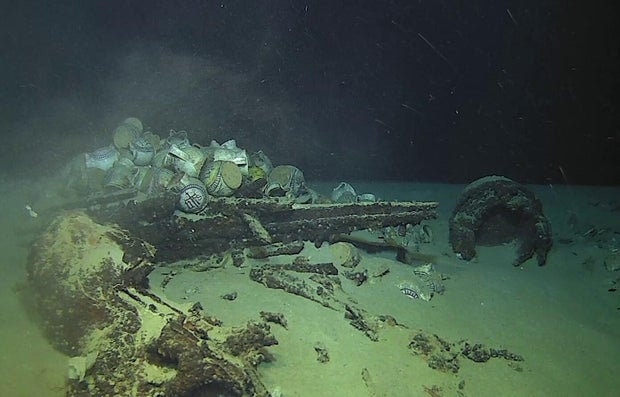
An hour later, the device designed to plunge as deep as 4,000 meters is gliding over piles of round pitchers on the sea floor.

Slowly, through its cameras, it reveals the wreck to the team sitting on deck.

It captures footage of a cannon, as well as hundreds of pitchers and plates, decorated with floral motifs, crosses and fish.
shipwreck-502898802-1228681525719586-3615561736483342987-n.jpg
Archaeologists say they discovered by chance what they say are the remains of a 16th-century merchant ship more than 1.5 miles underwater off southern France. National Navy via France's Department of Underwater and Submarine Archaeological Research

The robot shoots eight pictures per second for three hours, grabbing more than 86,000 images that will then be used to create a 3D model of the site.

Archaeologist Franca Cibecchini is delighted the water is so clear.

"The visibility is excellent. You almost can't tell it's so deep," she says.

"It is most likely a merchant ship carrying glazed pottery from Liguria," a region in the northwest of Italy, Cibecchini adds.

She says it could have been loaded on to the ship in the ports of Genoa or nearby Savona.

Experts previously identified two cauldrons, an anchor and six cannons at the shipwreck.

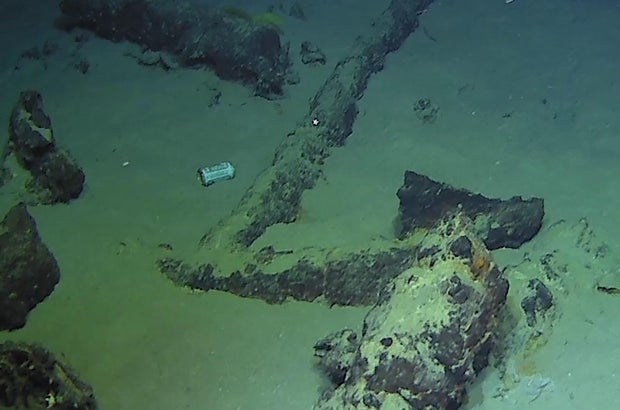
Modern waste, such as a soda can or an empty yogurt container, were spotted too. One image released by officials appeared to show an aluminum can next to an anchor.
anchor-can-493037804-1228681459052926-5277308859069340156-n.jpg
Archaeologists say they discovered by chance what they say are the remains of a 16th-century merchant ship more than 1.5 miles underwater off southern France. National Navy via France's Department of Underwater and Submarine Archaeological Research

"One of the deepest objects ever recovered"  

Marine Sadania, the lead archaeologist on the underwater dig, says findings will be key to understanding trade routes at the time the ship sank.

"We don't have very detailed texts about merchant ships in the 16th century, so this is a valuable source of information on maritime history," she says.

The experts hold their breath as the robot lowers a pitcher into a case as gently as possible, so as not to break it.

A third of all ceramics extracted from sea digs end up breaking, Sadania says.

In total, the team hauls up several jugs and plates.

Back on land, in a laboratory in the southern port city of Marseille, Sadania runs water over one of the jugs.

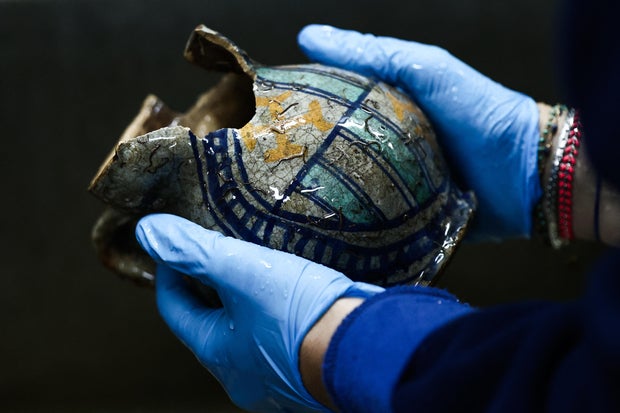
Dark blue lines run across its rounded side, creating rectangles, some of which are colored in with turquoise blue or decorated with saffron-yellow symbols.

"It's one of the deepest objects ever recovered from a wreck in France," she says.
FRANCE-ARCHAEOLOGY-SCIENCE-HISTORY-RESEARCH
This photograph shows a view of a ceramic jug, recovered from the wreck of the CAMARAT 4, during its analysis at the DRASSM laboratory in Marseille on April 16, 2026.  Thibaud MORITZ /AFP via Getty Images

Before this discovery, the deepest French authorities had found a sunken vessel was 1.4 miles under sea level off the southern city of Toulon in 2019. The wreckage belonged to La Minerve, a French submarine that plunged to its demise in 1968 with 52 navy crew on board, only four minutes after the start of a routine assignment.

On Tuesday, officials revealed that another 16th-century shipwreck was discovered by a naval vessel during a military exercise off the coast of Sweden.

In:

James Delgado on uncovering shipwrecks

Explorer James Delgado shares the secrets beneath the sea 05:49

Explorer James Delgado shares the secrets beneath the sea

(05:49)