



惯性聚合 高效追踪和阅读你感兴趣的博客、新闻、科技资讯
阅读原文 在惯性聚合中打开

推荐订阅源

D
DataBreaches.Net
T
Threatpost
N
News and Events Feed by Topic
PCI Perspectives
PCI Perspectives
V2EX - 技术
V2EX - 技术
D
Docker
G
Google Developers Blog
Microsoft Security Blog
N
News and Events Feed by Topic
cs.AI updates on arXiv.org
Google Online Security Blog
The GitHub Blog
The GitHub Blog
Hacker News - Newest:
Hacker News - Newest: "LLM"
Y
Y Combinator Blog
M
MIT News - Artificial intelligence
Blog — PlanetScale
Blog — PlanetScale
博客园 - 司徒正美
T
Troy Hunt's Blog
Webroot Blog
Webroot Blog
Security Archives - TechRepublic
量子位
Apple Machine Learning Research
H
Help Net Security
F
Full Disclosure
B
Blog
O
OpenAI News
H
Hackread – Cybersecurity News, Data Breaches, AI and More
博客园_首页
Google DeepMind News
Exploit-DB.com RSS Feed
Engineering at Meta
Engineering at Meta
大猫的无限游戏
大猫的无限游戏
Forbes - Security
Forbes - Security
Know Your Adversary
Know Your Adversary
B
Blog RSS Feed
MongoDB | Blog
MongoDB | Blog
Scott Helme
Scott Helme
T
The Exploit Database - CXSecurity.com
博客园 - 聂微东
cs.CV updates on arXiv.org
The Last Watchdog
The Last Watchdog
Recorded Future
Recorded Future
IT之家
IT之家
Project Zero
Project Zero
Stack Overflow Blog
Stack Overflow Blog
小众软件
小众软件
Attack and Defense Labs
L
Lohrmann on Cybersecurity
SecWiki News
SecWiki News
让小产品的独立变现更简单 - ezindie.com

Changelog — PlanetScale

Replica connections graph — PlanetScale Branch start maintenance webhook now available for Vitess enterprise customers — PlanetScale Deploy request UI updates — PlanetScale PostgreSQL CPU and I/O tracking — PlanetScale Branch start maintenance webhook — PlanetScale Cloudflare Workers integration — PlanetScale PlanetScale for Postgres is now Generally Available — PlanetScale PostgreSQL Schema Recommendations — PlanetScale Postgres maintenance windows — PlanetScale Support for 10 new Postgres extensions — PlanetScale 2025 PCI DSS reporting now available — PlanetScale AWS PrivateLink for Postgres — PlanetScale Google Cloud Provider support for Postgres databases — PlanetScale Insights: percent runtime — PlanetScale New region: AWS ca-central-1 (Montreal) — PlanetScale Postgres event triggers are now supported — PlanetScale New Postgres extension: pg_squeeze — PlanetScale Provisioned IOPS display for Metal clusters — PlanetScale Insights: max query latency graphs — PlanetScale Pinned databases update — PlanetScale New Postgres extensions: pg_cron and pg_partman_bgw — PlanetScale pscale shell now supports Postgres databases — PlanetScale Migration guides for Aurora, Neon, and Supabase — PlanetScale New pscale role commands for CLI — PlanetScale Postgres migration guides and scripts — PlanetScale Postgres role management — PlanetScale Expanded Postgres network-attached storage I/O configuration — PlanetScale 2025 SOC 1 Type 2 & SOC 2 Type 2 reports now available — PlanetScale Prometheus Metrics Additions: vstreamer events and errors — PlanetScale Postgres network-attached storage configuration — PlanetScale PlanetScale for Postgres — PlanetScale Metal storage estimation for deploy requests — PlanetScale SSO support for multiple organizations — PlanetScale New keyspace VSchema API endpoints — PlanetScale Aggressive deploy request cutover — PlanetScale Postgres migration scripts — PlanetScale Access request webhook — PlanetScale Webhook API endpoints — PlanetScale Storage webhook — PlanetScale Edge metrics are now available for Single Tenant and Managed customers — PlanetScale Insights: time range and refresh interval updates — PlanetScale Model Context Protocol support — PlanetScale PlanetScale workflows is now GA — PlanetScale Prometheus metrics are now available — PlanetScale Restore backups with a cluster size — PlanetScale Keyspace replication settings — PlanetScale Advanced workflow settings — PlanetScale You can now configure max VTGates — PlanetScale SLA commitment improvement — PlanetScale Metal instances are now available — PlanetScale You can now configure your VTGates in the dashboard — PlanetScale Adjusting the number of shards in a sharded keyspace — PlanetScale Infrastructure diagram: per-shard rollout status — PlanetScale Deploying changes to sharded keyspaces — PlanetScale Throttling deploy requests — PlanetScale PlanetScale vectors now supports quantization — PlanetScale PlanetScale workflows — PlanetScale Insights sparklines — PlanetScale Service tokens: all database permissions — PlanetScale Cluster configuration — PlanetScale Brownout notice: legacy connection strings — PlanetScale 2024 PCI DSS reporting now available — PlanetScale Instant deployments — PlanetScale Timezone display preferences — PlanetScale Service token permissions: branch creation — PlanetScale Insights: max latency reporting — PlanetScale Branching: rename and replace default branch — PlanetScale Insights: index usage tracking — PlanetScale Prevent backup deletion — PlanetScale 2024 SOC 2+ HIPAA — PlanetScale Insights: increased graph resolution — PlanetScale Insights: absolute x-axis time — PlanetScale Webhooks: New pending_cutover event for deploy requests — PlanetScale Deploy requests: auto-delete branch — PlanetScale Deprecation: legacy connection strings — PlanetScale Deploy requests: solo admins may now self-approve — PlanetScale Reason for closing a schema recommendation — PlanetScale Webhook payload update — PlanetScale New audit logs API endpoint — PlanetScale Deprecating old versions of the PlanetScale CLI — PlanetScale Branch cluster size updates now available via the API — PlanetScale New side navigation layout — PlanetScale VTGate errors are now in DataDog — PlanetScale Pin frequently used databases — PlanetScale Billing data now available via the API — PlanetScale Connecting to PlanetScale privately on GCP — PlanetScale Connecting to PlanetScale privately on AWS — PlanetScale Insights query latency percentile filtering — PlanetScale Character set and collation upgrade recommendations — PlanetScale Global replica credentials — PlanetScale Webhooks are now generally available — PlanetScale Hobby plan deprecation — PlanetScale Insights anomaly webhook — PlanetScale Deploy requests: remember auto-apply — PlanetScale Monthly spend alerts — PlanetScale Deprecating the Hobby plan — PlanetScale CPU and memory metrics now in Datadog — PlanetScale Schema recommendations — PlanetScale Safe migrations on development branches — PlanetScale Deprecating Scaler plan — PlanetScale
Single-node databases are now generally available — PlanetScale
2025-11-14 · via Changelog — PlanetScale

Single node Postgres databases are now available to all customers, starting at just $5 per month. Single node databases are a cost-effective option for early-stage projects, testing, development, and proof of concepts.

When creating or resizing a Postgres database, you have the option to choose between two types of production databases:

  • A highly available (HA) configuration with 1 primary and at least two replicas (the default).
  • A single-node, non-HA configuration.

Single-node databases do not come with replicas for high availability, but you can easily switch from non-HA mode to HA mode with just a couple clicks on your Clusters page.

This release also includes our new PS-5 database size and lower prices for PS-DEV Postgres development branches.
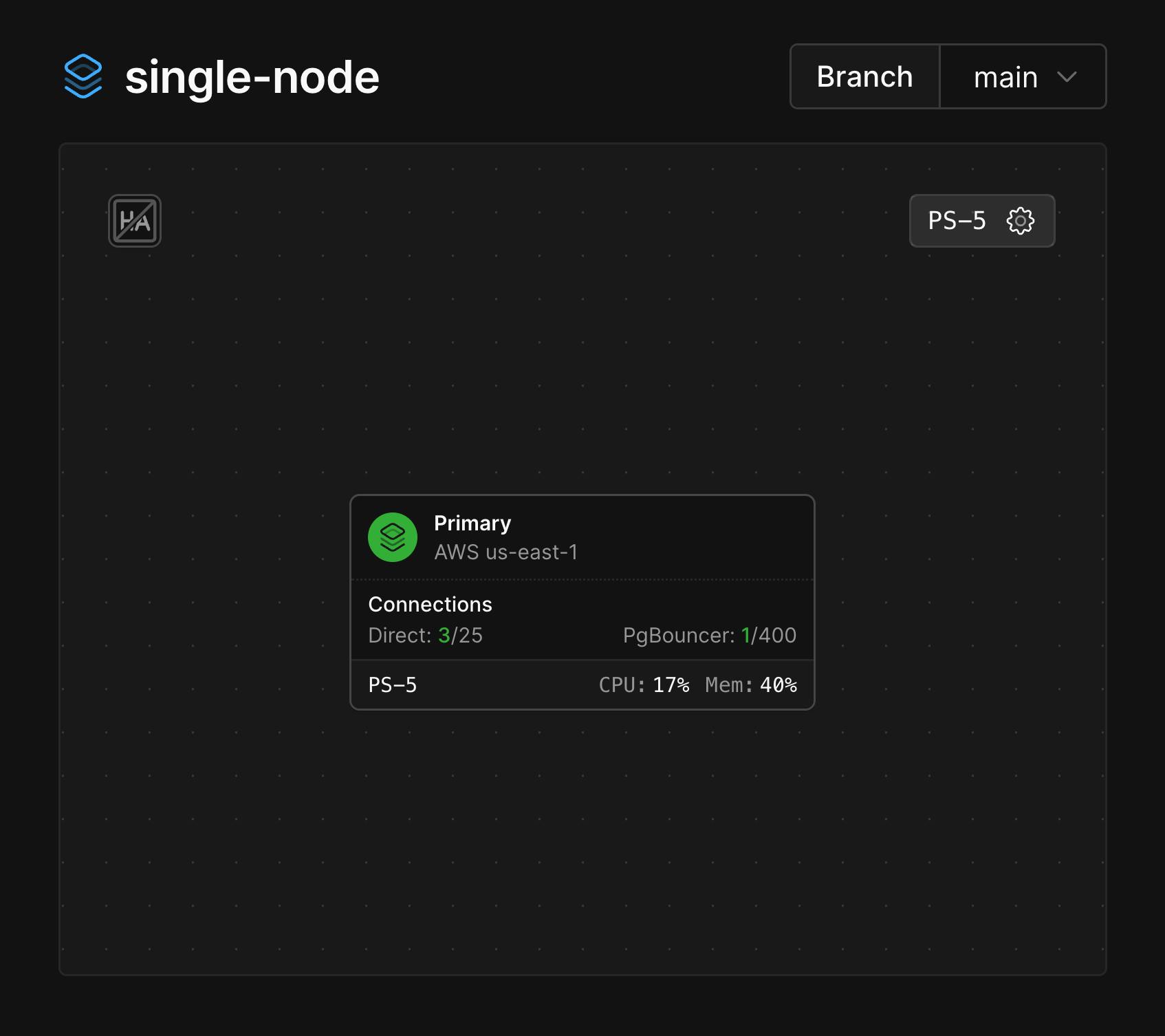
Single node Postgres database

Learn more about single-node databases in the announcement blog and in the documentation.