
惯性聚合 高效追踪和阅读你感兴趣的博客、新闻、科技资讯
阅读原文 在惯性聚合中打开

推荐订阅源

钛媒体:引领未来商业与生活新知
钛媒体:引领未来商业与生活新知
Security Latest
Security Latest
Jina AI
Jina AI
爱范儿
爱范儿
Attack and Defense Labs
Recent Commits to openclaw:main
GbyAI
GbyAI
N
News | PayPal Newsroom
Last Week in AI
Last Week in AI
V
Visual Studio Blog
SecWiki News
SecWiki News
H
Heimdal Security Blog
D
Darknet – Hacking Tools, Hacker News & Cyber Security
腾讯CDC
L
LINUX DO - 热门话题
I
InfoQ
罗磊的独立博客
博客园_首页
Know Your Adversary
Know Your Adversary
T
The Exploit Database - CXSecurity.com
博客园 - 【当耐特】
阮一峰的网络日志
阮一峰的网络日志
Hacker News - Newest:
Hacker News - Newest: "LLM"
T
Threat Research - Cisco Blogs
美团技术团队
IT之家
IT之家
AWS News Blog
AWS News Blog
OSCHINA 社区最新新闻
OSCHINA 社区最新新闻
N
Netflix TechBlog - Medium
Help Net Security
Help Net Security
S
Secure Thoughts
Microsoft Security Blog
Schneier on Security
Spread Privacy
Spread Privacy
B
Blog RSS Feed
N
News and Events Feed by Topic
L
Lohrmann on Cybersecurity
Google Online Security Blog
Microsoft Azure Blog
N
News and Events Feed by Topic
I
Intezer
Blog — PlanetScale
Blog — PlanetScale
云风的 BLOG
云风的 BLOG
A
Arctic Wolf
C
Cyber Attacks, Cyber Crime and Cyber Security
G
Google Developers Blog
The Register - Security
The GitHub Blog
The GitHub Blog
MyScale Blog
MyScale Blog
F
Full Disclosure

Swift for Visual Studio Code comes to Open VSX Registry | InfoWorld

Notion courts developers with a platform for AI agents and workflow automation Using continuous purple teaming to protect fast-paced enterprise environments A better way to work with SQL Server Evidence-driven workflows: Rethinking enterprise process design AWS debuts Graviton-powered Redshift RG instances to cut analytics costs SAP’s AI promises last year? Most are still rolling out First look: Lemonade serves up local AI with limitations GitLab CEO sees developer tool bill increasing 100-fold Red Hat adds support for agentic AI development What’s new and exciting in JDK 26 Kill the loading spinner with local-first data and reactive SQL A networking revolution at AWS Tokenmaxxing is super dumb How to add AI to an existing product (without annoying users) Your AI doesn’t need another database What happens when engineering teams reorganize around AI agents Python isn’t always easy When cloud giants meddle in markets 12 model-level deep cuts to slash AI training costs The best new features in Python 3.15 Teradata launches platform for enterprise AI agents moving beyond pilots Three skills that matter when AI handles the coding MongoDB targets AI’s retrieval problem Building AI apps and agents with Microsoft Foundry Designing front-end systems for cloud failure No, AI won’t destroy software development jobs Diskless databases: What happens when storage isn’t the bottleneck Vibe coding or spec-driven development? The agentic AI distraction Vibe coding or spec-driven development? How to choose Cloud providers are blinded by agentic AI SAP to acquire data lakehouse vendor Dremio Small language models: Rethinking enterprise AI architecture Making AI work through eval hygiene Improving AI agents through better evaluations AI in the cloud is easy but expensive Running AI in the cloud is easy – and expensive Making AI work for databases Harness teams of agentic coders with Squad Harness teams of coding agents with Squad Oracle NetSuite announces AI coding skills for SuiteCloud developers Why it’s so hard to create stand-alone Python apps A new challenge for software product managers The hidden cost of front-end complexity GitHub shifts Copilot to usage-based billing, signaling a new cost model for enterprise AI tools OpenAI’s Symphony spec pushes coding agents from prompts to orchestration The front-end architecture trilemma: Reactivity vs. hypermedia vs. local-first apps Enterprise AI is missing the business core The best JavaScript certifications for getting hired Google begins putting the guardrails on agentic AI Why world models are AI’s next frontier Where to begin a cloud career Google pitches Agentic Data Cloud to help enterprises turn data into context for AI agents How open source ideals must expand for AI Is your Node.js project really secure? How I doubled my GPU efficiency without buying a single new card SpaceX secures option to acquire AI coding startup Cursor for $60B Google’s Gemma 4 shines on local systems – both big and small AI is upending the SaaS game How AI is upending SaaS tools Snowflake offers help to users and builders of AI agents From the engine room to the bridge: What the modern leadership shift means for architects like me Addressing the challenges of unstructured data governance for AI The cookbook for safe, powerful agents Enterprises are rethinking Kubernetes GitHub pauses new Copilot sign-ups as agentic AI strains infrastructure Best practices for building agentic systems Making agents dull Oracle delivers semantic search without LLMs When cloud giants neglect resilience Exciting Python features are on the way Ease into Azure Kubernetes Application Network The agent tier: Rethinking runtime architecture for context-driven enterprise workflows MuleSoft Agent Fabric adds new ways to keep AI agents in line Salesforce launches Headless 360 to support agent‑first enterprise workflows Tap into the AI APIs of Google Chrome and Microsoft Edge Where will developer wisdom come from? GitHub adds Stacked PRs to speed complex code reviews The hyperscalers are pricing themselves out of AI workloads HTMX 4.0: Hypermedia finds a new gear Google Cloud introduces QueryData to help AI agents create reliable database queries Hands-on with the Google Agent Development Kit Are AI certifications worth the investment? AWS targets AI agent sprawl with new Bedrock Agent Registry Cloud degrees are moving online Swift for Visual Studio Code comes to Open VSX Registry AI agents aren't failing. The coordination layer is failing How Agile practices ensure quality in GenAI-assisted development Anthropic rolls out Claude Managed Agents Microsoft’s reauthentication snafu cuts off developers globally Meta’s Muse Spark: a smaller, faster AI model for broad app deployment Bringing databases and Kubernetes together Rethinking Angular forms: A state-first perspective Minimus Welcomes Yael Nardi as CBO to Facilitate Strategic Growth Microsoft announces end of support for ASP.NET Core 2.3 Get started with Python’s new frozendict type AWS turns its S3 storage service into a file system for AI agents Microsoft’s new Agent Governance Toolkit targets top OWASP risks for AI agents The winners and losers of AI coding GitHub Copilot CLI adds Rubber Duck review agent
The two-pass compiler is back – this time, it’s fixing AI code generation
by Vijay Pullur · 2026-04-16 · via Swift for Visual Studio Code comes to Open VSX Registry | InfoWorld

opinion

Apr 16, 20265 mins

How a battle-tested compiler architecture from the 1970s solves the reliability crisis in LLM-generated code.

If you came up building software in the 1990s or early 2000s, you remember the visceral satisfaction of determinism. You wrote code. The compiler analyzed it, optimized it, and emitted precisely the machine instructions you expected. Same input, same output. Every single time. There was an engineering rigor to it that shaped how an entire generation of developers thought about building systems.

Then large language models (LLMs) arrived and, almost overnight, code generation became a stochastic process. Prompt an AI model twice with identical inputs and you’ll get structurally different outputs—sometimes brilliant, sometimes subtly broken, occasionally hallucinated beyond repair. For quick prototyping that’s fine. For enterprise-grade software—the kind where a misplaced null check costs you a production outage at 2am—it’s a non-starter.

We stared at this problem for a while. And then something clicked. It felt familiar, like a pattern we’d encountered before, buried somewhere in our CS fundamentals. Then it hit us: the two-pass compiler.

A quick refresher

Early compilers were single-pass: read source, emit machine code, hope for the best. They were fast but brittle—limited optimization, poor error handling, fragile output. The industry’s answer was the multi-pass compiler, and it fundamentally changed how we build languages. The first pass analyzes, parses, and produces an intermediate representation (IR). The second pass optimizes and generates the final target code. This separation of concerns is what gave us C, C++, Java—and frankly, modern software engineering as we know it.
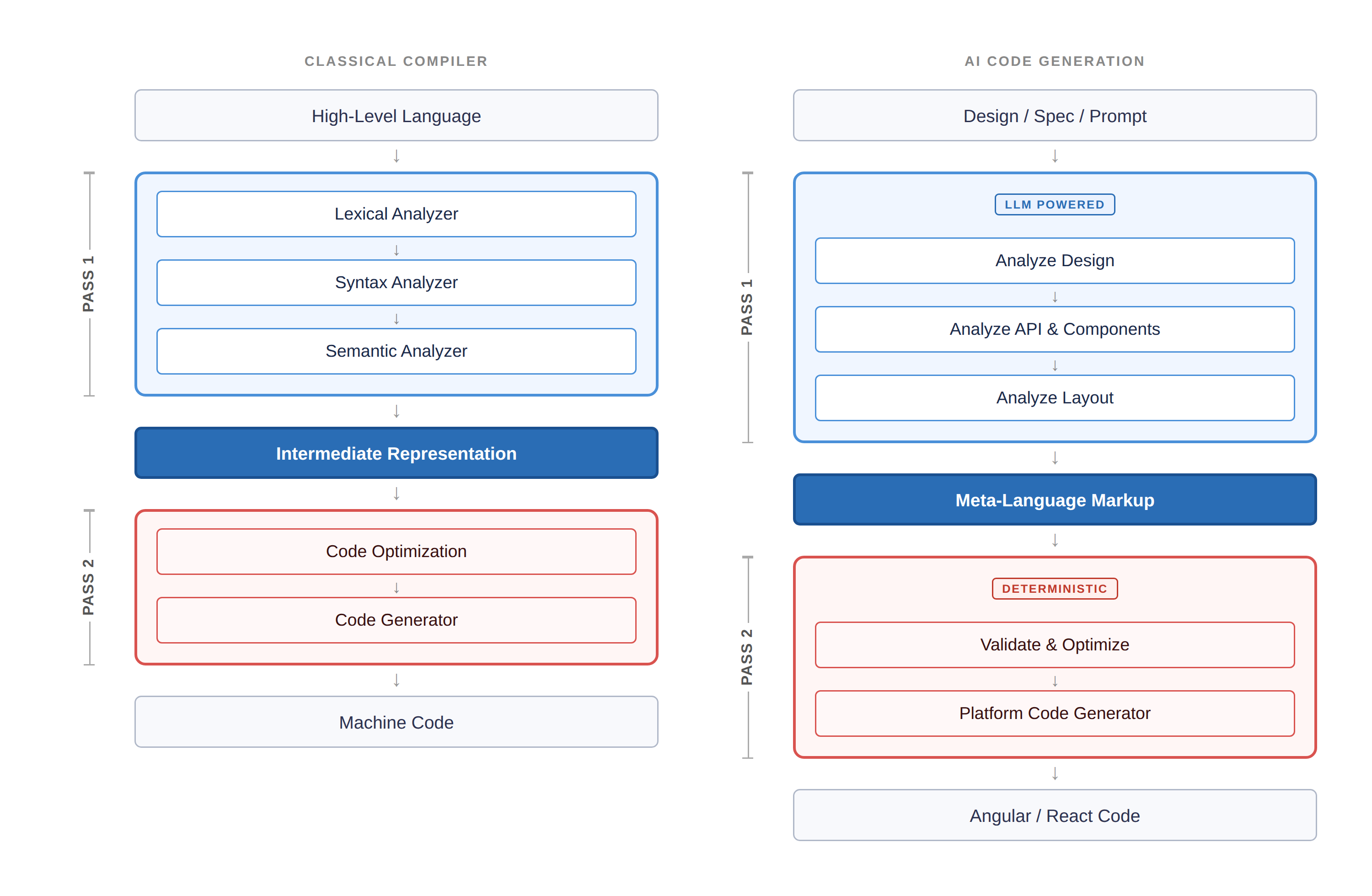
2-pass architecture

The structural parallel between classical two-pass compilation and AI-driven code generation.

WaveMaker

The analogy to AI code generation is almost eerily direct. Today’s LLM-based tools are, architecturally, single-pass compilers. You feed in a prompt, the model generates code, and you get whatever comes out the other end. The quality ceiling is the model itself. There’s no intermediate analysis, no optimization pass, no structural validation. It’s 1970s compiler design with 2020s marketing.

Applying the two-pass model to AI code generation

Here’s where it gets interesting. What if, instead of asking an LLM to go from prompt to production code in one shot, you split the process into two architecturally distinct passes—just like the compilers that built our industry?

Pass 1 is where the LLM does what LLMs are genuinely good at: understanding intent, decomposing design, and reasoning about structure. The model analyzes the design spec, identifies components, maps APIs, resolves layout semantics—and emits an intermediate representation, an IR. Not HTML. Not Angular or React. A well-defined meta-language markup that captures what needs to be built without committing to how.

This is critical. By constraining the LLM’s output to a structured meta-language rather than raw framework code, you eliminate entire categories of failure. The model can’t inject malformed <script> tags if it’s not emitting HTML. It can’t hallucinate nonexistent React hooks if it’s outputting component descriptors. You’ve reduced the stochastic surface area dramatically.

Pass 2 is entirely deterministic. A platform-level code generator—no LLM involved—takes that validated intermediate markup and emits production-grade Angular, React, or React Native code. This is the pass that plugs in battle-tested libraries, enforces security patterns, and applies framework-specific optimizations. Same IR in, same code out. Every time.

First pass gives you speed. Second pass gives you reliability. The separation of concerns is what makes it work.

Why this matters now

The advantages of this architecture compound in exactly the ways that matter for enterprise development. The meta-language IR becomes your durable context for iterative development—you’re not re-prompting the LLM from scratch every time you refine a component. Security concerns like script injection and SQL injection are structurally eliminated, not patched after the fact. Hallucinated properties and tokens get caught and stripped at the IR boundary before they ever reach generated code. And because Pass 2 is deterministic, you get reproducible, auditable, deployable output.

Pass 1 — LLM-powered

• Translates design/spec to structured components and design tokens
• Enables iterative dev with meta-markup as persistent context

Eliminates script/SQL injection by design

Pass 2 — Deterministic

• Generates optimized, secure, performant framework code
• Validates and strips hallucinated markup and tokens

Plugs in battle-tested libraries for reliability

If you’ve spent your career building systems where correctness isn’t optional, this should resonate. The industry spent decades learning that single-pass compilation couldn’t produce reliable software at scale. The two-pass architecture wasn’t just an optimization, but an engineering philosophy: separate understanding from generation, validate before you emit, and never let a single phase carry the entire burden of correctness.

We’re at the same inflection point with AI code generation right now. The models are powerful. The architecture around them has been naive. The fix isn’t to wait for a smarter model. It’s to apply the engineering discipline we’ve always known, and build systems where stochastic brilliance and deterministic reliability each do what they do best—in the right pass, at the right time.

Deterministic software engineering is cool again. Turns out it never really left.

New Tech Forum provides a venue for technology leaders—including vendors and other outside contributors—to explore and discuss emerging enterprise technology in unprecedented depth and breadth. The selection is subjective, based on our pick of the technologies we believe to be important and of greatest interest to InfoWorld readers. InfoWorld does not accept marketing collateral for publication and reserves the right to edit all contributed content. Send all inquiries to doug_dineley@foundryco.com.

Vijay Pullur

by Vijay Pullur

Contributor

Vijay Prasanna Pullur is a serial tech entrepreneur with a two-decade track record from web infrastructure and application platforms to cloud, social media, mobile, and now AI. As co-founder of Pramati ("exceptional minds"), a leading software product company with a unique corporate incubator model, Vijay has incubated and grown multiple software ventures, including exits to the likes of Autodesk, Accenture, and UKG. Vijay is currently CEO and co-founder at WaveMaker. He thrives on mentoring other entrepreneurs, discovering and nurturing exceptional talent and developing deep associations that foster long-term success.

Show me more