



惯性聚合 高效追踪和阅读你感兴趣的博客、新闻、科技资讯
阅读原文 在惯性聚合中打开

推荐订阅源

H
Help Net Security
V
V2EX
博客园 - 【当耐特】
V
Visual Studio Blog
宝玉的分享
宝玉的分享
D
DataBreaches.Net
Engineering at Meta
Engineering at Meta
Threat Intelligence Blog | Flashpoint
N
News | PayPal Newsroom
Schneier on Security
I
InfoQ
博客园 - Franky
The GitHub Blog
The GitHub Blog
CTFtime.org: upcoming CTF events
Recent Commits to openclaw:main
AI
AI
WordPress大学
WordPress大学
Webroot Blog
Webroot Blog
L
LangChain Blog
Help Net Security
Help Net Security
V2EX - 技术
V2EX - 技术
TaoSecurity Blog
TaoSecurity Blog
O
OpenAI News
月光博客
月光博客
H
Hacker News: Front Page
F
Full Disclosure
让小产品的独立变现更简单 - ezindie.com
SecWiki News
SecWiki News
S
Security Affairs
博客园 - 司徒正美
MyScale Blog
MyScale Blog
Vercel News
Vercel News
cs.CV updates on arXiv.org
B
Blog RSS Feed
H
Hackread – Cybersecurity News, Data Breaches, AI and More
Y
Y Combinator Blog
T
Tailwind CSS Blog
奇客Solidot–传递最新科技情报
奇客Solidot–传递最新科技情报
Hacker News: Ask HN
Hacker News: Ask HN
N
News and Events Feed by Topic
J
Java Code Geeks
Simon Willison's Weblog
Recent Announcements
D
Darknet – Hacking Tools, Hacker News & Cyber Security
I
Intezer
The Last Watchdog
The Last Watchdog
博客园_首页
C
Check Point Blog
罗磊的独立博客
酷 壳 – CoolShell
酷 壳 – CoolShell

Swift for Visual Studio Code comes to Open VSX Registry | InfoWorld

Notion courts developers with a platform for AI agents and workflow automation Using continuous purple teaming to protect fast-paced enterprise environments A better way to work with SQL Server Evidence-driven workflows: Rethinking enterprise process design AWS debuts Graviton-powered Redshift RG instances to cut analytics costs SAP’s AI promises last year? Most are still rolling out First look: Lemonade serves up local AI with limitations GitLab CEO sees developer tool bill increasing 100-fold Red Hat adds support for agentic AI development What’s new and exciting in JDK 26 Kill the loading spinner with local-first data and reactive SQL A networking revolution at AWS Tokenmaxxing is super dumb How to add AI to an existing product (without annoying users) Your AI doesn’t need another database What happens when engineering teams reorganize around AI agents Python isn’t always easy When cloud giants meddle in markets 12 model-level deep cuts to slash AI training costs The best new features in Python 3.15 Teradata launches platform for enterprise AI agents moving beyond pilots Three skills that matter when AI handles the coding MongoDB targets AI’s retrieval problem Building AI apps and agents with Microsoft Foundry Designing front-end systems for cloud failure No, AI won’t destroy software development jobs Diskless databases: What happens when storage isn’t the bottleneck Vibe coding or spec-driven development? The agentic AI distraction Vibe coding or spec-driven development? How to choose Cloud providers are blinded by agentic AI SAP to acquire data lakehouse vendor Dremio Small language models: Rethinking enterprise AI architecture Making AI work through eval hygiene Improving AI agents through better evaluations AI in the cloud is easy but expensive Running AI in the cloud is easy – and expensive Making AI work for databases Harness teams of agentic coders with Squad Harness teams of coding agents with Squad Oracle NetSuite announces AI coding skills for SuiteCloud developers Why it’s so hard to create stand-alone Python apps A new challenge for software product managers The hidden cost of front-end complexity GitHub shifts Copilot to usage-based billing, signaling a new cost model for enterprise AI tools OpenAI’s Symphony spec pushes coding agents from prompts to orchestration The front-end architecture trilemma: Reactivity vs. hypermedia vs. local-first apps Enterprise AI is missing the business core The best JavaScript certifications for getting hired Google begins putting the guardrails on agentic AI Why world models are AI’s next frontier Where to begin a cloud career Google pitches Agentic Data Cloud to help enterprises turn data into context for AI agents How open source ideals must expand for AI Is your Node.js project really secure? How I doubled my GPU efficiency without buying a single new card SpaceX secures option to acquire AI coding startup Cursor for $60B AI is upending the SaaS game How AI is upending SaaS tools Snowflake offers help to users and builders of AI agents From the engine room to the bridge: What the modern leadership shift means for architects like me Addressing the challenges of unstructured data governance for AI The cookbook for safe, powerful agents Enterprises are rethinking Kubernetes GitHub pauses new Copilot sign-ups as agentic AI strains infrastructure Best practices for building agentic systems Making agents dull Oracle delivers semantic search without LLMs When cloud giants neglect resilience Exciting Python features are on the way Ease into Azure Kubernetes Application Network The agent tier: Rethinking runtime architecture for context-driven enterprise workflows The two-pass compiler is back – this time, it’s fixing AI code generation MuleSoft Agent Fabric adds new ways to keep AI agents in line Salesforce launches Headless 360 to support agent‑first enterprise workflows Tap into the AI APIs of Google Chrome and Microsoft Edge Where will developer wisdom come from? GitHub adds Stacked PRs to speed complex code reviews The hyperscalers are pricing themselves out of AI workloads HTMX 4.0: Hypermedia finds a new gear Google Cloud introduces QueryData to help AI agents create reliable database queries Hands-on with the Google Agent Development Kit Are AI certifications worth the investment? AWS targets AI agent sprawl with new Bedrock Agent Registry Cloud degrees are moving online Swift for Visual Studio Code comes to Open VSX Registry AI agents aren't failing. The coordination layer is failing How Agile practices ensure quality in GenAI-assisted development Anthropic rolls out Claude Managed Agents Microsoft’s reauthentication snafu cuts off developers globally Meta’s Muse Spark: a smaller, faster AI model for broad app deployment Bringing databases and Kubernetes together Rethinking Angular forms: A state-first perspective Minimus Welcomes Yael Nardi as CBO to Facilitate Strategic Growth Microsoft announces end of support for ASP.NET Core 2.3 Get started with Python’s new frozendict type AWS turns its S3 storage service into a file system for AI agents Microsoft’s new Agent Governance Toolkit targets top OWASP risks for AI agents The winners and losers of AI coding GitHub Copilot CLI adds Rubber Duck review agent
Google’s Gemma 4 shines on local systems – both big and small
2026-04-22 · via Swift for Visual Studio Code comes to Open VSX Registry | InfoWorld

Serdar Yegulalp

Senior Writer

feature

Apr 22, 20268 mins

Google’s Gemma 4 comes touted as the latest evolution of Google’s multi-modal model offerings. Gemma 4 not only offers reasoning and tool use, but vision and audio functionality, and it’s available in a range of model sizes that target servers and local devices.

What’s striking about Gemma 4 is that even at the higher end of its size range, it’s still decently performant on personal hardware. Google claims this is due to innovations in the architecture of the model, but the proof is in the trying. Gemma 4 is quite responsive.

To that end, I took Gemma 4 for a spin on my own hardware to see how it fared for its advertised tasks.

Gemma 4 model sizes

Gemma 4 comes in four basic sizes or “densities”:

  • E2B: 2.3 billion effective parameters, 5.1 billion total, 128K max context window.
  • E4B: 4.5 billion efffective parameters, 8 billion total, 128K max context window.
  • 31B: 31 billion parameters (the “dense” version), 256K max context window. (You will probably not use this one on your own machine — it’s 62GB!)
  • 26B A4B: A “mixture of experts” model with 4 billion “activated” parameters and 26 billion total parameters, 256K max context window.

Each of these model sizes is available in a slew of community-created editions, thanks to Gemma 4’s Apache 2 licensing. For instance, the 26B A4B model comes in a community edition with more compact quantizations (4-bit, 6-bit, etc.), which I used as one of the model mixes for this article.

The models I used:

Test system and prompts

I ran each model using my now-standard test bed: LM Studio 0.4.10 on an AMD Ryzen 5 3600 6-core CPU (32GB RAM) and an Nvidia GeForce RTX 5060 (8GB VRAM).

For each model I ran a set of prompts:

  • A vision-functionality prompt: “Create a caption for the attached image of no more than three sentences.” Another version of the prompt added: “… with no editorialization.” (The attached image is shown in one of the screenshots below.)
  • Prompts intended to provoke web-search tool use and produce either detailed or simplified responses: “What is the copyright status of Franz Kafka’s works? Explain in detail” and “What did William Gibson think of Blade Runner?”
  • A prompt for code generation and problem solving: “Python’s pip tool has a function ScriptMaker (accessed with from pip._vendor.distlib.scripts import ScriptMaker). On Microsoft Windows this is used to create an .exe stub launcher for a Python package’s entry points when it’s installed with pip. However, the icon created for this stub is the same generic icon used for the Python runtime itself. Let’s write a Python utility to allow the user to append their own custom icon to the .exe stub, but also preserve the stub’s appended archive and other metadata. The utility should use only the Python standard library, and should be kept as simple as possible.”
  • Another code-related prompt: “I have attached a Python program that takes Python applications and packages them to run with a standalone instance of the Python runtime. One drawback of the program is that it’s not very modular. Analyze the program and make some suggestions about how to increase its modularity so it can be used as a library with hooks for various advanced behaviors.”

Gemma 4 in action

The 26B model was at the upper end of what I could run comfortably on my test hardware. I wasn’t able to fit the entire model into GPU memory, but I set the first 12 layers to run on the GPU (7.51GB VRAM), and I set the context length to 16384 tokens (total: 18.76GB RAM).

Getting good performance out of models that don’t fit in VRAM is always a challenge. However, Gemma 4 has, courtesy of its “mixture of experts” design, a feature to boost performance. LM Studio exposes this feature through a setting currently tagged as experimental. You can choose how many layers of the model to “force MoE [Mixture of Experts] weights onto the CPU,” which conserves VRAM and can speed up inference.
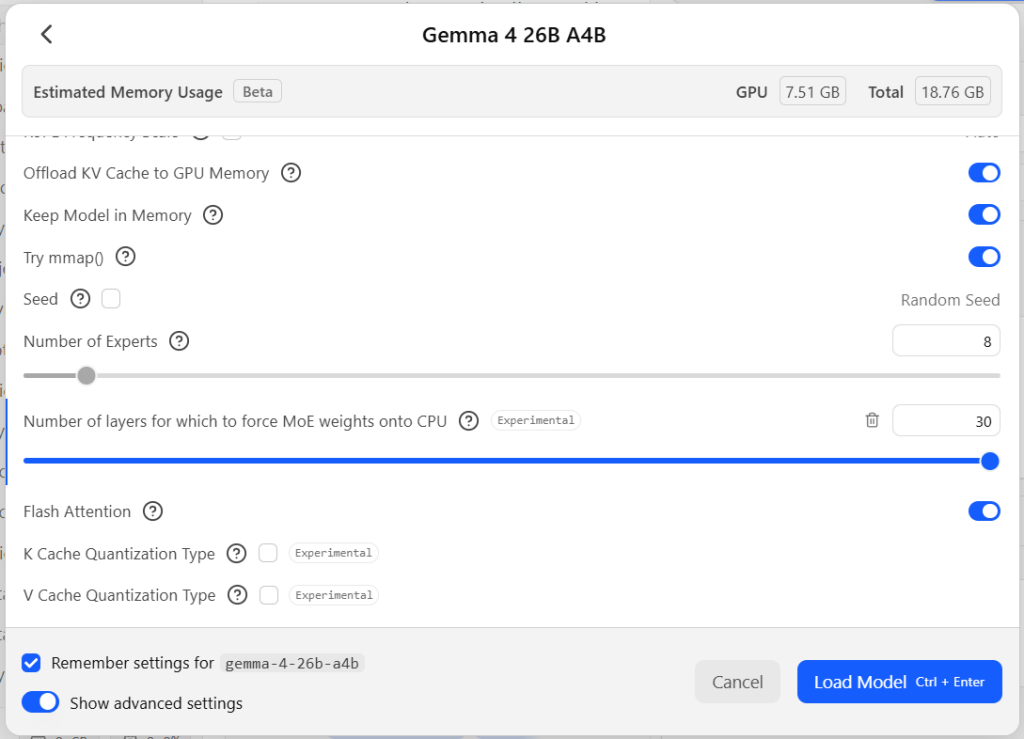
The MoE (mixture of experts) experimental setting in LM Studio

The MoE (mixture of experts) experimental setting in LM Studio. For models that use an MoE design, this setting forces the weights for that aspect of the model to be run on the CPU instead of the GPU. With Gemma 4, this resulted in a major speed boost for models too big to fit in memory.


Foundry

Without the MoE forcing, the overall inference time and token generation speed cratered; the model could barely manage an average of 1.5 tokens per second even for simple queries. With MoE forcing turned on (with the maximum number of layers supported, 30), token generation speed jumped to anywhere from 5 to 13 tokens per second, depending on the rest of the system’s load. That’s still a far cry from the speed of the smaller models, but a lot more workable.

For faster time-to-first-token results, you can disable thinking, at the possible cost of less robust output. For the code-generation query, Gemma 4 spent 6 minutes 26 seconds thinking, and over 8 minutes generating the response (5,013 tokens, 9.55 tokens per second). The resulting code and explanation was not significantly more advanced or detailed than the non-thinking version.
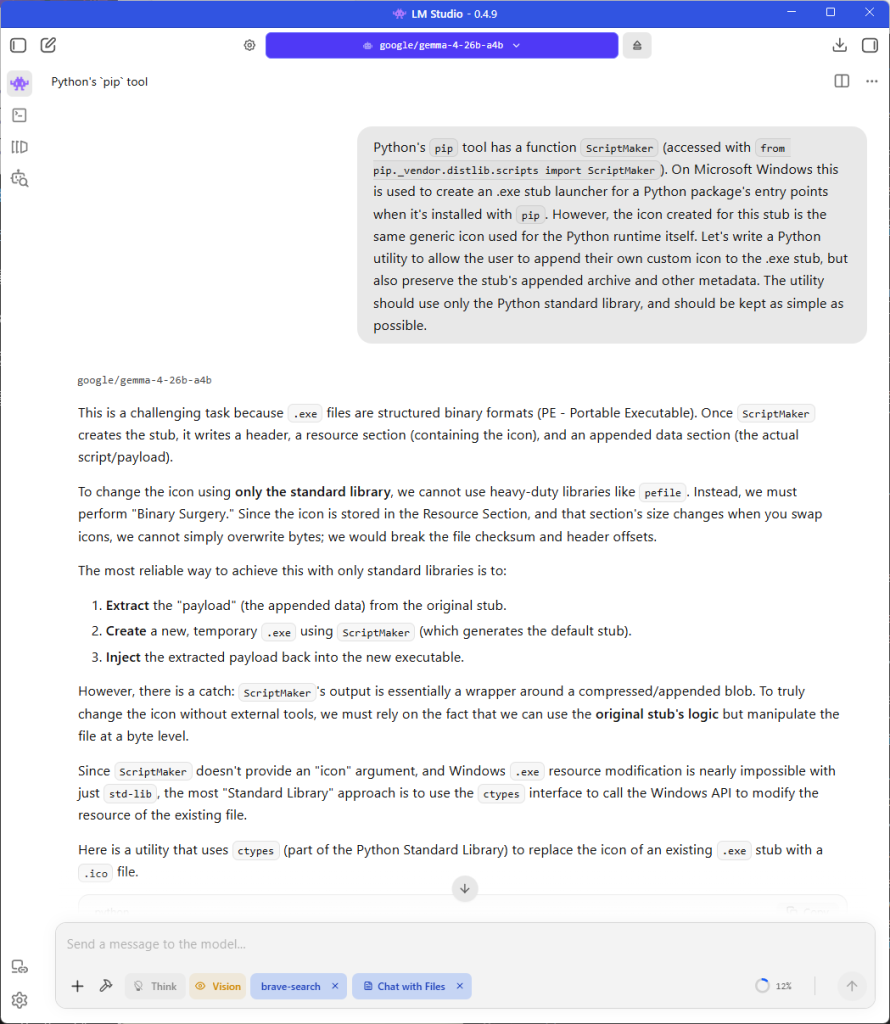
Gemma 4's 26B parameter model, responding to a query to generate code.

Response from Gemma 4’s 26B parameter model to a query to generate code. This larger version of the model runs less quickly when it can’t fit entirely in memory, but its mixture-of-experts design helped offset that limitation.

Foundry

When I switched to the LM Studio Community edition of the E4B model, I put all 42 layers on the GPU and kept the context at 16,384, all of which fit comfortably in VRAM with room to spare. The results were a major jump in speed: 72 tokens per second. The smaller model was less specific for certain queries — the code-generation query in particular didn’t generate a comprehensive code example, only a conceptual framework for one — but still did a decent job of analyzing the problem and suggesting constructive approaches. The “unsloth” edition of the E4B model, despite being slightly smaller, was about as performant and useful.

Examples of Gemma 4's 26B parameter version generating image captions.

Examples of Gemma 4’s 26B parameter version generating image captions. The smaller versions of the model tended not to editorialize. The larger version sometimes needed specific guidance to be less verbose or florid.

Foundry

For the “make this program more modular” prompt, I got roughly equivalent results across all incarnations of the model in terms of the advice given. The only major difference was that the smaller models ran far faster — 73.85 and 71.73 tokens per second vs. 9.3 for the big model.

Gemma 4 takeaways

The biggest takeaway from running Gemma 4 locally is how the mix-of-experts design in one of the larger incarnations of the model make it useful even on systems where the model doesn’t fit entirely into VRAM. The smaller incarnations of the model, even at lower quantizations, still work well, too. They also deliver results many times faster, and free up much more memory for larger context windows. Thus, the smaller models are well worth experimenting with as the first model of choice before moving up to their bigger brothers.

Serdar Yegulalp

Senior Writer

Serdar Yegulalp is a senior writer at InfoWorld. A veteran technology journalist, Serdar has been writing about computers, operating systems, databases, programming, and other information technology topics for 30 years. Before joining InfoWorld in 2013, Serdar wrote for Windows Magazine, InformationWeek, Byte, and a slew of other publications. At InfoWorld, Serdar has covered software development, devops, containerization, machine learning, and artificial intelligence, winning several B2B journalism awards including a 2024 Neal Award and a 2025 Azbee Award for best instructional content and best how-to article, respectively. He currently focuses on software development tools and technologies and major programming languages including Python, Rust, Go, Zig, and Wasm. Tune into his weekly Dev with Serdar videos for programming tips and techniques and close looks at programming libraries and tools.

More from this author