惯性聚合 高效追踪和阅读你感兴趣的博客、新闻、科技资讯
阅读原文 在惯性聚合中打开

推荐订阅源

D
DataBreaches.Net
S
Schneier on Security
T
The Exploit Database - CXSecurity.com
Webroot Blog
Webroot Blog
AI
AI
P
Palo Alto Networks Blog
Attack and Defense Labs
WordPress大学
WordPress大学
月光博客
月光博客
阮一峰的网络日志
阮一峰的网络日志
Spread Privacy
Spread Privacy
T
Tor Project blog
罗磊的独立博客
小众软件
小众软件
S
Security Affairs
酷 壳 – CoolShell
酷 壳 – CoolShell
量子位
Apple Machine Learning Research
T
Threatpost
NISL@THU
NISL@THU
博客园_首页
PCI Perspectives
PCI Perspectives
大猫的无限游戏
大猫的无限游戏
IT之家
IT之家
N
News and Events Feed by Topic
freeCodeCamp Programming Tutorials: Python, JavaScript, Git & More
Forbes - Security
Forbes - Security
博客园 - 叶小钗
D
Darknet – Hacking Tools, Hacker News & Cyber Security
OSCHINA 社区最新新闻
OSCHINA 社区最新新闻
Last Week in AI
Last Week in AI
L
LINUX DO - 热门话题
T
Threat Research - Cisco Blogs
cs.AI updates on arXiv.org
腾讯CDC
Security Latest
Security Latest
Exploit-DB.com RSS Feed
The Cloudflare Blog
A
About on SuperTechFans
爱范儿
爱范儿
Threat Intelligence Blog | Flashpoint
TaoSecurity Blog
TaoSecurity Blog
宝玉的分享
宝玉的分享
G
GRAHAM CLULEY
雷峰网
雷峰网
F
Full Disclosure
I
Intezer
Cloudbric
Cloudbric
博客园 - 三生石上(FineUI控件)
U
Unit 42

董泽润的技术笔记

美图 kv 存储 titan | 董泽润的技术笔记 浅析 redis lua 实现 | 董泽润的技术笔记 IO Pipeline 读 Minio 源码 聊聊最近基于 S3 的项目 | 董泽润的技术笔记 新手如何调试 MySQL | 董泽润的技术笔记 为什么泛型使你的程序变慢 | 董泽润的技术笔记 每个 gopher 都需要了解的 Go AST 小技巧!Wireshark 让调试 GRPC 不再困难 | 董泽润的技术笔记 小技巧!Mac 环境下编译 Go 服务 | 董泽润的技术笔记 小技巧!k8s 环境下调试服务 | 董泽润的技术笔记 小技巧!如何用 systemtap 排查问题 | 董泽润的技术笔记 小白的 redis 1 安全漏洞 | 董泽润的技术笔记 聊聊时钟源为什么会影响性能 | 董泽润的技术笔记 聊聊为什么 IDL 只能扩展字段而非修改 | 董泽润的技术笔记 什么是 Pause 容器 | 董泽润的技术笔记 弱智的 MySQL NULL | 董泽润的技术笔记 分享一个 UT failed 引出的思考 | 董泽润的技术笔记 聊聊如何做技术分享 | 董泽润的技术笔记 聊聊 Go 并发安全 | 董泽润的技术笔记
聊聊并发库 conc | 董泽润的技术笔记
2023-01-28 · via 董泽润的技术笔记

上个月 sourcegraph 放出了 conc 并发库,目标是 better structured concurrency for go, 简单的评价一下

每个公司都有类似的轮子,与以往的库比起来,多了泛型,代码写起来更优雅,不需要 interface, 不需要运行时 assert, 性能肯定更好

我们在写通用库和框架的时候,都有一个原则,并发控制与业务逻辑分离,背离这个原则肯定做不出通用库

整体介绍

1. WaitGroup 与 Panic

标准库自带 sync.WaitGroup 用于等待 goroutine 运行结束,缺点是我们要处理控制部分
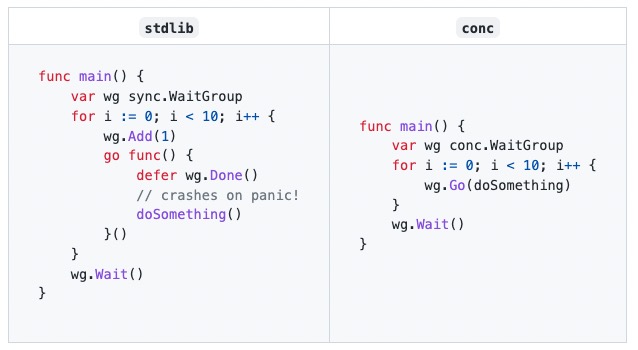
代码里大量的 wg.Addwg.Done 函数,所以一般封装成右侧的库

1
2
3
4
5
6
7
8
9
10
11
12
13
type WaitGroup struct {
wg sync.WaitGroup
pc panics.Catcher
}


func (h *WaitGroup) Go(f func()) {
h.wg.Add(1)
go func() {
defer h.wg.Done()
h.pc.Try(f)
}()
}

但是如何处理 panic 呢?简单的可以在闭包 doSomething 运行时增加一个 safeGo 函数,用于捕捉 recover

原生 Go 要生成大量无用代码,我司 repo 运动式的清理过一波,也遇到过 goroutine 忘写 recover 导致的事故。conc 同时提供 catcher 封装 recover 逻辑,conc.WaitGroup 可以选择 Wait 重新抛出 panic, 也可以 WaitAndRecover 返回捕获到的 panic 堆栈信息

1
2
3
4
5
6
7
8
9
10
11
12
13
func (h *WaitGroup) Wait() {
h.wg.Wait()


h.pc.Repanic()
}

func (h *WaitGroup) WaitAndRecover() *panics.RecoveredPanic {
h.wg.Wait()


return h.pc.Recovered()
}

2. ForEach 与 Map

高级语言很多的基操,在 go 里面很奢侈,只能写很多繁琐代码。conc封装了泛型版本的 iterator 和 mapper

1
2
3
4
5
6
7
func process(values []int) {
iter.ForEach(values, handle)
}

func concMap(input []int, f func(int) int) []int {
return iter.Map(input, f)
}

上面是使用例子,用户只需要写业务函数 handle. 相比 go1.19 前的版本,泛型的引入,使得基础库的编写更游刃有余

1
2
3
4
5
6
7
8

type Iterator[T any] struct {


MaxGoroutines int
}

MaxGoroutines 默认 GOMAXPROCS 并发处理传参 slice, 也可以自定义,个人认为不合理,默认为 1 最妥

1
2
3


func ForEachIdx[T any](input []T, f func(int, *T)) { Iterator[T]{}.ForEachIdx(input, f) }

ForEachIdx 在创建 Iterator[T]{} 可以自定义并发度,最终调用 iter.ForEachIdx

1
2
3
4
5
6
7
8
9
10
11
12
13
14
15
16
17
18
19


func (iter Iterator[T]) ForEachIdx(input []T, f func(int, *T)) {
......
var idx atomic.Int64

task := func() {
i := int(idx.Add(1) - 1)
for ; i < numInput; i = int(idx.Add(1) - 1) {
f(i, &input[i])
}
}

var wg conc.WaitGroup
for i := 0; i < iter.MaxGoroutines; i++ {
wg.Go(task)
}
wg.Wait()
}

ForEachIdx 泛型函数写得非常好,略去部分代码。朴素的实现在 for 循环里创建闭包,传入 idx 参数,然后 wg.Go 去运行。但是这样会产生大量闭包,我司遇到过大量闭包,造成 heap 内存增长很快频繁触发 GC 的性能问题,所以在外层只创建一个闭包,通过 atomic 控制 idx

1
2
3
4
5
6
7
func Map[T, R any](input []T, f func(*T) R) []R {
return Mapper[T, R]{}.Map(input, f)
}

func MapErr[T, R any](input []T, f func(*T) (R, error)) ([]R, error) {
return Mapper[T, R]{}.MapErr(input, f)
}

MapMapErr 也只是对 ForEachIdx 的封装,区别是处理 error

3. 各种 Pool 与 Stream

Pool 用于并发处理,同时 Wait 等待任务结束。相比我司现有 concurrency 库

  • 增加了泛型实现
  • 增加了对 goroutine 的复用
  • 增加并发度设置(我司有,但 conc 实现方式更巧秒)
  • 支持的函数签名更多

先看一下支持的接口

1
2
3
4
5
6
Go(f func())
Go(f func() error)
Go(f func(ctx context.Context) error)
Go(f func(context.Context) (T, error))
Go(f func() (T, error))
Go(f func() T)
1
Go(f func(context.Context) (T, error))

理论上这一个足够用了,传参 Context, 返回泛型类型与错误。

1
Wait() ([]T, error) 

这是对应的 Wait 回收函数,返回泛型结果 []T 与错误。具体 Pool 实现由多种组合而来:Pool, ErrorPool, ContextPool, ResultContextPool, ResultPool

1
2
3
4
5
6
7
8
9
10
11
12
13
14
15
16
17
18
19
20
21
22
23
24
25
26
27
func (p *Pool) Go(f func()) {
p.init()

if p.limiter == nil {

select {
case p.tasks <- f:

default:


p.handle.Go(p.worker)
p.tasks <- f
}
}
......
}

func (p *Pool) worker() {


defer p.limiter.release()

for f := range p.tasks {
f()
}
}

复用方式很巧妙,如果处理速度足够快,没必要过多创建 goroutine

Stream 用于并发处理 goroutine, 但是返回结果保持顺序

1
2
3
4
5
6
7
type Stream struct {
pool pool.Pool
callbackerHandle conc.WaitGroup
queue chan callbackCh

initOnce sync.Once
}

实现很简单,queue 是一个 channel, 类型 callbackCh 同样也是 channel, 在真正派生 goroutine 前按序顺生成 callbackCh 传递结果

Stream 命名很差,容易让人混淆,感觉叫 OrderedResultsPool 更理想,整体非常鸡肋

超时

超时永远是最难处理的问题,目前 conc 库 Wait 函数并没有提供 timeout 传参,这就要求闭包内部必须考滤超时,如果添加 timeout 传参,又涉及 conc 内部库并发问题题

1
Wait() ([]T, error)

比如这个返回值,内部 append 到 slice 时是有锁的,如果 Wait 提前结束了会发生什么?

[]T 拿到的部分结果只能丢弃,返回给上层 timeout error

Context 框架传递参数

通用库很容易做的臃肿,我司并发库会给闭包产生新的 context, 并继承所需框架层的 metadata, 两种实现无可厚非,这些细节总得要处理

小结

代码量不大,感兴趣的可以看看。没有造轮子的必要,够用就行,这种库写了也没价值

分享知识,长期输出价值,这是我做公众号的目标。同时写文章不容易,如果对大家有所帮助和启发,请帮忙点击在看点赞分享 三连