
惯性聚合 高效追踪和阅读你感兴趣的博客、新闻、科技资讯
阅读原文 在惯性聚合中打开

推荐订阅源

K
Kaspersky official blog
小众软件
小众软件
Engineering at Meta
Engineering at Meta
博客园 - 三生石上(FineUI控件)
WordPress大学
WordPress大学
G
Google Developers Blog
Cyber Security Advisories - MS-ISAC
V
V2EX
freeCodeCamp Programming Tutorials: Python, JavaScript, Git & More
Google DeepMind News
Security Archives - TechRepublic
CTFtime.org: upcoming CTF events
C
Check Point Blog
aimingoo的专栏
aimingoo的专栏
罗磊的独立博客
钛媒体:引领未来商业与生活新知
钛媒体:引领未来商业与生活新知
MongoDB | Blog
MongoDB | Blog
L
LINUX DO - 热门话题
酷 壳 – CoolShell
酷 壳 – CoolShell
奇客Solidot–传递最新科技情报
奇客Solidot–传递最新科技情报
H
Help Net Security
Martin Fowler
Martin Fowler
G
GRAHAM CLULEY
Simon Willison's Weblog
OSCHINA 社区最新新闻
OSCHINA 社区最新新闻
博客园 - Franky
V
Vulnerabilities – Threatpost
云风的 BLOG
云风的 BLOG
博客园_首页
C
Cybersecurity and Infrastructure Security Agency CISA
量子位
Stack Overflow Blog
Stack Overflow Blog
Recent Announcements
让小产品的独立变现更简单 - ezindie.com
I
Intezer
Scott Helme
Scott Helme
A
About on SuperTechFans
博客园 - 司徒正美
Hacker News: Ask HN
Hacker News: Ask HN
The GitHub Blog
The GitHub Blog
Forbes - Security
Forbes - Security
Threat Intelligence Blog | Flashpoint
博客园 - 聂微东
人人都是产品经理
人人都是产品经理
The Cloudflare Blog
cs.CV updates on arXiv.org
Spread Privacy
Spread Privacy
T
Tailwind CSS Blog
S
Security Affairs
宝玉的分享
宝玉的分享

OpenRouter Blog

Choosing the Optimal Image Input Detail Level in LLMs — OpenRouter Blog DeepSeek V4 Is Earning Agentic Token Share — OpenRouter Blog The Open Weight Models that Matter: June 2026 — OpenRouter Blog The OpenRouter MCP Server — OpenRouter Blog Introducing the Unified Image API — OpenRouter Blog The AI Governance Checklist That Maps to Your Stack — OpenRouter Blog Enforce AI Data Residency at the Routing Layer — OpenRouter Blog OpenRouter vs Portkey: Routing Network vs Control Plane — OpenRouter Blog OpenRouter vs LiteLLM: Managed vs Self-Hosted Gateway — OpenRouter Blog Connect OpenClaw to OpenRouter: One Key, Failover, Free Models — OpenRouter Blog Connect SillyTavern to OpenRouter: Setup, Models, Fixes — OpenRouter Blog A Robot is Sprinting Towards You: Do You Want it Running on Claude or Grok? Kilo Code + OpenRouter: Setup, Routing, and Free Models — OpenRouter Blog Codex CLI with OpenRouter: config.toml Setup and Models — OpenRouter Blog Claude Code with OpenRouter: Setup, Models, and Costs — OpenRouter Blog How to Use OpenRouter With Any Coding Agent or AI Tool — OpenRouter Blog Subagent: Let Your Model Delegate the Busywork — OpenRouter Blog Free LLM API in 2026: 13 Options Ranked and Compared — OpenRouter Blog How to Enforce Agentic AI Governance at the API Layer — OpenRouter Blog Keep Your Agent Running When Models Disappear — OpenRouter Blog Hermes Agent + OpenRouter: Setup, Model Choice & Routing Config — OpenRouter Blog Lowest-Cost LLM Inference: The Complete OpenRouter Guide — OpenRouter Blog How OpenRouter Model Routing Works: Providers, Fallbacks & Auto Router — OpenRouter Blog OpenRouter Failover: Provider Failover vs Model Fallbacks Explained — OpenRouter Blog Surpassing Frontier Performance with Fusion — OpenRouter Blog LLM Gateway: What It Is and How to Choose One — OpenRouter Blog Advisor: Give Any Model a Lifeline to a Smarter One — OpenRouter Blog Gemini 2.5 Flash API - Pricing, Quickstart & Provider Comparison — OpenRouter Blog EU AI Act & Colorado ADMT Compliance: Human Oversight for AI Agents — OpenRouter Blog May Release Spotlight — OpenRouter Blog Guardrails: Protect your Agents, Data, and Costs — OpenRouter Blog OpenRouter Raises $113M Series B — OpenRouter Blog Human-in-the-Loop Tools for the Agent SDK — OpenRouter Blog Consistent Web Search and Fetch Across Every Model — OpenRouter Blog GPT-5.5 Price Increase: What It Actually Costs — OpenRouter Blog New Audio APIs for Speech and Transcription — OpenRouter Blog Response Caching: Zero Cost for Identical Requests — OpenRouter Blog April Release Spotlight — OpenRouter Blog Create OpenRouter Accounts via CLI with Stripe Projects — OpenRouter Blog Opus 4.7 Agent SDK: Building Multi-turn Agent Workflows on OpenRouter — OpenRouter Blog Build Your Own Harness with the Agent SDK — OpenRouter Blog Introducing Workspaces — OpenRouter Blog Announcing Video Generation — OpenRouter Blog Auto Exacto: Adaptive Quality Routing, On by Default — OpenRouter Blog February Release Spotlight — OpenRouter Blog OpenRouter Outages on February 17 and 19, 2026 — OpenRouter Blog January Release Spotlight — OpenRouter Blog Distillable Models and Synthetic Data Pipelines with NeMo Data Designer — OpenRouter Blog December Release Spotlight — OpenRouter Blog Response Healing: Reduce JSON Defects by 80%+ — OpenRouter Blog The 2025 State of AI Report — OpenRouter Blog Is Implicit Caching Prompt Retention? — OpenRouter Blog Provider Variance: Introducing Exacto — OpenRouter Blog 1 million free BYOK requests per month — OpenRouter Blog The First-Ever Image Model Is Up on OpenRouter — OpenRouter Blog GPT-5 is now live — OpenRouter Blog Audio Inputs and PDF URLs for Apps — OpenRouter Blog Presets: How To Seamlessly Transfer Model Configurations Across Apps — OpenRouter Blog New Privacy-Focused Provider Drop: Venice — OpenRouter Blog Use OpenRouter Models in Cursor: Try it with Moonshot AI Updates to Our Free Tier: Sustaining Accessible AI for Everyone — OpenRouter Blog New Stealth Model: "Cypher Alpha" — OpenRouter Blog Introducing Presets: Manage LLM Configs from Your Dashboard! — OpenRouter Blog Dev & BYOK Updates: Uptime API + Smarter Key Management — OpenRouter Blog Simplifying Our Platform Fee — OpenRouter Blog GIF Prompts, Omni Search, Tool Caching, and BYOK Flags — OpenRouter Blog New Features: Reasoning Streams, Crypto Invoices, End-User IDs & More — OpenRouter Blog Passkeys, DevEx Upgrades, and a New Guide for TypeScript Agents — OpenRouter Blog New Provider Drop: Cerebras Is Here — OpenRouter Blog Better Insights, Faster Metrics, and New Developer Power Tools — OpenRouter Blog Privacy Clarity, New Providers, OAuth Upgrade, and Gemini Gets Parallel Tools — OpenRouter Blog Universal PDF Support — OpenRouter Blog Smarter Charts, Inline SVGs, and Live Usage Accounting — OpenRouter Blog Quasar Alpha and Optimus Alpha Reveal — OpenRouter Blog "Stealth" model: Optimus Alpha — OpenRouter Blog “Stealth” model: Quasar Alpha — OpenRouter Blog Never Pay for Empty AI Responses Again — OpenRouter Blog Deep Research & Many New Models — OpenRouter Blog Introducing Nitro and Floor Price Shortcuts — OpenRouter Blog Introducing Cloudflare as a new provider — OpenRouter Blog Reasoning Tokens for Thinking Models — OpenRouter Blog Introducing Web Search via the API — OpenRouter Blog Standardized finish reasons — OpenRouter Blog Happy New Year! Introducing a new Auto Router — OpenRouter Blog Holiday launches: Web Search & Price Cuts — OpenRouter Blog Bring Your Own API Keys — OpenRouter Blog Crypto Payments API — OpenRouter Blog Structured Outputs & Free Gemini Flash 2.0 — OpenRouter Blog Price Drops and Llama 3.3 70b — OpenRouter Blog Author Pages & Amazon Nova — OpenRouter Blog
Dinner is Served — OpenRouter Blog
Afzal Jasani · 2026-06-12 · via OpenRouter Blog

A few weeks ago I was with my team in SF at a conference. We originally had dinner plans at a pretty standard American restaurant but I had other plans and quickly pulled an audible to get us a reservation for sushi. Last minute changes aren’t ideal but neither is a mediocre meal after working a conference booth all day. Plus who doesn’t love sushi?

My wife and I have done sushi omakase for every celebration for the past 10 years. I know my way around the menu without even looking at it. Most inexperienced sushi lovers go straight for the O-toro but there’s so much more out there. So naturally I told everyone I would be ordering for the table. I’ve consistently done this with friends, family, and work colleagues. 100% of the time people are willing to outsource their agency in this specific situation to enjoy a meal.

I have a strongly held opinion about how we break bread: family style, every time.

The case for optionality

But why? On one hand it reduces the risk of ordering solo and your hawaiian ribeye tasting like garbage. On the other hand it magnifies the memory of “omg that caviar wagyu bite was the single best bite I’ve had all year”. That moment stays with us. I always say for a first visit, taste everything. You can always order more later. But that only works if we do family style.

Standardizing on one LLM is the same as everyone ordering their own entree. You might be optimizing for the safe pick instead of the best outcome. I’ve talked to hundreds of companies who started their AI journey by picking one provider say OpenAI, Anthropic, or Gemini. When standardizing on one provider you’re making a bet based on what you know today and what you need today. It’s the age old story of “no one gets fired for buying and implementing salesforce” except that’s kind of changing. By the time I talk to these companies they’re ready to “graduate” to utilizing more than just one model-family and one modality. New use cases are showing up every day. It often looks like this:

  • Start off with OpenAI enterprise and deploy licenses to a select few teams.
  • Monitor usage across the initial cohort which shows up-and-to-the-right trends.
  • Give access to additional teams.
  • New use cases like image generation, transcription, and creative writing emerge.
  • Find out that OpenAI doesn’t have the best models for your use and you need Gemini.
  • Go to Gemini or any other provider to set up access and now observability, governance, and provisioning are broken.

The current pattern I’m seeing today looks like cost pressure but it’s deeper than that. Companies have blown through their annual budgets and it’s only June. There’s a strong desire to reduce token usage and I get it. If you accidentally use Opus 4.8 you might run through your daily budget and then you have no other options left. Close your laptop and go for a walk.

While list price didn’t change on Opus 4.7 several people wrote about the “tokenizer tax”. This was a silent change made by Anthropic which had almost a 35% increase in input tokens. That’s a meaningful change. Newer more proficient models are increasing in price as well. Anthropic released Fable which is priced at $10/M input tokens and $50/M output tokens. And it goes higher: OpenAI’s GPT-5.5 Pro lands at $30/M input tokens and $180/M output tokens. Use with caution!

Cost pressure is a forcing mechanism which can lead to either better or worse outcomes. From my reference point, I’m optimistic it’s leading to some better outcomes. I’m also lucky enough to enable these outcomes. This was a common theme during my days working in data infra. So many conversations revolved around compute costs and how much teams were spending on their data warehouse. But this focuses too much on the explicit costs versus the implicit costs. The most strategic leaders flip this conversation on its head. I would often hear “I’m already spending $1M a year on compute costs so I don’t care about reducing that by 30%. Instead, what’s more valuable is if my team of 40 analysts which costs me $7M a year is more productive. I need speed and efficiency when it comes to developer tools”.

Routing is a first class citizen

Before we dive into this next section, a quick note on what OpenRouter actually is. OpenRouter is the canonical marketplace for accessing AI. We make inference just work. We remove all the overhead around picking a provider, or picking a model, and understanding things: latency, price, TPS, model benchmarks, etc.

So now you can access hundreds of LLMs in one place through OpenRouter in a clean standardized API spec. How incredible that this exists? And all this sounds great almost like you can have your cake AND eat it but what do people actually do in reality?

Luckily I was able to pull some data around this. It’s also divine timing that today the team released our analytics API!
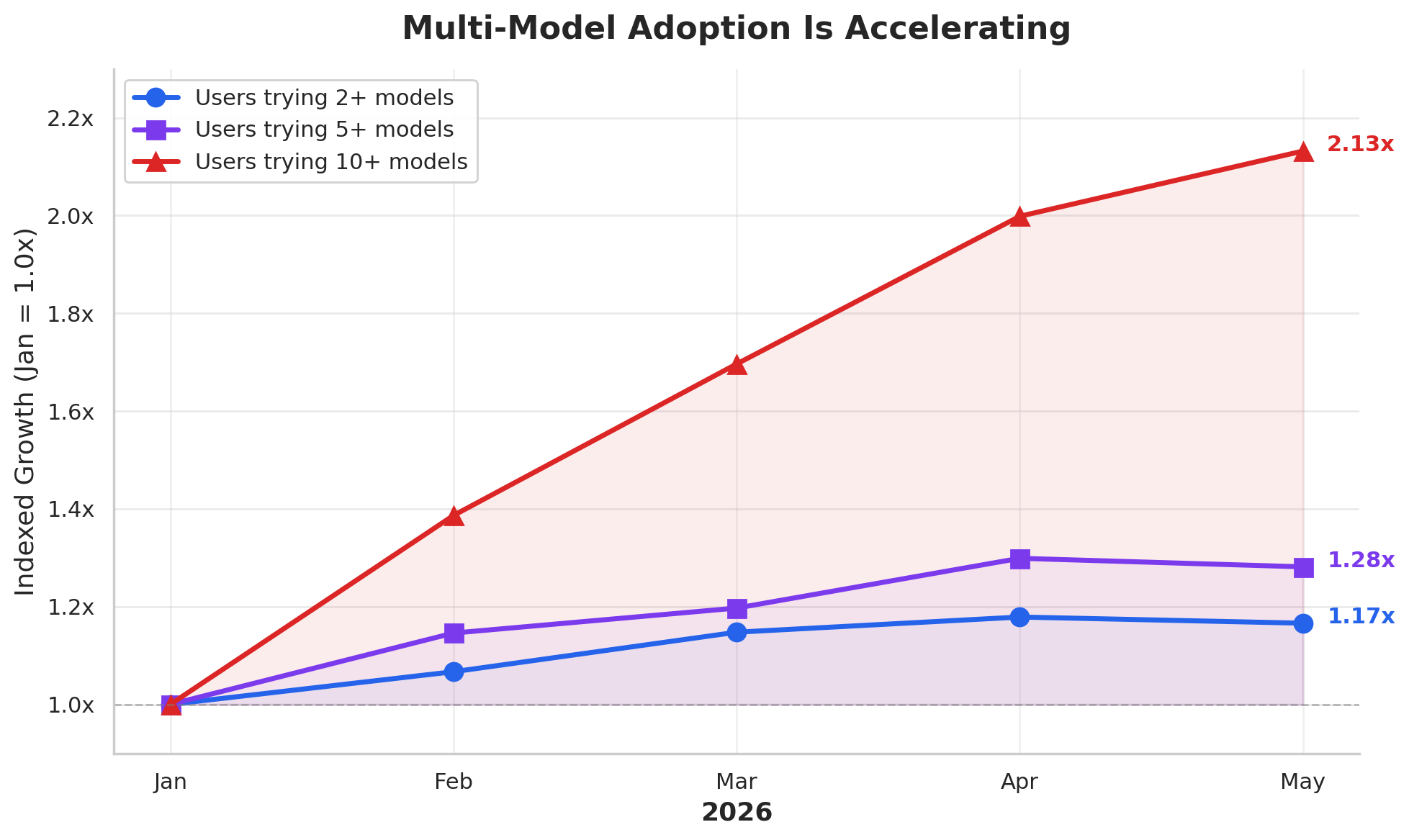
Multi-Model Adoption Is Accelerating: indexed growth of users trying 2+, 5+, and 10+ models, Jan–May 2026, reaching 2.13x

Multi-model adoption was a hypothesis we have always had but we can clearly see growth trends alongside this story. This makes sense and is expected but it obscures the fact that most people could just be trying the newest version of each model. For example, Anthropic has released Opus 4.6, Opus 4.7, and Opus 4.8 all within the graph’s timeline. So what would be more interesting is how users adopt across model families.
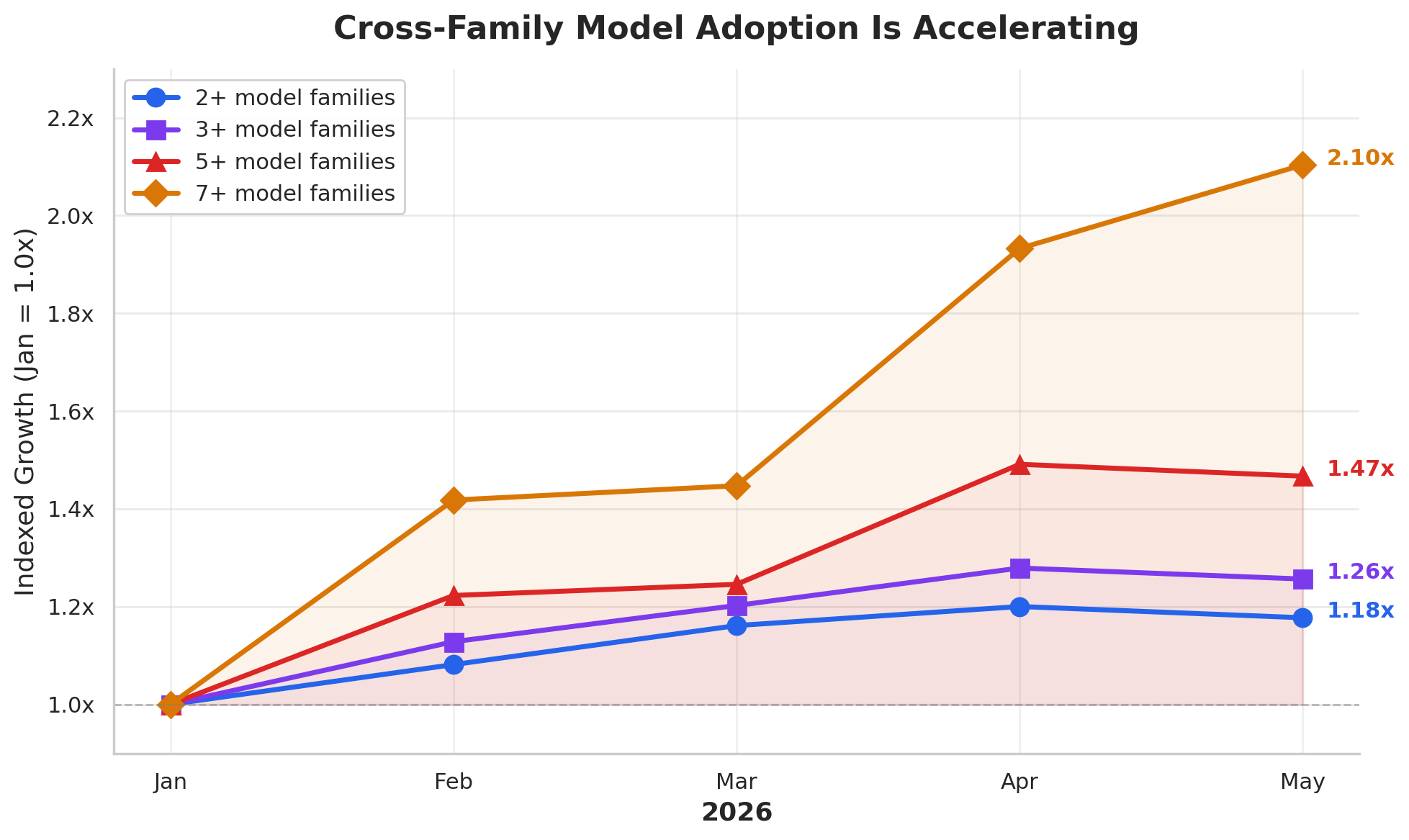
Cross-Family Model Adoption Is Accelerating: indexed growth of users spreading inference across 2+, 3+, 5+, and 7+ model families, Jan–May 2026, reaching 2.10x

Now here we can capture the real growth around users actively spreading inference across model families. This paints a more realistic picture of what continuously graduating looks like. Let’s layer in one more data point around model releases as well.
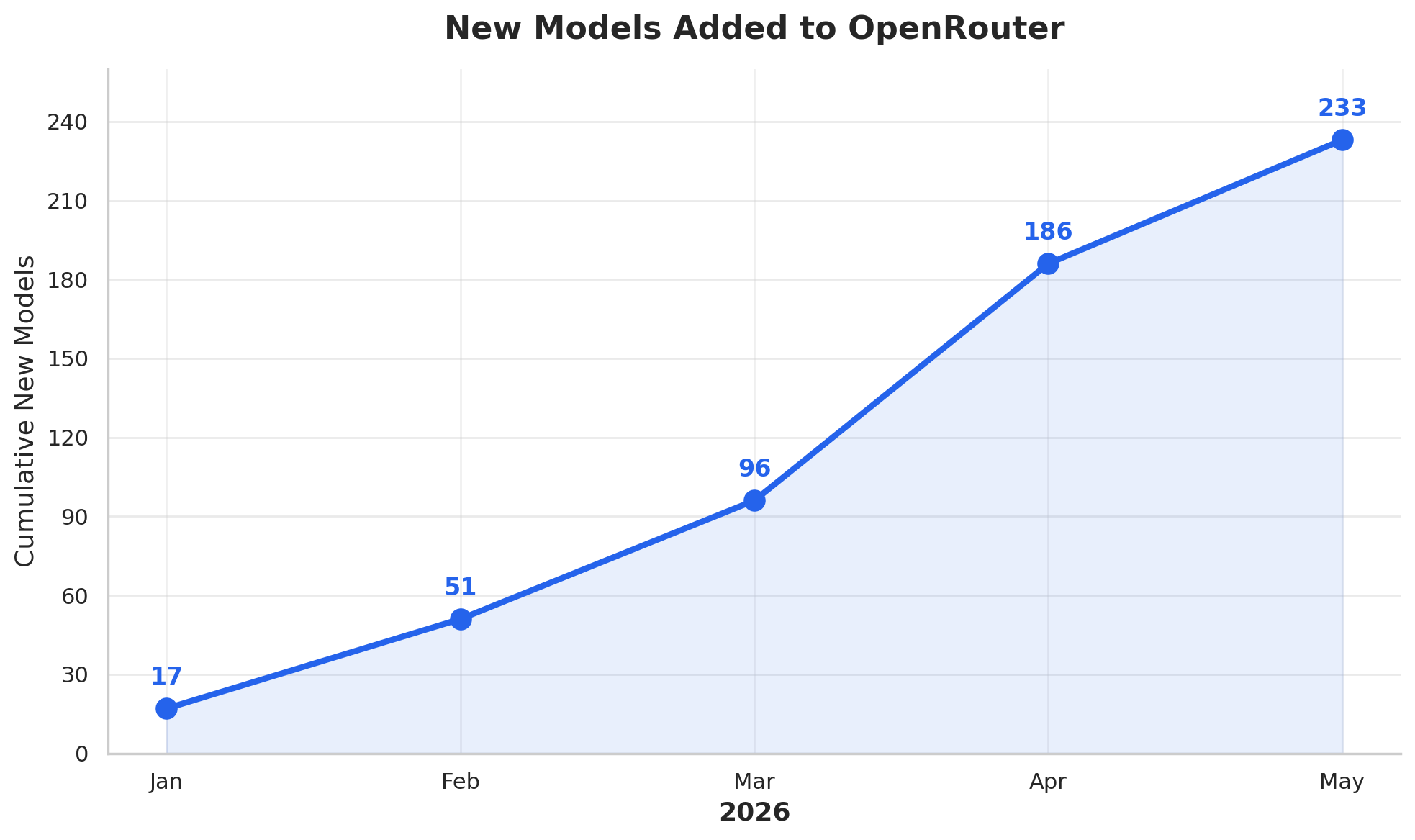
New Models Added to OpenRouter: cumulative new models Jan–May 2026, climbing from 17 to 233

This is a cumulative chart since release schedules aren’t always consistent. But we can see one big outlier from March to April where we had 90 new model releases. That’s huge! So many more options to pick from at an increasing velocity.

That can also be a little stressful. It’s like going to a restaurant and the menu has 225 items (one of my favorite restaurants). Even with family style you can’t try them all. We obviously thought about this and don’t want our users to have to know the difference between every single model. So we built out things like auto-router and pareto-router to make it easier to pick which model to use.

All this ties back to the cost pressure I mentioned earlier. Companies are actually utilizing OpenRouter in an interesting way. They are able to bring their average weighted cost per token down over time. How is this possible? Well if you route specific workloads to specific model providers and models based on your required outcomes then you can take advantage of say Deepseek v4 flash which only costs around $0.10/M tokens on input and $0.20/M tokens on output.

Take this one step further by utilizing a model provider like Cerebras which has some of the best throughput and now you’re the maestro like Bradley Cooper except we’re doing the heavy lifting for you.
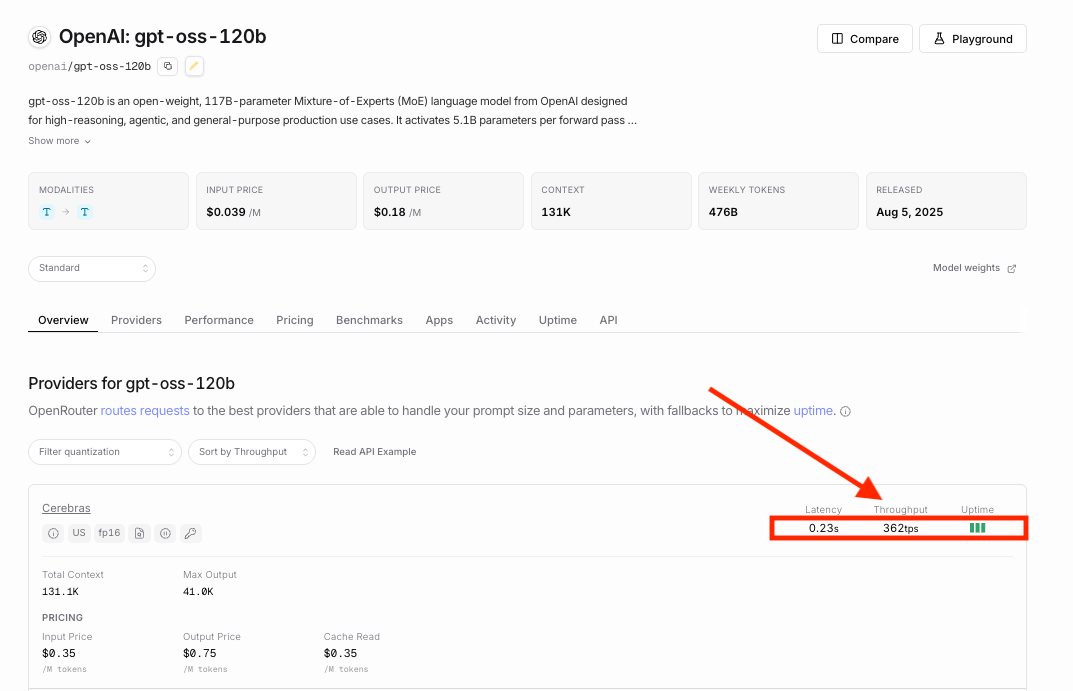
OpenRouter model page for gpt-oss-120b showing the Cerebras provider with 0.23s latency and 362 tps throughput

Or you route some of your traffic to flex priority tier on Gemini models to take advantage of 50% off. Again the choice is yours.
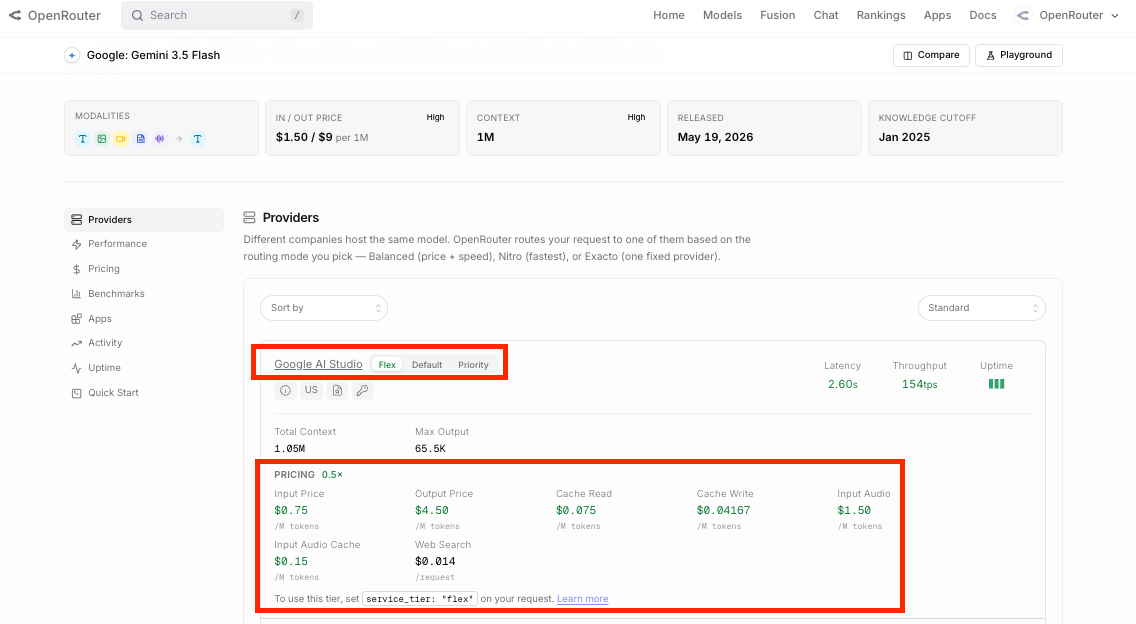
OpenRouter model page for Google Gemini 3.5 Flash highlighting the flex tier pricing at 50% off

We have some exciting stuff around model intelligence that we will be sharing soon. Overall, the theme is still the same: we make inference just work.

It feels like the tailwinds that were driving AI adoption are moving towards AI optimization. We understand that the amount of money we are spending on AI inference isn’t going to decrease by any meaningful magnitude, so what’s the next best alternative? It’s bringing the average weighted cost per token down. Organizations are becoming more intentional with democratizing usage across teams while reducing risk when it comes to governance. This really only happens if you’re not vendor locked into a single provider. When you choose to use different models for different use cases you gain leverage at each turn. You finally get to sit at the dinner table and eat as you please, family style.