





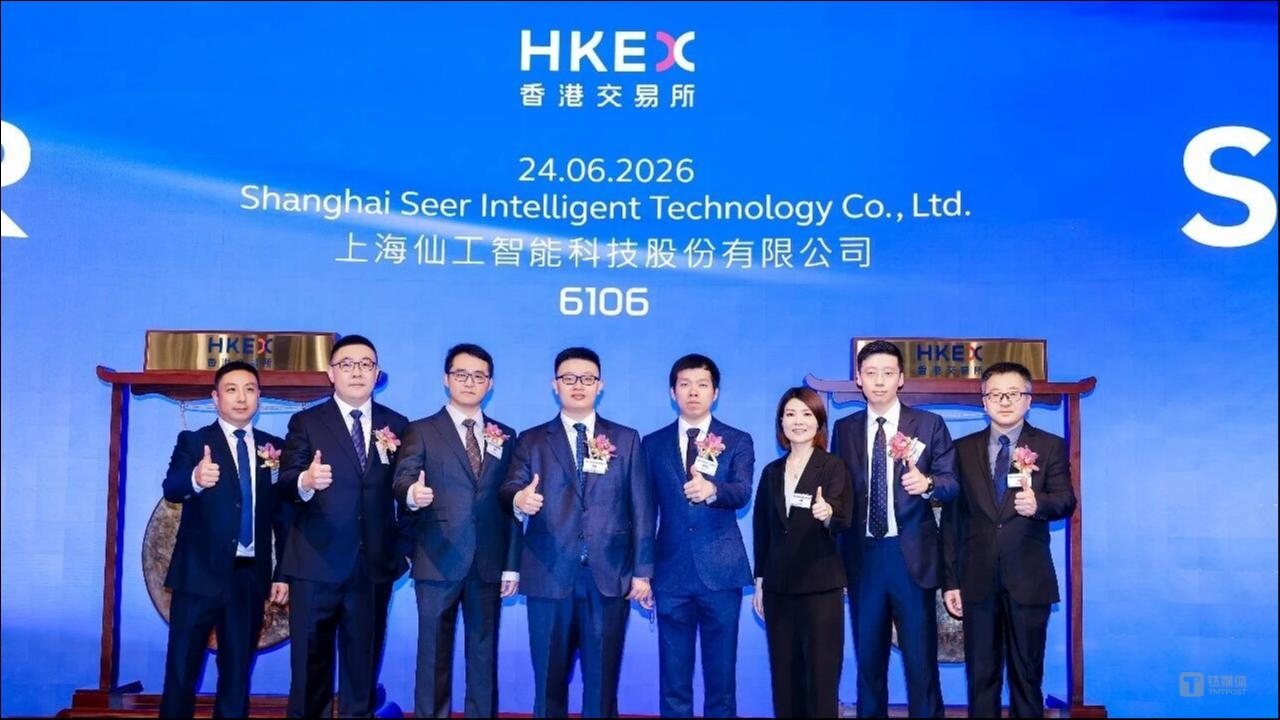
NextFin News -- Shanghai SEER Intelligent Technology Co., Ltd (stock code: 06106.HK) on Wednesday debuted on the Main Board of the Hong Kong Stock Exchange, becoming the first “robot brain” pure-play stock in the Hong Kong market.
The total number of shares offered globally (before the greenshoe) was 10,497,300, priced at HK$101.6 per share, with a board lot of 50 shares. The offering size before the greenshoe was HK$1.067 billion; if the greenshoe was fully exercised, it would increase to HK$1.226 billion. The IPO implied a market capitalization of HK$11.227 billion. Net proceeds were approximately HK$995.4 million.
The allotment results showed that SEER ’s Hong Kong public offer was 5,934.56 times subscribed, triggering the clawback mechanism. There were 222,966 valid applications, and the one-lot (50-share) success rate was only 5%. The international placing was 21.29 times subscribed. A total of eight cornerstone investors subscribed for HK$462 million, accounting for 43.34% of the offering. Among them, HHLRA (Hillhouse) led as the cornerstone investor with a subscription of HK$118 million; Yuanbao Family Office and 3W Fund each subscribed for US$15 million. Other well-known institutions also participated, including GF Fund, Ruihua Investment, Zhonghe Capital, Yishao, and ACCF Capital.
On its first trading day, SEER opened flat at HK$101.6 before rallying sharply. It hit an intraday high of HK$140.5, up 38.3%, with turnover exceeding HK$500 million. By the close, the share price finished above HK$128, up more than 26%, lifting total market capitalization past HK$14 billion—making it one of the highest-valued newly listed robotics stocks in Hong Kong.
According to data from CIC, SEER ranked No. 1 worldwide in sales volume of intelligent robot controllers for three consecutive years from 2023 to 2025, with its global market share rising steadily to 25%. Its global sales ranking in the industrial intelligent robotics market climbed from third in 2024 to second in 2025, with market share continuing to expand. As the top-ranked “robot brain” player, SEER shipped more than 12,000 units in 2025—about 70% growth versus 2024. Revenue rose more than 30% year on year; gross margin for its “robot brain” (controllers) exceeded 80%, and overall gross margin reached as high as 47.4%. It is among the few embodied-intelligence robotics companies in the market that both command core technologies and have achieved scaled revenue.
SEER was founded in 2020. Its founder, Zhao Yue, previously studied in the eight-year medical program at Chu Kochen Honors College, Zhejiang University, and simultaneously pursued a major in Electronic Information Engineering during his undergraduate years. Driven by a deepening interest in robotics, he withdrew and later re-entered Zhejiang University to pursue further study at the College of Control Science and Engineering, becoming one of the university’s most influential alumni. He led his team to three RoboCup Robot Soccer world championships—in 2013, 2014, and 2017—building a solid technical foundation and demonstrating top-tier team leadership. Co-founders Ye Yangsheng and Wang Qun were also core members of the championship team.
Over the past six years, SEER completed four rounds of fundraising, totaling approximately RMB 283 million. Behind it stands a roster of top-tier institutional investors, including Hillhouse Capital, ECOVACS, IDG Capital, SAIF Partners, and GLP Hidden Hill Capital, among others. Centered on an intelligent robot control system (i.e., the robot “brain”), the company offers a one-stop solution spanning controllers, software, robots, and accessories, with the goal of making the development, acquisition, and use of intelligent robots barrier-free.
Since its inception, SEER has built the world’s first large-scale open platform for intelligent robots. Leveraging an open ecosystem and a plug-and-play controller architecture, the company has achieved rapid delivery of more than 2,000 robot SKUs, successfully integrated with over 400 core component models, and expanded its service network to 35 countries and regions worldwide. It has served more than 2,100 customers in total, creating a robust application flywheel that spans industries and scenarios.
On the data front, SEER has taken a “real-robot data” path, cumulatively shipping tens of thousands of intelligent robots of different types—including humanoids, robot dogs, embodied forklifts, hybrid robots, and cleaning robots. Operating around the clock in continuous duty cycles, these deployments have generated large volumes of real-world feedback and closed-loop data across multiple embodiments and scenarios. On the scenario front, robots powered by SEER’s “brain” have been deployed in over 1,000 factories, spanning more than 20 industries such as 3C, automotive, automation equipment, new energy, semiconductors, construction machinery, and biopharmaceuticals—accumulating scarce, industrial-grade embodied-intelligence scenario data assets. On the model front, SEER has already applied on-device end-to-end (E2E) models and VLA models to its embodied-intelligence robot products, enabling an end-to-end direct mapping from sensor data to control commands. This has helped embodied-intelligence robots break through the bottlenecks of traditional rule-driven architectures, enabling cross-scenario generalization and autonomous execution of complex tasks.
In an industry shaped by data-driven development, embodied models likewise follow the Scaling Law—the scale of high-quality data determines the upper bound of model capability. This means that companies that are first to accumulate a sufficient volume of high-quality, real-world data will also be the first to unlock the scalable returns of larger models.
Leveraging its first-mover advantage in large-scale, real-world deployments, SEER Robotics has built a data flywheel spanning “deployment → data feedback → closed-loop training → model iteration → scaled deployment.” Real-world data is continuously fed back into the model after systematic cleaning, labeling, and training, steadily strengthening model capabilities and in turn expanding deployment scale and the boundaries of applicable scenarios. This creates a defensible moat in which data assets and model capabilities reinforce each other—one that latecomers find difficult to replicate.