






NextFin News -- The humanoid robotics industry is undergoing a pivotal shift—from “able to walk” to “able to work.” In this transition, all eyes are fixed on one thing: the dexterous hand.
Widely recognized as the component with the highest technical barriers and the most concentrated value in the humanoid robot supply chain, it accounts for 15% to 20% of the total machine cost. The challenge of building it lies in packing, into a space smaller than an adult palm, more than 20 degrees of freedom worth of joints, miniature actuation systems, multimodal sensors, and real-time control algorithms—while also striking a balance among lightweight design, high payload, low cost, and scalable mass production. Globally, only a handful of players can meet all of these requirements at once.
As a result, the dexterous hand is seen within the industry as the “last mile” to commercializing humanoid robots—and it has become the most fiercely contested segment of the current supply chain.
Recently, Xynova, a domestic provider of full-stack general-purpose dexterous-manipulation solutions and one of the “Hangzhou New Eight Champions,” completed an A-round financing of several hundred million yuan. The round was co-led by Li Auto’s strategic investment arm, CSC Capital, and China Securities Co., Ltd. (CSC) Investment, with participation from Yangtze River Delta Digital Culture Group and Yuanjia Fund. Existing shareholders—including Caitong Capital, Xiaomi’s strategic investment arm, and CETC Fund—continued to increase their stakes. Light Source Capital served as the exclusive financial advisor. To date, the company’s cumulative funding has reached nearly RMB 1 billion.
It is understood that the proceeds from this round will be used primarily to build a highly reliable general-purpose dexterous actuation platform, strengthen capabilities for scaled mass production and delivery, and advance a full-stack closed loop spanning “hardware + algorithms + data.” According to the plan, by the end of 2026 the company will officially reach production capacity of 10,000 dexterous hands and 200,000 miniature electric cylinders per year.
Xynova was founded in late 2024. Unlike single-product hardware suppliers in the sector, the company positions itself as a full-stack solution provider for general-purpose dexterous manipulation. Architecturally, it takes the dexterous hand as the core hardware foundation, uses integrated arm-hand coordination as the execution framework, and relies on “cerebellum”-style motion-control algorithms as the intelligent hub—aiming to build a complete closed-loop control system from “perception–control–feedback,” and to provide humanoid robot OEMs, algorithm companies, research clients, and end-scenario customers with a software-and-hardware foundation for dexterous manipulation.
Founder and CEO Xia Yuxuan, born in the post-1995 generation, graduated from a top-tier international university with dual degrees in physics and computer science. He previously worked at Morgan Stanley, CDH Investments, and other institutions, and has long focused on hard tech and high-end manufacturing—spanning autonomous driving and LiDAR to chips and optical modules.
In the span of a year, the team grew from five or six people in its early startup days to more than 300. Its core members have over two decades of technical expertise in high-performance motor systems, motor control, mechatronics, and precision drive technologies. It is understood that most of these R&D and engineering talents come from front-line industry players such as DJI, Schaeffler, KUKA, Apple, FESTO, CATL, UAES (United Automotive Electronic Systems), and leading medical robotics companies. The team also brings together a deep bench of technical talent with backgrounds from universities in China and abroad, including Tsinghua University, Shanghai Jiao Tong University, Zhejiang University, Wuhan University, and the University of Pennsylvania, Columbia University, and the Technical University of Munich. Collectively, they have the engineering experience to systematically transfer capabilities in motors and motor control, mechanical transmission, structures, and algorithms into the embodied intelligence domain.
At present, dexterous-hand design largely revolves around three major technical approaches: direct-drive motors, tendon-cable drive (cable drive), and linkage drive, while some manufacturers are also exploring hybrid drive solutions.
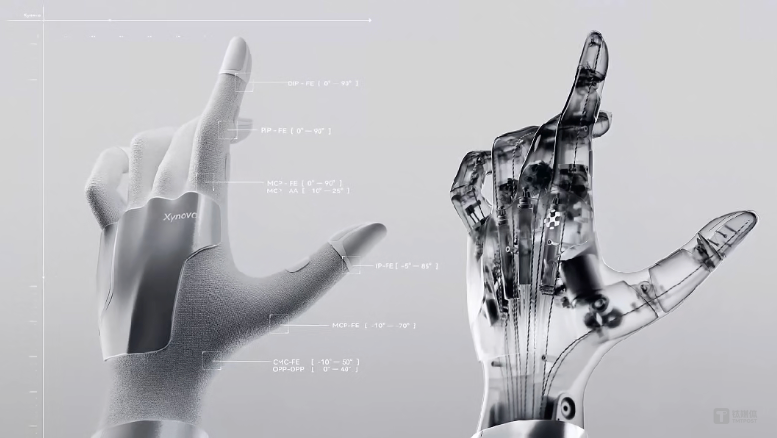
Xynova Future has opted for a hybrid drive solution centered on cable drive. In August last year, it launched the world’s first fully in-house developed, mass-producible, high-DoF tendon-driven dexterous hand, Xynova Flex 1. Xynova Flex 1 offers 25 degrees of freedom, with a palm weighing just 380 grams, a payload capacity of over 30 kilograms, and fingertip force exceeding 20N per finger. Xynova Future said it is currently the lightest and highest-payload high-DoF dexterous hand on the market.
In mid-May, building on Flex 1’s arm-hand integration advantage, it introduced the world’s first biomimetic dexterous hand using a “tendon-cable + direct-drive motor” hybrid drive, Flex 2, with a palm weighing under 400g and 23 degrees of freedom (19 active and 4 passive). Its fingertip force exceeds 20N, peak one-handed grasp payload reaches up to 12kg, and its rated payload for continuous operation is 4kg. At the same time, Flex 2 integrates four types of sensors—vision, touch, force, and proximity—and, paired with a humanoid “cerebellum-like algorithm,” can perform more complex and intelligent hand operations such as adaptive grasping and backdrivability under load.
According to its roadmap, Xynova Future will further expand its product portfolio in 2026, with plans to roll out the second-generation Flex series dexterous hands featuring systematic upgrades to sensing capabilities, miniature actuators, and transmission performance.
Scaling up to true mass production of dexterous hands remains a global challenge to this day. The key bottlenecks include the supply-chain maturity of miniature coreless DC motors and gear reducers, the long-term durability of tendon-cable materials, the stability of multi-DoF coordinated control algorithms, and the remaining room to bring down the cost of multimodal sensors.
Looking at the industry landscape, even Tesla’s Optimus has seen dexterous-hand mass-production progress lag significantly behind the robot body itself. Most domestic dexterous-hand makers are still in a “small-batch, customized” stage, with annual deliveries typically in the hundreds of units.
Whether Xinuo Future can genuinely ramp up to a 10,000-unit-level production capacity by year-end will be the key litmus test of how real its positioning as a “full-stack solution provider” truly is. After all, in hard tech, the amount raised is only the starting line—mass-production capability and customer word of mouth are what ultimately decide the outcome.