


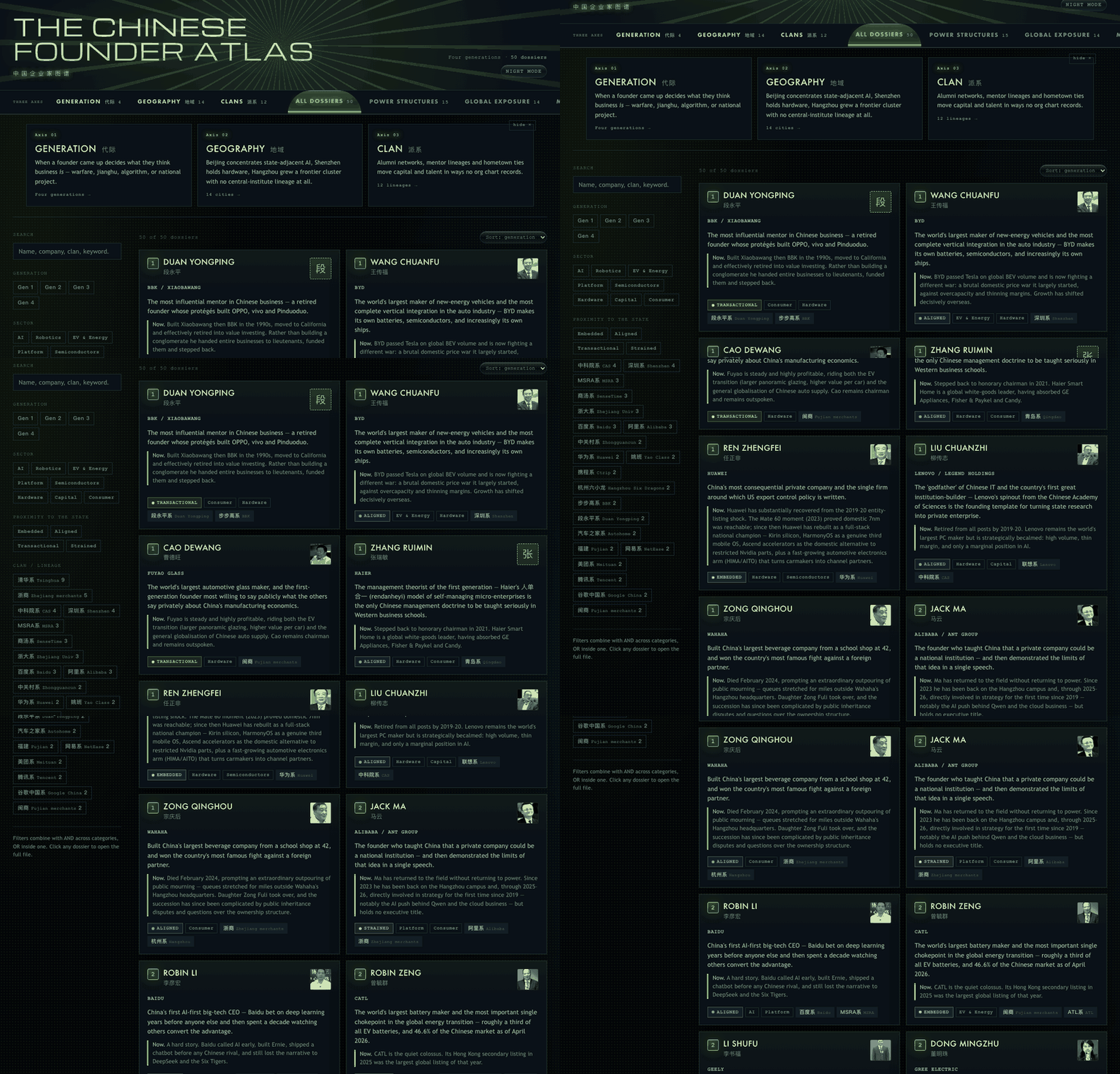
I want to share a project I built earlier this month: The Chinese Founder Atlas—which I vibe-coded with Claude.1
This atlas is meant to help people become more familiar with China’s tech world—its culture and the people in it. I’m quite pleased with how it turned out, though building it also gave me a humbling reminder of what Alfred Korzybski said that, the map is not the territory, and any act of simplification smuggles in its own bias. Consider this an ongoing, heuristic project rather than anything definitive. I’ll try to keep revising it, and I’d love to hear what you think.
Here is a mini-essay on why I made this Atlas in the first place:
As a cinephile, one thing worth knowing is how distinctly Chinese filmmakers organize themselves into “generations.” The Fifth Generation—represented by Zhang Yimou and Chen Kaige—carries a sensibility shaped by China’s post-reform period, though they often indulge in grand historical meaning-making and nationalism, as they were gradually absorbed into the establishment. The Sixth Generation, represented by Jia Zhangke and Lou Ye, turns to urban realism, to individual alienation inside a rapidly urbanizing China. This generational shorthand functions like a cheat code. You name a filmmaker’s generation, which is essentially a number, and you instantly know which fabric of reality they inhabit, which China (and which world) they’re metabolizing. A post–Cultural Revolution China, an Olympics-era China, and Xi Jinping’s China are, after all, astoundingly different worlds.
I found it revealing—very blunt and instrumental, but not a bad way to understand important individuals through the collective forces that shaped them. Ren Zhengfei, the Huawei founder, once said at an internal meeting: "A great era will inevitably produce great heroes." In China, founders, like filmmakers, tend to be molded by their era and then emerge as a generation. This made me wonder why we have no equivalent taxonomy for them.
Last year, I published a piece, “The China Tech Canon,” in Asterisk Magazine. When I republished it on my own newsletter, I extended the essay to sort Chinese tech founders into four generations.2 There are, of course, other axes for categorizing founders. Geography—both where they’re from and where they’re based—is an obvious one. Clan is another one: the institutions and companies founders come from or remain affiliated with, not unlike the American “PayPal Mafia.” This atlas tries to hold all three axes at once and present other information.
First, generation. Yang Zhilin—the clearest example of what I’d call the fourth generation—was born and raised in a rich China, in 1992 in Guangdong Province. Founder of Moonshot AI, he went to the prestigious Yao class as a Tsinghua undergraduate, earned his PhD at Carnegie Mellon, banters with Jensen Huang at NVIDIA’s GTC, and has to navigate a US–China relationship now defined by tech rivalry. He once dreamed of being a rock star; his company was named after Pink Floyd’s The Dark Side of the Moon. Yang was a drummer in a Tsinghua rock band with his eventual co-founder. In contrast, Ren Zhengfei, the legendary founder of Huawei, eighty-one this year, shares very little with Yang. He belongs to what I call the first generation, the one that endured poverty and political chaos. He once told the public that his greatest wish in high school was to eat a white-flour steamed bun. He speaks in the cadences of Maoist rhetoric, yet built a ten-billion-yuan campus modeled on nineteenth-century Paris, Heidelberg, and Bologna. (Yang named his company after a British rock album; Huawei’s own name, tellingly, literally means “Chinese achievement.”)
Jack Ma’s generation—the second—was the fruit of China’s WTO entry, when global capital flooded in; they are more libertarian than the generations around them, and had a window in which to be outspoken and controversial in public. Zhang Yiming, part of the third generation, founder of ByteDance, and his cohort seized the mobile-internet moment, building products like TikTok so good that Meta spent years—and an antitrust trial’s worth of leaked internal documents—trying to replicate them.
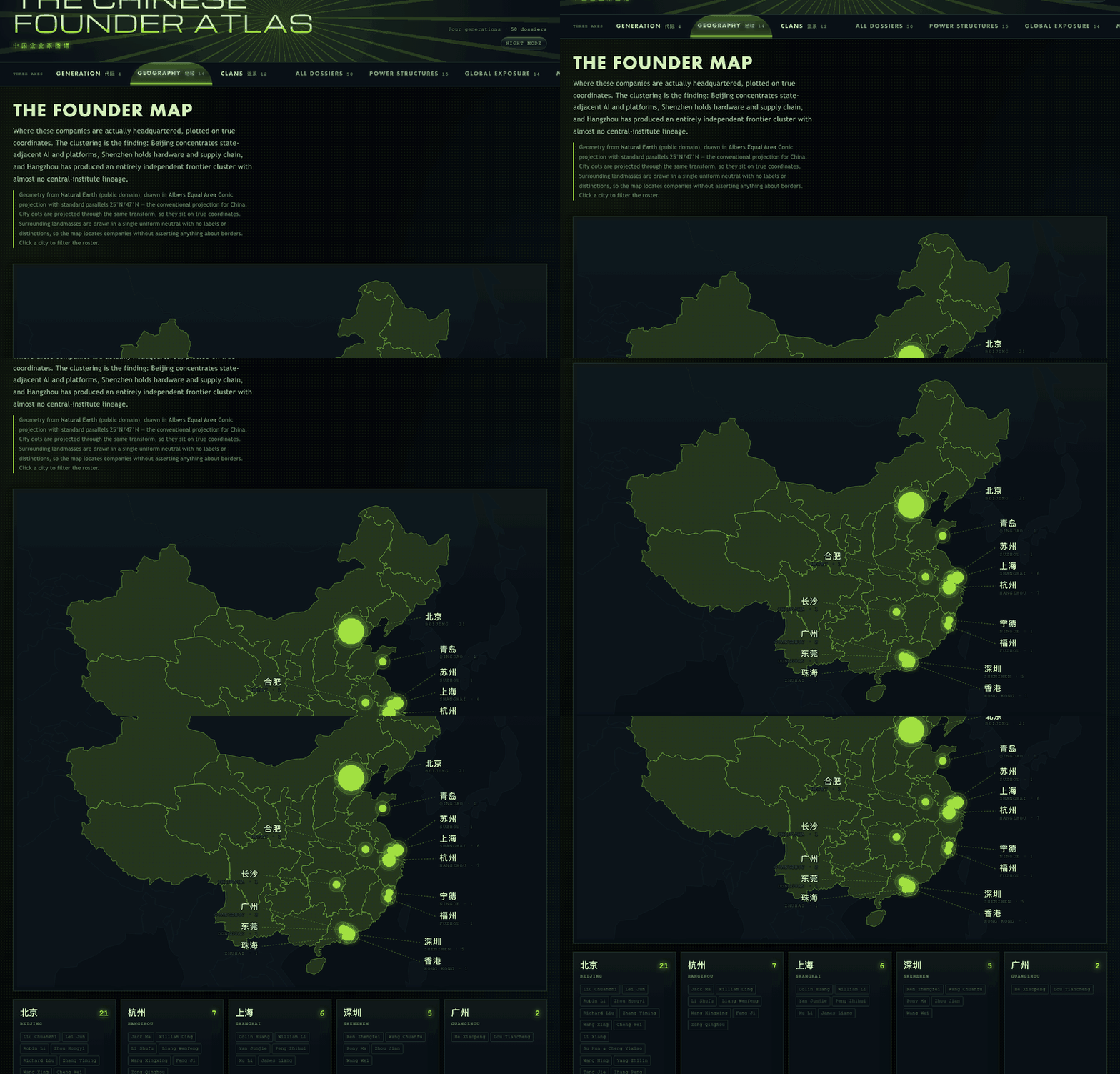
There’s a second axis, geography, which is tightly bound up with China’s regional competition and local culture. A “Shenzhen founder” and a “Beijing founder” imply distinct business sectors and temperaments. Alibaba, as everyone knows, is quintessentially a Hangzhou company—Jack Ma’s own mythology is inseparable from Hangzhou and its famous West Lake. I’ve heard people argue that Wang Xingxing’s success at Unitree owes something to his origins: he grew up in Yuyao, Zhejiang, a region with a prosperous merchant tradition, so of course a Zhejiang upbringing would leave a founder obsessed with shaving every last cent of cost out of a robot.
Last, clan, or lineage. Chinese founders don’t quite operate as a “PayPal Mafia” does in the U.S., but people do routinely describe someone as being “from” a particular clan, shorthand for the resources and networks that founder can draw on. In the age of AI, when resources (compute, funding, who gets chosen to even try) concentrate around a handful of elite universities, clan becomes a useful lens for parsing that concentration. Z.ai, born in 2019 as a spinoff of Tsinghua’s Knowledge Engineering Group, is headquartered in Zhongguancun in Beijing, the most resource-dense square mile for AI in China. And DJI—one of Shenzhen’s great manufacturing miracles—has a “DJI mafia,” seeding a generation of veterans now running ventures across 3-D printing, robotics, and portable power.3
Finally, at least to my own eyes, this atlas leaves out many, many names and important context. Plenty of founders have a base and an influence that spill past any single region, their companies operating in several cities at once; the map's disproportionate concentration of founders in Beijing doesn't fully capture that reality, though I was surprised by just how many founders do claim Beijing as home base. Several founders, too, straddle more than one generation, so a handful of names appear more than once. Another thing is, women are still rare at the very top of China’s business and tech world. If you try to name the exceptions, the list includes Zhou Qunfei, Dong Mingzhu, and Jean Liu. Zhou is a badass self-made woman, and it’s hard not to moved by her story. She started as a migrant factory worker at fifteen and went on to build her company, Lens Technology, into an empire manufacturing touchscreens for Apple and Tesla, becoming one of the richest self-made women on earth.
At the very last minute, I added one more dimension: each founder's proximity to the state. I thought this might be useful, especially in some discussions where Chinese founders are cast either as pawns of the state or as players receiving unconditional government support to win an unfair game. Claude sorted them into four categories—embedded, aligned, transactional, strained—and did a reasonable job of it. But take that particular axis with a grain of salt.
You can explore the Atlas here (it still lives in a Claude artifact for now!).4
A small note from Afra:
To my subscribers, sorry for the quiet on Substack. I’ve been deep in a few reporting pieces and a personal essay for a range of magazines and publications (my inner voice keeps yelling “I want to be a great writer with a portfolio of bylines!”). They’ll start rolling out over the next few months, and I’ll keep you posted here. And at the same time, I will work on my Substack cadence. Thanks for your love and support.
I’ll be in Washington, DC, September 6–12—mainly for a September 11 event hosted by Johns Hopkins’ ACF, Getting Tech Right: U.S.–China Policy for a New Era, where I’ll be speaking on a panel about AI, society, and labor. You can register the event here. I’m also using the trip as an excuse to linger a little, I haven’t been back to DC since 2018, and very much looking forward to visiting some museums and meeting great writers and thinkers there. If you’ll be in town and would like to meet, I’d love to hear from you. Email me at afrazhaowang@gmail.com.
此内容由惯性聚合(RSS阅读器)自动聚合整理,仅供阅读参考。 原文来自 — 版权归原作者所有。