


From April 11 to April 15, 2026, Spain’s Prime Minister Pedro Sánchez visited China — his fourth official trip to the country in just over three years. The relationship between China and Spain has gradually become one of the most substantial among EU member states, with Madrid actively positioning itself as a bridge between Beijing and Brussels at a moment when the European Union’s relations with the United States are under strain. Sánchez signed a number of economic deals in Beijing as well as an agreement on strategic diplomatic dialogue — a tangible sign that ties continue to deepen.
But another key component of China’s deepening relationship with Spain in recent years has been increased cooperation and engagement on media and information. China’s growing media engagement in Spain, involving a range of actors, has unfolded as the country’s media landscape is already under significant strain amid commercial pressures, political polarization, and the spread of disinformation.
Through cooperation agreements with the Agencia EFE and Europa Press news agencies, China has steadily gained access to Spanish audiences. At the same time, diaspora media outlets — some aligned with or closely linked to Chinese associations — serve both as platforms for Chinese-speaking communities and as channels for Chinese state messaging. Adding further complexity to this landscape is the role of the Chinese Embassy, which has directly intervened in political and academic settings, pressuring universities and lobbying parliament on matters it regards as being in China’s strategic interests, including Taiwan.
Lingua Sinica sat down with Shiany Pérez-Cheng (鄭夏霓), an analyst specializing in China’s information manipulation and interference, to examine how these dynamics intersect, mapping the architecture of Chinese influence in Spain.
The following is an edited excerpt.
Dalia Parete: Lingua Sinica has been looking at groups such as Cátedra China, friendship associations, and business groups. When diaspora media cover their meetings with Spanish officials so extensively, what’s the purpose? Is there a structure behind it?
Shiany Pérez-Cheng: China’s business people’s associations are part of united front work — Beijing’s system for extending political influence abroad. That’s well established. And that’s exactly why they cover these meetings so thoroughly, saying, “we met with officials from Madrid, from Barcelona, from wherever.” It’s a way of signaling: look how deep our connections run into Spanish institutions.
The whole thing is vertical. It starts with the United Front Work Department in Beijing, runs through the propaganda apparatus, and comes into Spain through the embassy. From there, it branches into diaspora associations, diaspora media, and Chinese students and scholars’ associations. And when you read what the Spain-based groups are publishing — these exhaustive reports, “we met with this official, attended that event” — it reads like an activity report written for Beijing, so someone back home knows who deserves credit.
Dalia Parete: Can you give an example of what that looks like?
Shiany Pérez-Cheng: Sometimes it’s really interesting because if you know how to look for information, they are very open. They tend to report interference operations without calling it that.
For example, in 2017, Richard Gere came to Spain. He’s involved with the Tibet cause and the Dalai Lama. He met with then-Madrid Mayor Manuela Carmena, who was co-organizing a forum on urban violence. Carmena said she wanted to invite the Dalai Lama to attend and asked Gere to pass along the invitation. This was all public.
Just days later, the Association for the Promotion of the Peaceful Reunification of China in Spain (西班牙中國和平統一促進會), whose president also heads one of the main business people’s associations, sent a small delegation to the Madrid town hall with a letter for the mayor. The letter was bilingual, Chinese and Spanish. The first half was propaganda about Tibet and the Dalai Lama. The second half was essentially: we know how friendly our ties are; we’re investors; we send a lot of tourists; and Carmena should bear that friendship in mind. The implicit message was clear: receive the Dalai Lama, and the relationship will suffer.
The diaspora media covered it proudly: “Look what we did, we delivered this letter to the town hall, the Dalai Lama did not come.” What’s remarkable is that they documented the whole operation themselves — who participated, how it was conducted. They just didn’t call it interference.
Dalia Parete: What role does the Chinese embassy play in Spain? In 2017, the embassy reportedly pressured the University of Salamanca to cancel “Taiwan Cultural Days” and the events were ultimately called off. How did that unfold?
Shiany Pérez-Cheng: What happened was that the Taiwan representative was invited to give the opening speech at this “Taiwan Cultural Days” event, and somehow the embassy knew the exact content of his remarks. So they must have had someone on the inside. My take is that they were informed through the university’s Chinese Students and Scholars Association. The president of that association was also lecturing on the same master’s program where the cultural days were organized, so he would have been in the room for the opening session.
There’s another case I’ve been told about at a private university. They organized an event with the ambassador and put up a background map of Asia, provided by the university, in which Taiwan was shown separately from China, perhaps in a different color. The ambassador refused to give his speech until they either replaced the map or took it down.
But the embassy’s reach goes beyond academia and into the political sphere, too. When a motion was tabled at the Foreign Affairs Commission at Spain’s Parliament in February 2025 to discuss China’s manipulation of UN Resolution 2758 (which Beijing uses to claim Taiwan has no right to participate in international organizations) the Chinese Ambassador wrote an op-ed in El Periódico just a week later, followed by the Consul General in Barcelona publishing another op-ed in Catalan media a couple of months after, both arguing that Taiwan is China. The embassy also sent a note warning that debating the motion would affect the traditional friendship relations between China and Spain. The pressure worked. The motion disappeared from the commission’s agenda entirely, and the president of the Foreign Affairs Commission traveled to China for a week-long visit that same May.
Read the Full Interview at Lingua Sinica
Explore the Lingua Sinica Databse
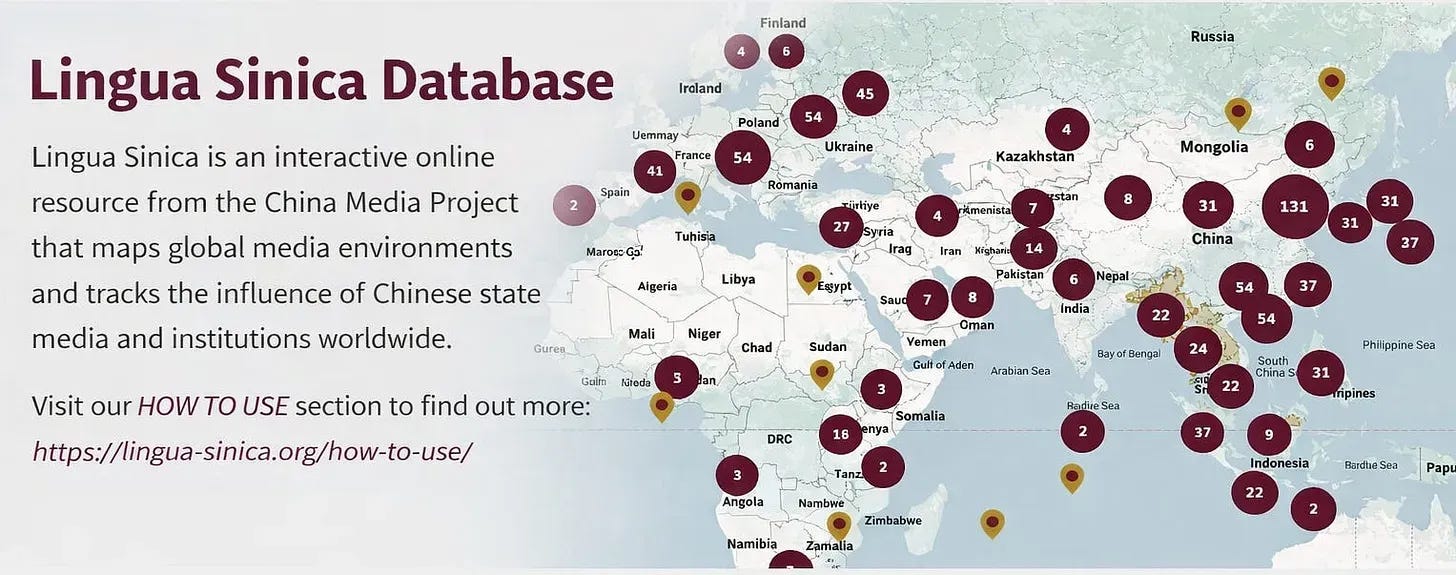
To learn more about China’s media engagements in Spain — selected below — check out the Lingua Sinica database. Note that the LS database now allows search by date, with a full calendar function. We encourage readers to explore the database of PRC engagements by selecting for countries, engagement types and dates under the map (don’t forget to click “Filter”). We have also implemented a full-site search function in the banner of the site. Enjoy!
August 8, 2025
Learn More About This Activity
July 27, 2024
Learn More About This Activity
March 30, 2023