


American companies spending the most on AI have seen their revenue grow five times faster than the economy as a whole. Non-spenders are tracking the economy closely. This is according to Ramp, a fintech with a side hustle in excellent firm-level data across the US.
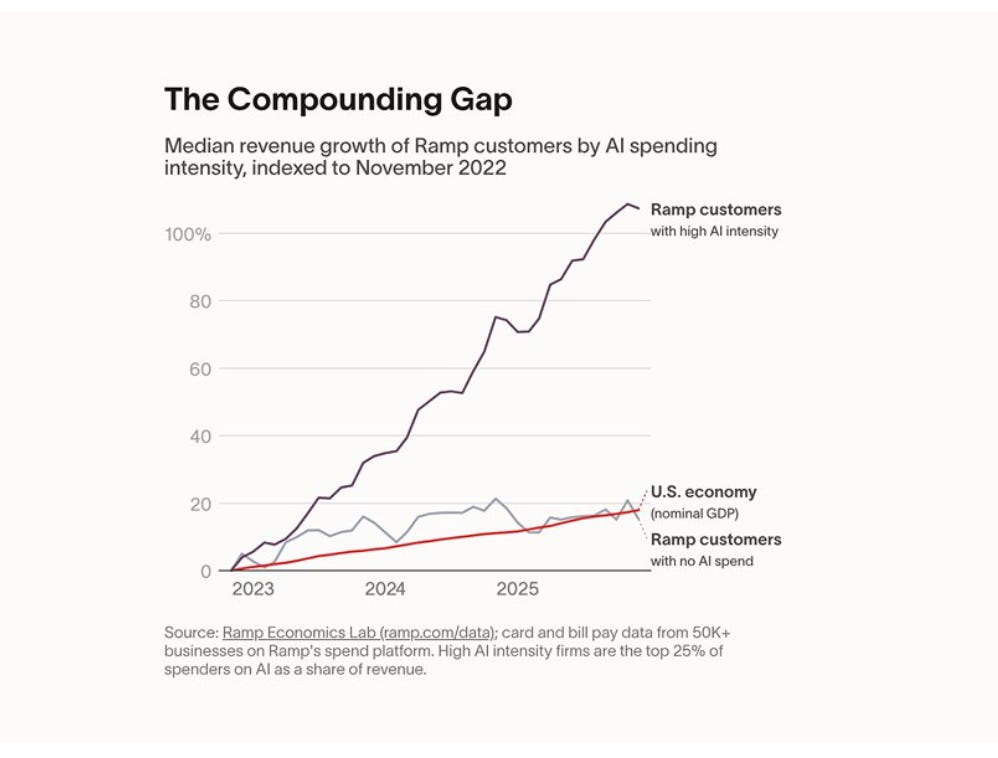
Ramp’s finding echoes this 2020 AEA paper by James Bessen and colleagues. Bessen examined broadly defined automation investment at the firm level across the Dutch non-financial economy between 2000 and 2016. Firms that automated grew sales 2% faster than those that didn’t.
But which firms automated? Other studies by Acemoglu et al. give some kind of answer: automotators were already largely more productive and had higher output than non-automators. In my book, I took this further, arguing that any type of automation is a complex undertaking and requires a better management team than not.
AI also seems to be fuelling a surge in new business formation, according to Torsten Slok. It’s much easier and cheaper to launch a company today with the help of LLM-based AI. A mediocre ChatGPT lawyer, finance director or marketing manager is, after all, better than none.
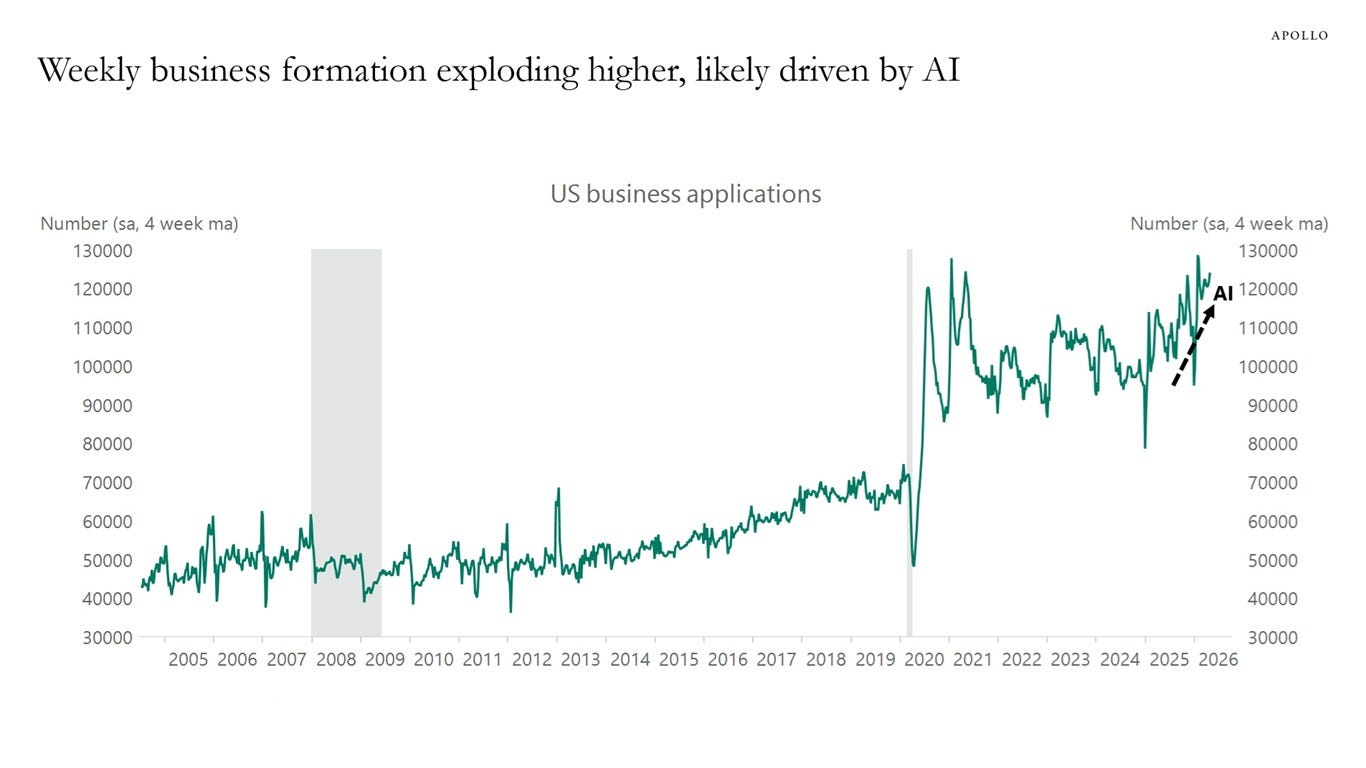
In the hysteria of the AI narrative, all of this is boringly plausible. It’s a technology which reduces the costs of certain classes of cognitive activities; so we’ll do more of them.
Anthropic released some fascinating data on how Claude has changed the way Claude itself is built. The amount of code contributed per developer is eight times higher in the current quarter than the average to the end of 2024. There is a meaningful uptick starting in 2025 as Claude 4 and Claude Code were rolled out. We discuss whether lines of code are a meaningful metric below.
I found this chart more interesting—showing how well Claude Code can complete different classes of tasks. It appears that the Mythos, Anthropic’s latest release, which is only available internally and to select organisations such as the NSA, has demonstrated a step change in capabilities.
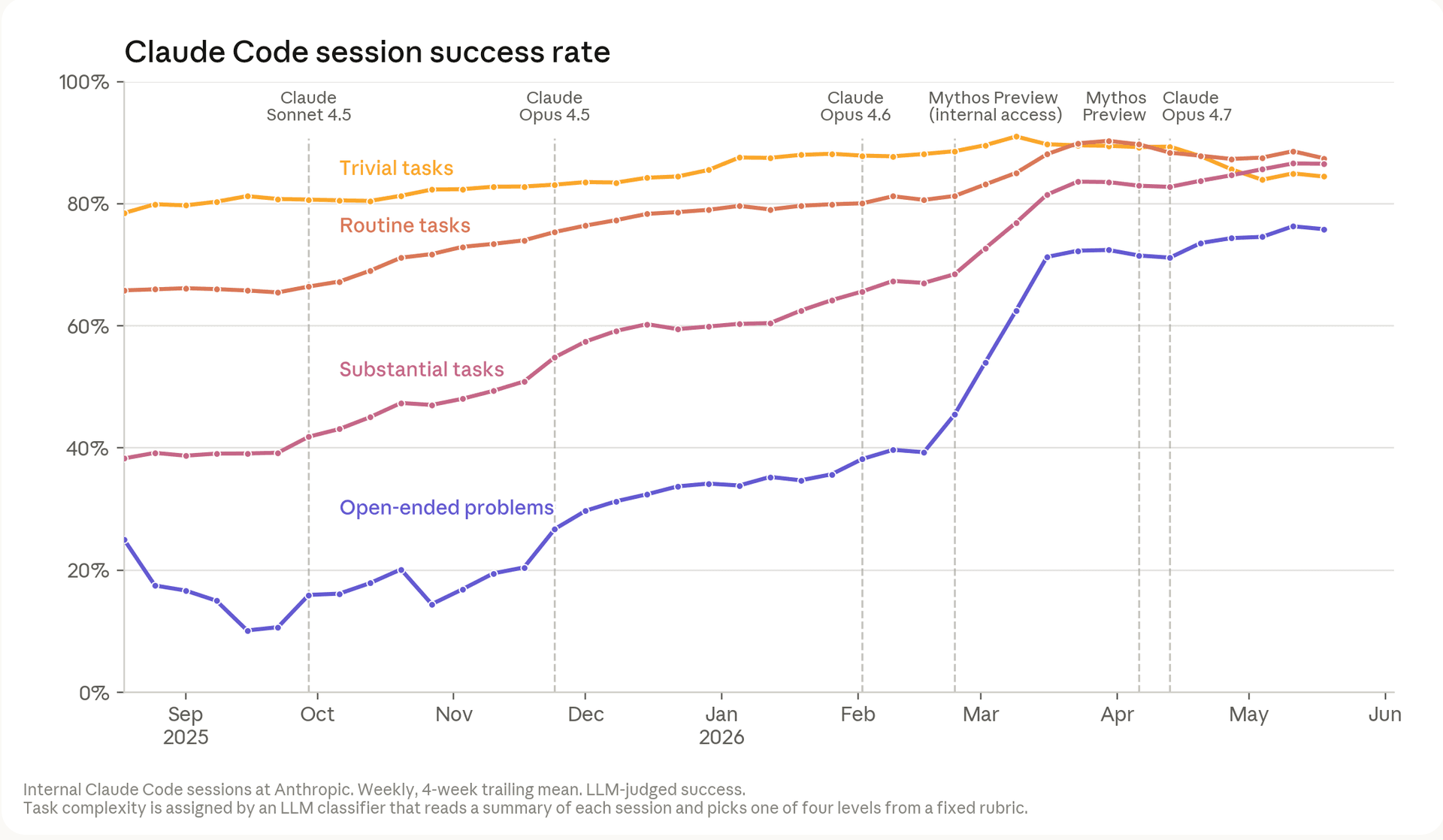
Anthropic took the opportunity to warn against the risk of recursive self-improvement, going as far as suggesting “it would be good for the world to have the option to slow or temporarily pause frontier AI development to enable societal structures and alignment research to keep up.” To be fair to Anthropic, they’ve been reasonably consistent with that idea for a few years—as have others.
A multi-lateral process can’t hurt things much, especially in today’s fractious environment. However, I’m sceptical about this threshold for “recursive self-improvement” as a notion of a runaway technology. For two reasons. First, we are dealing with increasingly abstract layers of automation that accelerate the product roadmaps of human-directed companies (not out-of-control machines). So there may be a risk, but it isn’t recursive. It’s a strategy. The second is that commercial realities act as a natural attenuator: securing the capital, the chips, and the power will prove less tractable than pouring out reams of Python code.
此内容由惯性聚合(RSS阅读器)自动聚合整理,仅供阅读参考。 原文来自 — 版权归原作者所有。