
惯性聚合 高效追踪和阅读你感兴趣的博客、新闻、科技资讯
阅读原文 在惯性聚合中打开

推荐订阅源

Simon Willison's Weblog
Help Net Security
Help Net Security
P
Privacy International News Feed
T
Threat Research - Cisco Blogs
C
Cisco Blogs
C
CERT Recently Published Vulnerability Notes
NISL@THU
NISL@THU
L
LINUX DO - 热门话题
Security Latest
Security Latest
A
Arctic Wolf
G
GRAHAM CLULEY
月光博客
月光博客
S
Securelist
D
Docker
J
Java Code Geeks
T
Troy Hunt's Blog
T
Tenable Blog
让小产品的独立变现更简单 - ezindie.com
SecWiki News
SecWiki News
S
Security @ Cisco Blogs
量子位
freeCodeCamp Programming Tutorials: Python, JavaScript, Git & More
L
LINUX DO - 最新话题
Recent Commits to openclaw:main
aimingoo的专栏
aimingoo的专栏
博客园 - 【当耐特】
H
Heimdal Security Blog
The Hacker News
The Hacker News
博客园 - 三生石上(FineUI控件)
Application and Cybersecurity Blog
N
Netflix TechBlog - Medium
Vercel News
Vercel News
Forbes - Security
Forbes - Security
B
Blog RSS Feed
H
Hackread – Cybersecurity News, Data Breaches, AI and More
IT之家
IT之家
B
Blog
MongoDB | Blog
MongoDB | Blog
博客园 - 聂微东
Google DeepMind News
S
Secure Thoughts
Threat Intelligence Blog | Flashpoint
C
Check Point Blog
云风的 BLOG
云风的 BLOG
CTFtime.org: upcoming CTF events
T
The Blog of Author Tim Ferriss
L
Lohrmann on Cybersecurity
F
Full Disclosure
D
Darknet – Hacking Tools, Hacker News & Cyber Security
P
Proofpoint News Feed

Comments for John D. Cook

Writing down harmonic numbers Incircles and Excircles of Pythagorean triangles Writing Prolog with ChatGPT Solving a chess puzzle with Claude and Prolog Comment on Formally proving a calculation with Claude and Lean by David Roberts Comment on Aitken acceleration before Aitken by lagomoof Comment on The Latin of Linux by David Comment on Partitions over permutations by Michael Kinyon Comment on Online (one-pass) algorithms by ross Comment on Expected IQ spread on a jury by blaine Comment on Calculating the expected range of normal samples by Blaise F Egan Comment on Turning K-L divergence into a metric by Emil Comment on Hilbert transform as an infinite matrix by Brian Oxley
The Star Trek lemma
John · 2026-06-25 · via Comments for John D. Cook

I was reading an article this evening and saw a footnote to a book by Arthur Baragar [1]. This caught my eye because he was my officemate at UT for a year.

I found his book on Archive.org and was surprised to see “The Star Trek Lemma” in the table of contents. What could this be?

It’s a theorem that goes back to Euclid that applies to an angle formed by connecting a point to two other points on a circle. The theorem says “The measure of an inscribed angle is half the measure of the arc it subtends.” But why call it the Star Trek lemma? Quoting Arthur:

In the spirit of Euclid, we will refer to this theorem as the Star Trek lemma because of the figure associated with the statement of the theorem. … Before Star Trek, as far as I know, this theorem had no name, though some might call it Euclid III.20, which is its proposition number in Euclid’s Elements (Book III, Proposition 20).

Here is my reconstruction of the figure given in the book.
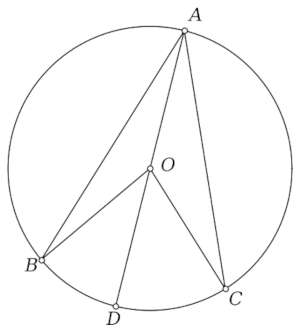
Baragar's illustration of the Star Trek lemma

The lemma says that ∠BAC is half of ∠BOC.

[1] Baragar, Arthur (2001), A Survey of Classical and Modern Geometries: With Computer Activities, Prentice Hall