
惯性聚合 高效追踪和阅读你感兴趣的博客、新闻、科技资讯
阅读原文 在惯性聚合中打开

推荐订阅源

美团技术团队
罗磊的独立博客
SecWiki News
SecWiki News
The Register - Security
The GitHub Blog
The GitHub Blog
钛媒体:引领未来商业与生活新知
钛媒体:引领未来商业与生活新知
博客园 - 三生石上(FineUI控件)
S
Schneier on Security
IT之家
IT之家
博客园 - 聂微东
T
The Exploit Database - CXSecurity.com
Recorded Future
Recorded Future
大猫的无限游戏
大猫的无限游戏
Know Your Adversary
Know Your Adversary
Latest news
Latest news
Vercel News
Vercel News
G
GRAHAM CLULEY
D
DataBreaches.Net
D
Darknet – Hacking Tools, Hacker News & Cyber Security
S
SegmentFault 最新的问题
博客园_首页
雷峰网
雷峰网
T
Tenable Blog
Spread Privacy
Spread Privacy
让小产品的独立变现更简单 - ezindie.com
酷 壳 – CoolShell
酷 壳 – CoolShell
Cisco Talos Blog
Cisco Talos Blog
V
Visual Studio Blog
J
Java Code Geeks
博客园 - Franky
The Cloudflare Blog
Apple Machine Learning Research
C
CERT Recently Published Vulnerability Notes
T
Threatpost
Google DeepMind News
F
Fortinet All Blogs
P
Privacy International News Feed
T
Threat Research - Cisco Blogs
T
The Blog of Author Tim Ferriss
V
Vulnerabilities – Threatpost
Recent Announcements
Blog — PlanetScale
Blog — PlanetScale
Security Latest
Security Latest
U
Unit 42
M
MIT News - Artificial intelligence
Y
Y Combinator Blog
K
Kaspersky official blog
有赞技术团队
有赞技术团队
B
Blog
腾讯CDC

John D. Cook

Distinguishing variables from parameters Silver Rectangles and the Ways of Kings Derivative equals inverse Who you gonna believe: Grok or the docs? Brace expansion tree When will the decimals in a/b repeat? Height of harmonic numbers Writing down harmonic numbers Hart’s theorem Incircles and Excircles of Pythagorean triangles Regular expressions that work “everywhere” Consecutive Pythagorean triangle sides The Star Trek lemma Lobachevsky’s integral formula Queens on a prime order board All pieces on a 6 by 5 board Formalizing a ring theorem with Lean 4 and Claude Partial fraction decomposition Three examples suffice Testing pentagonal numbers Quaternion Rotations, Claude, and Lean Writing Prolog with ChatGPT Solving a chess puzzle with Claude and Prolog Formally proving a calculation with Claude and Lean Pulling on a thread Aitken acceleration before Aitken The Laplace limit A crank formula for π From Kepler to Bessel Mr. Bessel’s eponymous functions
RSA munitions T-shirt
John · 2026-06-14 · via John D. Cook

Back when the US government classified strong encryption as “munitions,” RSA public key cryptography was illegal to export. In 1995, Adam Back protested this by creating a terse, obfuscated implementation of RSA in Perl code and used it as an email signature.

The code was also printed on T-shirts. The shirt was classified as munitions because it contained source code for strong encryption. More on the shirt here.
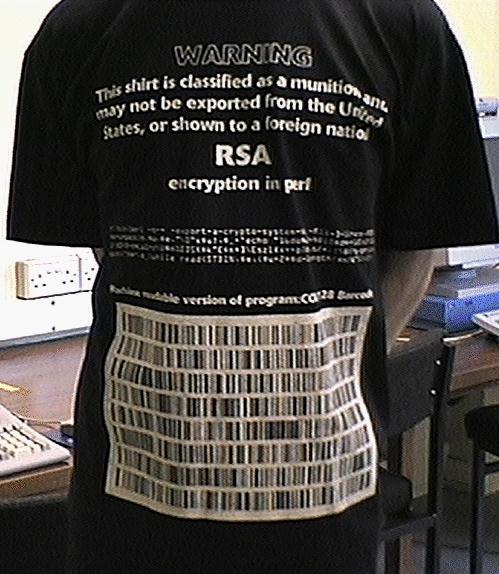
Adam Back's munitions T-shirt

This was the code:

#!/bin/perl -s-- -export-a-crypto-system-sig -RSA-3-lines-PERL
$m=unpack(H.$w,$m."\0"x$w),$_=`echo "16do$w 2+4Oi0$d*-^1[d2%Sa
2/d0<X+d*La1=z\U$n%0]SX$k"[$m*]\EszlXx++p|dc`,s/^.|\W//g,print
pack('H*',$_)while read(STDIN,$m,($w=2*$d-1+length$n&~1)/2)

My initial intention was to unpack the code, explaining each piece in detail. I don’t have the time or patience for that, and I imagine many readers don’t either. For more of a blow-by-blow explanation, see this commentary from 1995.

dc

In the middle of the code is

    echo ... | dc

This is the most dense and most important part of the code. Perl calls the dc calculator to do the arbitrary precision arithmetic that RSA encryption requires.

I’ve written about bc several times. bc (“basic calculator”) was a originally a more user-friendly wrapper around the reverse-Polish dc (“desktop calculator”). dc is still part of every Unix and Unix-like system, but I imagine bc is far more popular.

The important feature of dc for this post is that it is stack-based, meaning that users would push data and commands on to the stack and pop results off the stack. A sequence of commands that might be understandable when interactively using dc would look cryptic in a transcript. This is part of what makes the code so cryptic.

I’ll parse just a tiny bit of the dc code to give a flavor of what it does. The first four characters 16do instructs dc to push 16 on to the stack, duplicate it, and set the output radix to 16, i.e. these four characters tell dc to work in hexadecimal.

Believe it or not, the dc code is computing

mk mod n

using fast exponentiation, which is the key step in the RSA algorithm.

Textbook RSA

Note that Adam Back’s code is computing what we would now call textbook RSA, not RSA as it has been refined over the years and is currently implemented.

Related posts