
惯性聚合 高效追踪和阅读你感兴趣的博客、新闻、科技资讯
阅读原文 在惯性聚合中打开

推荐订阅源

N
News | PayPal Newsroom
IT之家
IT之家
钛媒体:引领未来商业与生活新知
钛媒体:引领未来商业与生活新知
大猫的无限游戏
大猫的无限游戏
GbyAI
GbyAI
Threat Intelligence Blog | Flashpoint
L
LangChain Blog
S
SegmentFault 最新的问题
CTFtime.org: upcoming CTF events
Project Zero
Project Zero
P
Privacy & Cybersecurity Law Blog
V
Vulnerabilities – Threatpost
博客园 - 三生石上(FineUI控件)
Recorded Future
Recorded Future
The Hacker News
The Hacker News
C
CXSECURITY Database RSS Feed - CXSecurity.com
C
CERT Recently Published Vulnerability Notes
宝玉的分享
宝玉的分享
aimingoo的专栏
aimingoo的专栏
T
Tor Project blog
T
The Exploit Database - CXSecurity.com
Schneier on Security
H
Help Net Security
cs.AI updates on arXiv.org
M
MIT News - Artificial intelligence
W
WeLiveSecurity
P
Proofpoint News Feed
A
About on SuperTechFans
S
Securelist
I
InfoQ
G
Google Developers Blog
博客园 - 司徒正美
博客园 - 叶小钗
Latest news
Latest news
F
Fortinet All Blogs
G
GRAHAM CLULEY
腾讯CDC
Jina AI
Jina AI
S
Schneier on Security
I
Intezer
V
Visual Studio Blog
美团技术团队
V2EX - 技术
V2EX - 技术
freeCodeCamp Programming Tutorials: Python, JavaScript, Git & More
The Cloudflare Blog
Microsoft Security Blog
Blog — PlanetScale
Blog — PlanetScale
P
Proofpoint News Feed
罗磊的独立博客
Y
Y Combinator Blog

Modular Blog

Qualcomm to Acquire Modular Modular 26.4: SOTA MoE Serving, Model Bringup via Agent Skills, Mojo 1.0 Beta 2 and More ModCon 2026: Modular’s Developer Conference Day Zero: MiniMax M3 Open Weights on Modular Cloud Modverse #55: Mojo 1.0 Beta, Community Mojo Libraries, and Real-Time Patient Conversations Powered by MAX What about OpenCL and CUDA C++ alternatives? (Democratizing AI Compute, Part 5) Why LLM Inference Needs a New Kind of Router - Part 3 Three trends from MLSys 2026 Why LLM Inference Needs a New Kind of Router - Part 2 How I built a pure Mojo app (and 10 libraries) with AI agents Hippocratic AI partners with Modular to power flexible, high-quality inference for real-time patient conversations Translating to Mojo via AI Agents Inkwell: Why Your Inference Platform Matters As Much As Your Model Why LLM Inference Needs a New Kind of Router - Part 1 Modular 26.3: Mojo 1.0 Beta, MAX Video Gen, and more Modverse #54: AMD AI DevDay, New Modular Offices, and a Community That Keeps Shipping How Frontier Coding Agents Built a Video Diffusion Pipeline on MAX TileTensor Part 1 - Safer, More Efficient GPU Kernels Modular Opens Edinburgh & San Francisco Offices Structured Mojo Kernels Part 4 - Portability and the Road Ahead Day Zero Launch: Fastest Performance for Gemma 4 on NVIDIA and AMD Modverse #54: From GTC to Edinburgh, a Community Building Momentum Software Pipelining for GPU Kernels: Part 1 - The Pipeline Problem Structured Mojo Kernels Part 3 - Composition in Practice Modular 26.2: State-of-the-Art Image Generation and Upgraded AI Coding with Mojo Modular at NVIDIA GTC 2026: MAX on Blackwell, Mojo Kernel Porting, and DeepSeek V3 on B200 Structured Mojo Kernels Part 2 - The Three Pillars Modverse #53: Community Builds, Research Milestones, and a Growing Ecosystem Structured Mojo Kernels Part 1 - Peak Performance, Half the Code The Claude C Compiler: What It Reveals About the Future of Software BentoML Joins Modular The Five Eras of KVCache Modular 26.1: A Big Step Towards More Programmable and Portable AI Infrastructure How to Beat Unsloth's CUDA Kernel Using Mojo—With Zero GPU Experience 🔥 Modular 2025 Year in Review The path to Mojo 1.0 Modverse #52: Advancing AI Together — Community Projects & Platform Milestones Modular 25.7: Faster Inference, Safer GPU Programming, and a More Unified Developer Experience "TTS 1 Max" (powered by Modular Platform) Ranked #1 Speech Model on Artificial Analysis PyTorch and LLVM in 2025 — Keeping up With AI Innovation Achieving State-of-the-Art Performance on AMD MI355 — in Just 14 Days Modular Raises $250M to scale AI's Unified Compute Layer Modular 25.6: Unifying the latest GPUs from NVIDIA, AMD, and Apple Matrix Multiplication on Blackwell: Part 4 - Breaking SOTA Modverse #51: Modular x Inworld x Oracle, Modular Meetup Recap and Community Projects Matrix Multiplication on Blackwell: Part 3 - The Optimizations Behind 85% of SOTA Performance Matrix Multiplication on Blackwell: Part 2 - Using Hardware Features to Optimize Matmul Matrix Multiplication on Blackwell: Part 1 - Introduction Modverse #50: Modular Platform 25.5, Community Meetups, and Mojo's Debut in the Stack Overflow Developer Survey Modular Platform 25.5: Introducing Large Scale Batch Inference SF Compute and Modular Partner to Revolutionize AI Inference Economics AI Agents for AWS Marketplace Modverse #49: Modular Platform 25.4, Modular 🤝 AMD, and Modular Hack Weekend Inside Modular Hack Weekend: Top Projects and Community Highlights How is Modular Democratizing AI Compute? (Democratizing AI Compute, Part 11) Modular 25.4: One Container, AMD and NVIDIA GPUs, No Lock-In Introducing Mammoth: Enterprise-Scale GenAI Deployments Made Simple Modular + AMD: Unleashing AI performance on AMD GPUs Modverse #48: Modular Platform 25.3, MAX AI Kernels, and the Modular GPU Kernel Hackathon Exploring Metaprogramming in Mojo Modular GPU Kernel Hackathon Highlights: Innovation, Community, & Mojo🔥 Modular’s bet to break out of the Matrix (Democratizing AI Compute, Part 10) Modular Platform 25.3: 450K+ Lines of Open Source Code and pip Packaging A New, Simpler License for MAX and Mojo Why do HW companies struggle to build AI software? (Democratizing AI Compute, Part 9) Modverse #47: MAX 25.2 and an evening of GPU programming at Modular HQ What about the MLIR compiler infrastructure? (Democratizing AI Compute, Part 8) What about Triton and Python eDSLs? (Democratizing AI Compute, Part 7) MAX 25.2: Unleash the power of your H200's–without CUDA! What about TVM, XLA, and AI compilers? (Democratizing AI Compute, Part 6) Modverse #46: MAX 25.1, MAX Builds, and Democratizing AI Compute CUDA is the incumbent, but is it any good? (Democratizing AI Compute, Part 4) MAX 25.1 - Introducing MAX Builds How did CUDA succeed? (Democratizing AI Compute, Part 3) Paged Attention & Prefix Caching Now Available in MAX Serve What exactly is “CUDA”? (Democratizing AI Compute, Part 2) Modular DeepSeek's Impact on AI (Democratizing AI Compute, Part 1) Modular Hands-on with Mojo 24.6 Evaluating Llama Guard with MAX 24.6 and Hugging Face Modular Introducing MAX 24.6: A GPU Native Generative AI Platform MAX GPU: State of the Art Throughput on a New GenAI platform Understanding SIMD: Infinite Complexity of Trivial Problems Community Spotlight: Writing Mojo with Cursor Hands-on with Mojo 24.5 MAX 24.5 - With SOTA CPU Performance for Llama 3.1 Announcing stack-pr: an open source tool for managing stacked PRs on GitHub Debugging in Mojo🔥 Write hardware-agnostic custom ops for PyTorch | Modular Take control of your AI A brief guide to the Mojo n-body example What's new in MAX 24.4? MAX on macOS, fast local Llama3, native quantization and GGUF support What’s new in Mojo 24.4? Improved collections, new traits, os module features and core language enhancements MAX 24.4 - Introducing quantization APIs and MAX on macOS Deep dive into ownership in Mojo What ownership is really about: a mental model approach Fast⚡k-means clustering in Mojo🔥: a guide to porting Python to Mojo🔥 for accelerated k-means clustering
Develop locally, deploy globally
No items found. · 2024-07-09 · via Modular Blog

The recent surge in AI application development can be attributed to several factors: (1) advancements in machine learning algorithms that unlock previously intractable use cases, (2) the exponential growth in computational power enabling the training of ever-more complex models, and (3) the ubiquitous availability of vast datasets required to fuel these algorithms. However, as AI projects become increasingly pervasive, effective development paradigms, like those commonly found in traditional software development, remain elusive.

In particular, it remains nearly impossible to build streamlined and scalable development workflows that bridge the gap between local development and cloud deployment. These workflows are complicated because AI tooling is fragmented, with each tool presenting its own trade-offs and limitations.

Today’s AI developers must leverage a multitude of different tools across their end-to-end AI workflows. Some tools work for cloud accelerators but are limited to local CPUs, while others excel for local CPU development but aren’t cloud-enabled. Working across these tools requires problematic abstractions and translators to unify fundamentally incompatible technologies, requiring rewriting of model or application code to make it all work together.

__wf_reserved_inherit

Sometimes, it seems impossible to piece together the right combination of tools and hardware to support the full developer lifecycle and provide the best performance-to-cost trade-off for any given model.

How MAX helps

MAX solves these problems by providing a unified inference API backed by a state-of-the-art compiler and inference runtime that works with a variety of models and hardware types across local laptops and common cloud instances. MAX doesn't require you to migrate your entire AI pipeline and serving infrastructure to something new—it meets you where you are now and allows you to upgrade incrementally.

MAX makes your pipeline portable across a wide range of CPU architectures—Intel, AMD, and ARM—and GPUs, opening up more portability and performance. MAX allows you to take advantage of the breadth and depth of different cloud instances at the best price, ensuring you always get the best inference cost-performance ratio.

MAX unlocks local to cloud

With MAX, you can develop AI applications locally and then easily package them for deployment to any cloud environment. This unified workflow offers several critical advantages:

  1. Speed and Flexibility: Downloading MAX enables local development for rapid iteration and testing. Importantly, MAX doesn’t just run locally but is faster on many use cases than industry standard local LLM frameworks, like llama.cpp, making development even faster. You can quickly modify code, run experiments, and debug issues without the setup and latency associated with remote servers.
  2. Resource Availability: On local machines, you have direct access to local hardware resources, such as CPU and GPUs, for free. Spinning up and paying for cloud instances is unnecessary and isn’t bottlenecked by availability.
  3. Control and Customization: Local environments can be tailored to specific project needs, allowing developers to install custom libraries, frameworks, and tools without restrictions. Importantly, for latency-sensitive applications, fully controlled local development boxes provide less noise than shared cloud instances.
  4. Consistency: Developing with MAX locally and bundling our infrastructure into OCI-compatible containers like Docker means you can ensure that what you build locally works seamlessly in production environments.
  5. Global Scale: Finally, MAX is highly optimized for the AI hardware running in popular data center cloud providers like AWS, Azure, and GCP—including CPU and GPUs (coming soon!). Users can scale their AI applications globally with no code changes and state-of-the-art performance.

How MAX works

The industry lacks a unified AI infrastructure platform and is instead flush with “point solutions” that only work for specific models, hardware, and OS’s. When we began the effort to unify the world's AI infrastructure, we realized fragmentation in the stack was driven by a lack of a common programming model for AI hardware. That's why we created Mojo, a new unifying programming language for AI hardware that combines Python’s expressiveness with C’s performance.

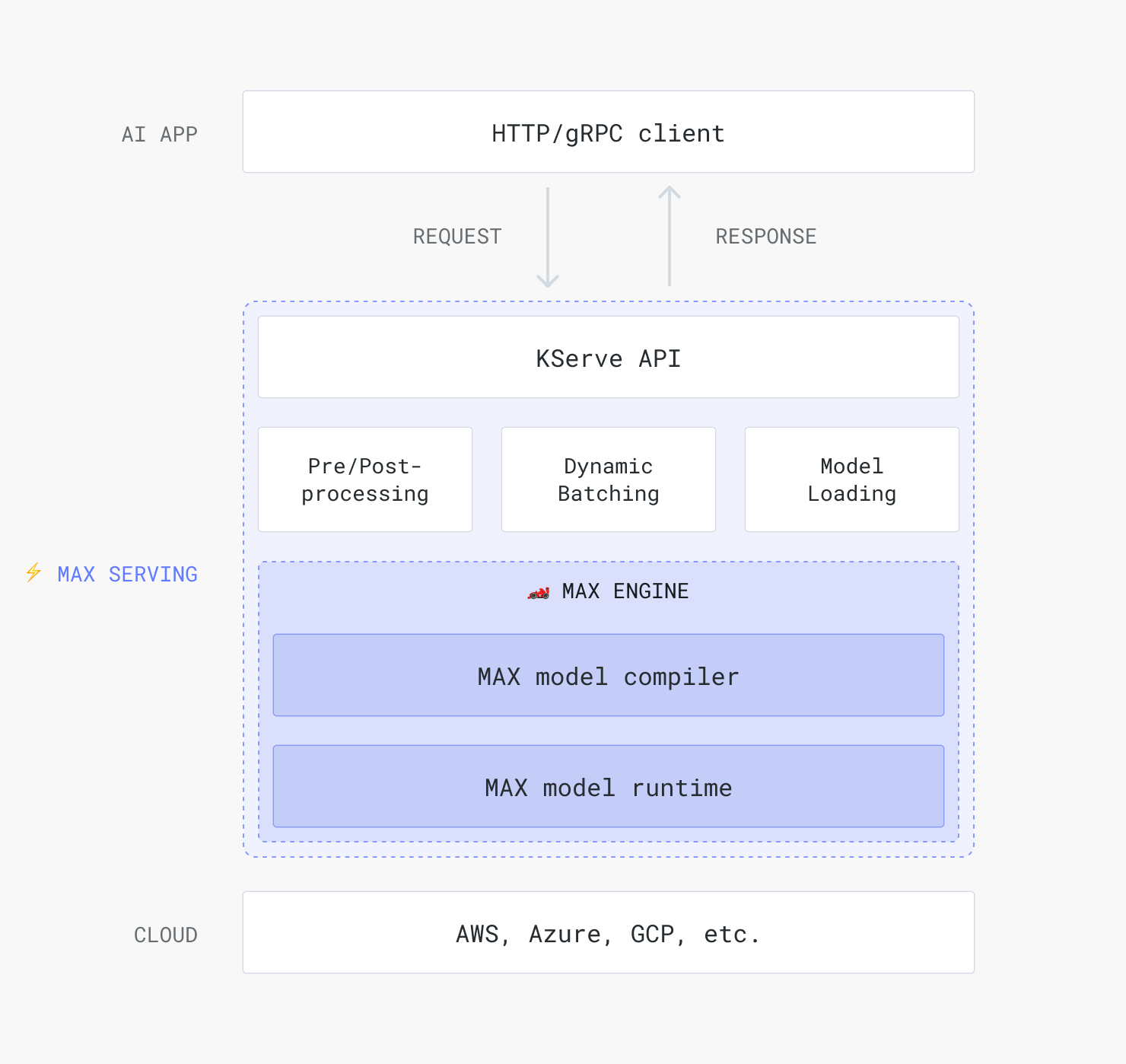
Mojo is the core technology that provides the foundation for the rest of the MAX platform. The MAX Engine, our next-generation graph compiler and runtime system, leverages Mojo to implement its low-level mathematical operations, such as MatMul. This provides unparalleled portability and performance and makes local-to-cloud workflows possible. You can load any model into MAX Engine and achieve low-latency inference on a wide range of hardware.

__wf_reserved_inherit

All that said, you do not need to use Mojo to use MAX. You can bring your existing models to the framework and execute them with MAX Engine using our API libraries in Python and C. However, using Mojo with MAX gives you superpowers. Mojo allows you to write custom ops for your model or write a full inference graph for optimal performance in MAX Engine.

Finally, integrating MAX as part of your AI development workflow makes it easy to deploy your locally developed models into production using trustworthy tools that include robust scaling, monitoring, and deployment templates.
__wf_reserved_inherit

With MAX, you can serve your model using industry-compatible tools, including NVIDIA's Triton Server. Because we already interoperate with the tools you already use, we make it easy to drop MAX into your existing workflows that require model versioning, multi-model deployment, and support for various deployment environments, making it a versatile solution for AI inference deployment. Read about how easy this is right now!