
惯性聚合 高效追踪和阅读你感兴趣的博客、新闻、科技资讯
阅读原文 在惯性聚合中打开

推荐订阅源

T
The Blog of Author Tim Ferriss
Threat Intelligence Blog | Flashpoint
大猫的无限游戏
大猫的无限游戏
月光博客
月光博客
博客园 - Franky
博客园 - 三生石上(FineUI控件)
爱范儿
爱范儿
腾讯CDC
罗磊的独立博客
OSCHINA 社区最新新闻
OSCHINA 社区最新新闻
T
Tailwind CSS Blog
P
Privacy International News Feed
The Cloudflare Blog
D
Darknet – Hacking Tools, Hacker News & Cyber Security
T
Threat Research - Cisco Blogs
Hugging Face - Blog
Hugging Face - Blog
Project Zero
Project Zero
S
SegmentFault 最新的问题
美团技术团队
WordPress大学
WordPress大学
奇客Solidot–传递最新科技情报
奇客Solidot–传递最新科技情报
云风的 BLOG
云风的 BLOG
Spread Privacy
Spread Privacy
CTFtime.org: upcoming CTF events
B
Blog
Cisco Talos Blog
Cisco Talos Blog
The GitHub Blog
The GitHub Blog
G
Google Developers Blog
T
The Exploit Database - CXSecurity.com
Simon Willison's Weblog
freeCodeCamp Programming Tutorials: Python, JavaScript, Git & More
C
Cisco Blogs
NISL@THU
NISL@THU
J
Java Code Geeks
C
CERT Recently Published Vulnerability Notes
T
Tor Project blog
K
Kaspersky official blog
宝玉的分享
宝玉的分享
Martin Fowler
Martin Fowler
I
Intezer
U
Unit 42
博客园 - 聂微东
C
Check Point Blog
Recent Announcements
Microsoft Azure Blog
Latest news
Latest news
博客园 - 司徒正美
G
GRAHAM CLULEY
S
Schneier on Security
V
Visual Studio Blog

Modular Blog

Qualcomm to Acquire Modular Modular 26.4: SOTA MoE Serving, Model Bringup via Agent Skills, Mojo 1.0 Beta 2 and More ModCon 2026: Modular’s Developer Conference Day Zero: MiniMax M3 Open Weights on Modular Cloud Modverse #55: Mojo 1.0 Beta, Community Mojo Libraries, and Real-Time Patient Conversations Powered by MAX What about OpenCL and CUDA C++ alternatives? (Democratizing AI Compute, Part 5) Why LLM Inference Needs a New Kind of Router - Part 3 Three trends from MLSys 2026 Why LLM Inference Needs a New Kind of Router - Part 2 How I built a pure Mojo app (and 10 libraries) with AI agents Hippocratic AI partners with Modular to power flexible, high-quality inference for real-time patient conversations Translating to Mojo via AI Agents Inkwell: Why Your Inference Platform Matters As Much As Your Model Why LLM Inference Needs a New Kind of Router - Part 1 Modular 26.3: Mojo 1.0 Beta, MAX Video Gen, and more Modverse #54: AMD AI DevDay, New Modular Offices, and a Community That Keeps Shipping How Frontier Coding Agents Built a Video Diffusion Pipeline on MAX TileTensor Part 1 - Safer, More Efficient GPU Kernels Modular Opens Edinburgh & San Francisco Offices Structured Mojo Kernels Part 4 - Portability and the Road Ahead Day Zero Launch: Fastest Performance for Gemma 4 on NVIDIA and AMD Modverse #54: From GTC to Edinburgh, a Community Building Momentum Software Pipelining for GPU Kernels: Part 1 - The Pipeline Problem Structured Mojo Kernels Part 3 - Composition in Practice Modular 26.2: State-of-the-Art Image Generation and Upgraded AI Coding with Mojo Modular at NVIDIA GTC 2026: MAX on Blackwell, Mojo Kernel Porting, and DeepSeek V3 on B200 Structured Mojo Kernels Part 2 - The Three Pillars Modverse #53: Community Builds, Research Milestones, and a Growing Ecosystem Structured Mojo Kernels Part 1 - Peak Performance, Half the Code The Claude C Compiler: What It Reveals About the Future of Software BentoML Joins Modular The Five Eras of KVCache Modular 26.1: A Big Step Towards More Programmable and Portable AI Infrastructure How to Beat Unsloth's CUDA Kernel Using Mojo—With Zero GPU Experience 🔥 Modular 2025 Year in Review The path to Mojo 1.0 Modverse #52: Advancing AI Together — Community Projects & Platform Milestones Modular 25.7: Faster Inference, Safer GPU Programming, and a More Unified Developer Experience "TTS 1 Max" (powered by Modular Platform) Ranked #1 Speech Model on Artificial Analysis PyTorch and LLVM in 2025 — Keeping up With AI Innovation Achieving State-of-the-Art Performance on AMD MI355 — in Just 14 Days Modular Raises $250M to scale AI's Unified Compute Layer Modular 25.6: Unifying the latest GPUs from NVIDIA, AMD, and Apple Matrix Multiplication on Blackwell: Part 4 - Breaking SOTA Modverse #51: Modular x Inworld x Oracle, Modular Meetup Recap and Community Projects Matrix Multiplication on Blackwell: Part 3 - The Optimizations Behind 85% of SOTA Performance Matrix Multiplication on Blackwell: Part 2 - Using Hardware Features to Optimize Matmul Matrix Multiplication on Blackwell: Part 1 - Introduction Modverse #50: Modular Platform 25.5, Community Meetups, and Mojo's Debut in the Stack Overflow Developer Survey Modular Platform 25.5: Introducing Large Scale Batch Inference SF Compute and Modular Partner to Revolutionize AI Inference Economics AI Agents for AWS Marketplace Modverse #49: Modular Platform 25.4, Modular 🤝 AMD, and Modular Hack Weekend Inside Modular Hack Weekend: Top Projects and Community Highlights How is Modular Democratizing AI Compute? (Democratizing AI Compute, Part 11) Modular 25.4: One Container, AMD and NVIDIA GPUs, No Lock-In Modular + AMD: Unleashing AI performance on AMD GPUs Modverse #48: Modular Platform 25.3, MAX AI Kernels, and the Modular GPU Kernel Hackathon Exploring Metaprogramming in Mojo Modular GPU Kernel Hackathon Highlights: Innovation, Community, & Mojo🔥 Modular’s bet to break out of the Matrix (Democratizing AI Compute, Part 10) Modular Platform 25.3: 450K+ Lines of Open Source Code and pip Packaging A New, Simpler License for MAX and Mojo Why do HW companies struggle to build AI software? (Democratizing AI Compute, Part 9) Modverse #47: MAX 25.2 and an evening of GPU programming at Modular HQ What about the MLIR compiler infrastructure? (Democratizing AI Compute, Part 8) What about Triton and Python eDSLs? (Democratizing AI Compute, Part 7) MAX 25.2: Unleash the power of your H200's–without CUDA! What about TVM, XLA, and AI compilers? (Democratizing AI Compute, Part 6) Modverse #46: MAX 25.1, MAX Builds, and Democratizing AI Compute CUDA is the incumbent, but is it any good? (Democratizing AI Compute, Part 4) MAX 25.1 - Introducing MAX Builds How did CUDA succeed? (Democratizing AI Compute, Part 3) Paged Attention & Prefix Caching Now Available in MAX Serve What exactly is “CUDA”? (Democratizing AI Compute, Part 2) Modular DeepSeek's Impact on AI (Democratizing AI Compute, Part 1) Modular Hands-on with Mojo 24.6 Evaluating Llama Guard with MAX 24.6 and Hugging Face Modular Introducing MAX 24.6: A GPU Native Generative AI Platform MAX GPU: State of the Art Throughput on a New GenAI platform Understanding SIMD: Infinite Complexity of Trivial Problems Community Spotlight: Writing Mojo with Cursor Hands-on with Mojo 24.5 MAX 24.5 - With SOTA CPU Performance for Llama 3.1 Announcing stack-pr: an open source tool for managing stacked PRs on GitHub Debugging in Mojo🔥 Write hardware-agnostic custom ops for PyTorch | Modular Take control of your AI Develop locally, deploy globally A brief guide to the Mojo n-body example What's new in MAX 24.4? MAX on macOS, fast local Llama3, native quantization and GGUF support What’s new in Mojo 24.4? Improved collections, new traits, os module features and core language enhancements MAX 24.4 - Introducing quantization APIs and MAX on macOS Deep dive into ownership in Mojo What ownership is really about: a mental model approach Fast⚡k-means clustering in Mojo🔥: a guide to porting Python to Mojo🔥 for accelerated k-means clustering
Introducing Mammoth: Enterprise-Scale GenAI Deployments Made Simple
No items found. · 2025-06-10 · via Modular Blog

Today, we’re excited to announce a public preview of Mammoth, Modular’s Kubernetes-native platform for scalable, high-performance GenAI serving. Mammoth marks a major step in our mission to democratize AI infrastructure.

What is Mammoth?

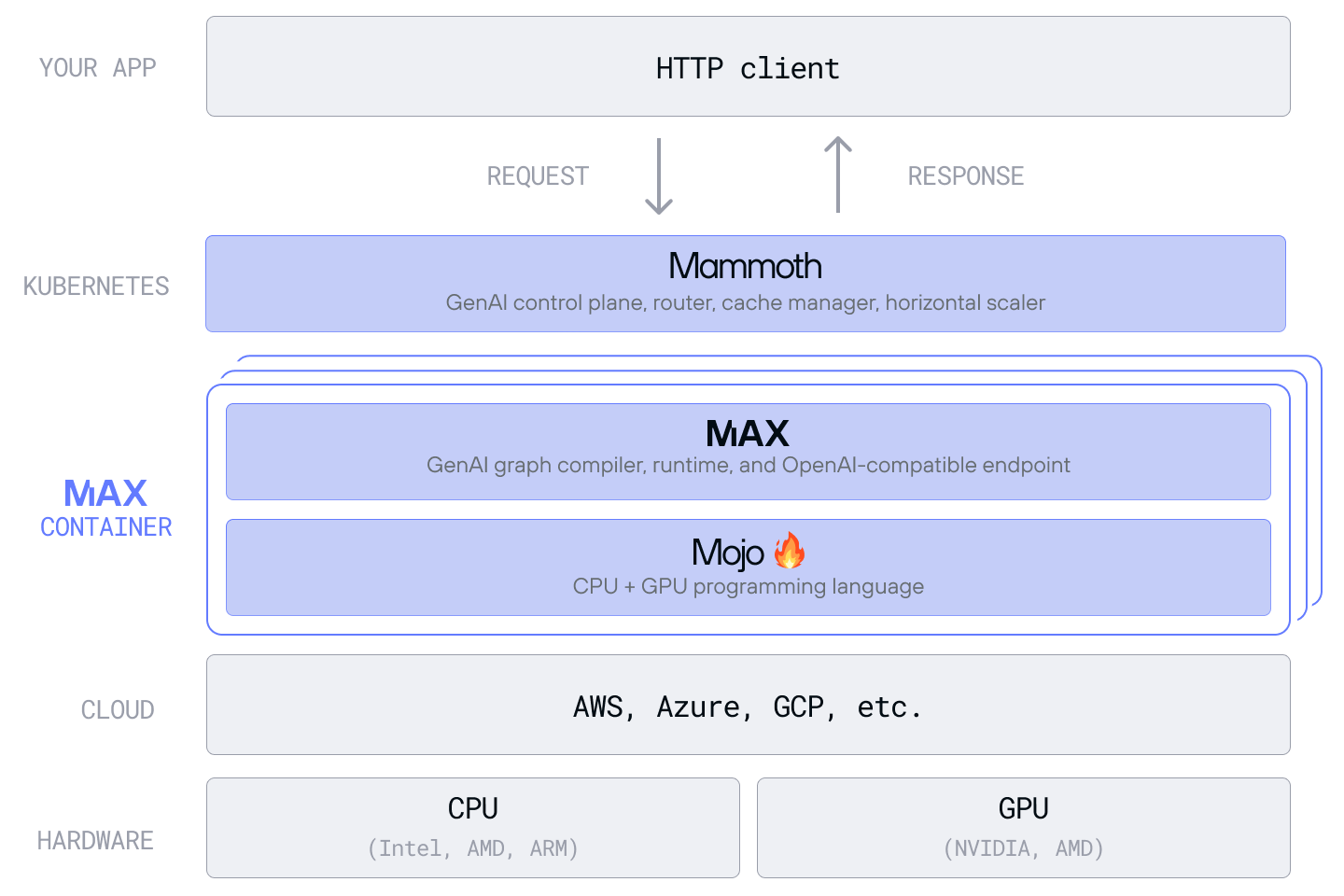
Mammoth is a distributed AI serving tool designed for enterprise-scale deployment. It bridges the gap between models and production-grade inference infrastructure, enabling you to serve multiple models efficiently across diverse hardware—while optimizing performance, controlling costs, and reducing operational complexity.

While existing serving solutions force you to choose between simplicity and scale, Mammoth delivers both through intelligent automation and vertical integration with the MAX Platform.
__wf_reserved_inherit

Why we built Mammoth

Our journey to build Mammoth began with listening to our enterprise customers. Time and again, we heard the same frustrations:

"We can run one model well, but managing dozens of models across our infrastructure is a nightmare."
"Our GPU utilization is terrible because we can't efficiently share resources between different AI workloads."
"Our competitors ship new AI features monthly while we're stuck in multi-month deployment cycles just to get our latest models into production."

These challenges intensify as organizations move from prototypes to production AI services and from smaller to larger models. What worked in controlled demos fails at production scale with millions of users.

These issues aren't just technical inconveniences—they're fundamental barriers to AI adoption at scale. Companies are spending more time managing infrastructure than innovating. They're watching expensive GPU resources sit idle while simultaneously struggling to meet performance demands.

The industry needs a platform that abstracts away the complexity of distributed AI serving while preserving performance and hardware flexibility. Mammoth delivers exactly that—built on MAX’s unmatched speed and portability.

The power of intelligent orchestration

Mammoth’s intelligent control plane sets it apart—it acts as the brain of your AI infrastructure, automatically optimizing model placement based on performance needs, cluster state, and hardware capabilities.

Imagine you're a media company running several AI applications across a mixed GPU fleet. Your content moderation system relies on Llama models for fast text analysis during peak hours, while your video platform uses Gemma models for real-time analysis and ultra-low latency chat moderation. Meanwhile, your tagging system uses embedding models to categorize massive volumes of content, optimizing for throughput over speed.

To support these use cases, your infrastructure spans a mix of GPUs—new NVIDIA B200s and H100s, older A100s from earlier deployments, and recently added AMD MI300x and MI325x GPUs to cut costs and avoid vendor lock-in.

"Traditional approaches force you to manually configure each model for specific hardware, leading to complex deployment processes, suboptimal performance, and poor resource utilization."

Mammoth's intelligent orchestration changes this equation entirely by transforming how workloads run across your GPU fleet. It prioritizes live content analysis on your fastest GPUs during peak hours, runs moderation models efficiently on A100s, and shifts tagging to cost-effective AMD hardware. As demand shifts—like tagging ramping overnight—Mammoth automatically reallocates resources to maintain performance and maximize efficiency.

The result: every model runs on the right hardware at the right time, turning your diverse infrastructure into a unified, adaptive system optimized for price-performance and your changing business needs.

Features that matter in production

Multi-Model, Multi-Hardware Efficiency: Deploy and serve multiple models simultaneously across different hardware types without complex configuration. Mammoth handles the orchestration seamlessly.

Automatic Scaling with Intelligence: Mammoth's auto-scaling isn't just about spinning up more instances—it's about understanding your application's performance requirements and scaling in ways that maintain those guarantees while optimizing cost.

Advanced Resource Optimization: Mammoth implements disaggregated inference architecture that automatically separates workloads into specialized prefill nodes for prompt processing and decode nodes for token generation. This intelligent separation matches each inference phase to optimal hardware while automatically handling complex distributed optimizations, allowing your teams to focus on model quality rather than infrastructure tuning.

Enterprise-Grade Reliability: Built on Kubernetes with enterprise reliability patterns, Mammoth provides the fault tolerance and observability that production AI applications require.

Incredible performance benefits

Mammoth isn’t just another Kubernetes operator or serving framework. Instead of orchestrating bespoke components, Mammoth offers a vertically integrated stack—where each layer, from MAX to the Mojo programming language, works in concert to amplify performance, efficiency, and portability beyond what traditional frameworks can deliver.

Deploying through Mammoth means MAX’s compiler, scheduling, and batching optimizations are automatically tuned to your hardware and traffic, while Mammoth understands both model characteristics and cluster state, and seamlessly coordinates between inference phases. The result: multiplicative performance improvements.

In benchmarks comparing Mammoth's intelligent routing against standard load balancing approaches used with vanilla serving frameworks, we've demonstrated over 2x improved throughput for multi-turn chat scenarios.

Most importantly, Mammoth evolves with the rest of our system. As we advance serving optimizations, hardware support, and model architectures, your deployments automatically benefit—no rewrites, no manual integration. The stack upgrades seamlessly, so your AI infrastructure stays cutting-edge instead of turning into technical debt.

Get started today

Mammoth public preview is available now for organizations ready to streamline and scale their AI infrastructure.

  • For AI Teams: Eliminate the complexity of multi-model deployment.
  • For CTOs: Turn unpredictable AI infrastructure costs into scalable, high-ROI operations.
  • For Business Leaders: Bring AI features to market faster—with less overhead and greater agility.

The future of AI infrastructure is intelligent, automated, and built for scale. With Mammoth, you're not just adapting—you're leading it.

Ready to experience Mammoth? Visit our documentation to get started with the public preview, or contact our team to discuss how Mammoth can transform your AI infrastructure strategy.